

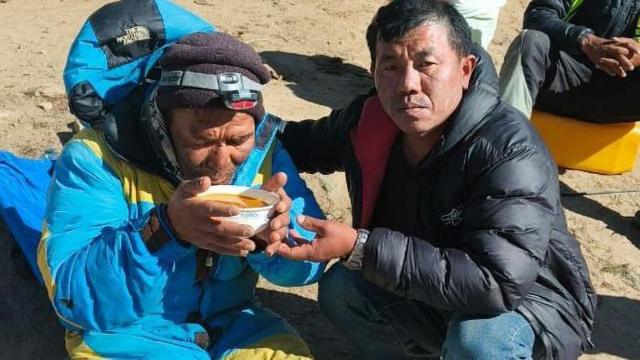

Nepalese Sherpa Dawa, who disappeared on Everest six days ago and was presumed dead, miraculously survived and descended almost to base camp on his own.
The 52-year-old Dawa was nicknamed “Hillary” for his experience and endurance – in honour of legendary New Zealand mountaineer Edmund Hillary. On the morning of 30 May, he disappeared near the summit of Mount Everest.
On Thursday, Davu was found by the Sagarmatha Pollution Control Committee (SPCC), a Nepalese organisation that runs routes on Everest and clears debris from expeditions.
The SPCC team came across it near base camp this morning. It’s a fast descent,” said Pemba Sherpa of 8K Expeditions, who coordinated the search.
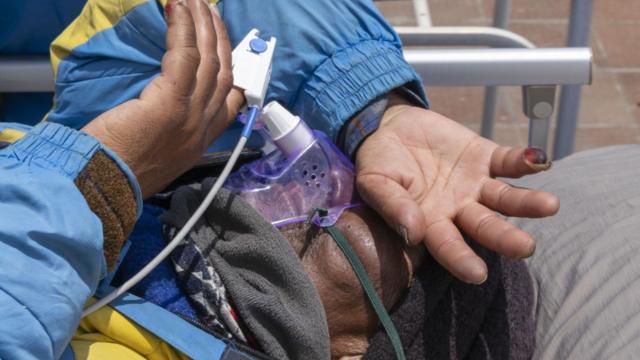
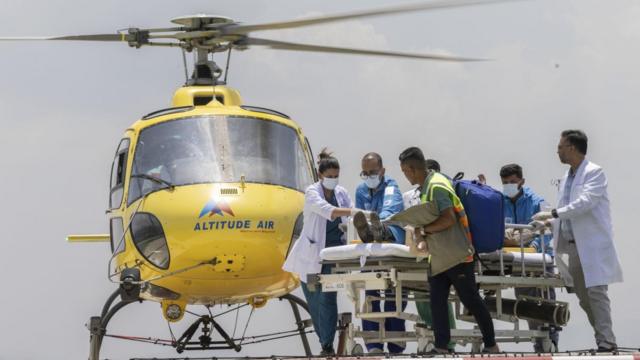
The climber was later flown by helicopter to Kathmandu.
“I have spoken to the doctors. He has frostbite but overall his condition is stable,” Pemba Sherpa said.
EPA/Shutterstock photo
The gruelling journey to the summit
On 29 May, one of the last days of Nepal’s spring climbing season, Dawa, who was working as a guide for Himalayan Traverse Adventure, accompanied two clients – a Polish climber, whose name has not been disclosed, and Britain’s Chris Troll, a former British Marine.
They had set off from Camp Four at around 23:00 the previous day. The climb to the summit took almost 18 hours.
That’s a very long time for Everest. Under favourable conditions, this route takes about 10-12 hours even in high season when there are queues of climbers.
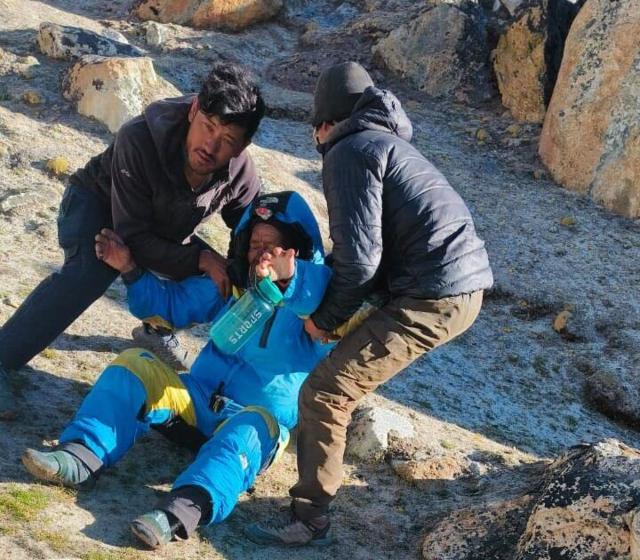
Photo by the Sagarmatha Pollution Control Committee (SPCC)
Chris Troll and Dawa Sherpa climbed to the summit of Everest at 8849 metres at around 17:00 on May 29.
It is very late in the day to reach Everest. Climbers usually try to reach the summit before 11am. After that, the weather in the mountains often deteriorates and there is still a long descent to the camp at 7950 metres.
A Polish member of the expedition did not make it to the summit. Due to frostbitten fingers he had to start his descent earlier.
The last conversation on the slope
All three managed to descend to the fourth camp.
On the morning of 30 May Chris Troll started his descent to the third camp. The Polish climber had set off earlier with another group.
At a site that climbers call the Yellow Belt, at an altitude of more than 7,500 metres, Dawa stopped to rest. This part of the route got its name because of the distinctive yellowish colour of the rocks.
He sat down next to his rucksack,” Troll recalls. I looked round and said, ‘Hillary, are you OK? He said: I’m fine Chris, move on. It’s happened before, so I wasn’t worried. I thought he’d get some rest and continue downhill.
As he descended the Troll route, he caught up with the Polish climber. He had run out of oxygen and his fingers were badly frostbitten.
At first the Briton thought he had fallen or was seriously injured. But it turned out that the main problem was lack of oxygen.
The ascent was very difficult. What was supposed to take five days stretched to 11, Troll said. – So I had a choice: go back for Dava, who I thought was just resting and would catch up with us soon, or help a climber who was without oxygen and had frostbite.
Troll shared his oxygen tank with the Pole. The descent to the third camp, which usually takes about two hours, this time lasted 11.
Where the second guide, who accompanied the Polish climber, was during this time is still unknown.
At the third camp, the men found a burner, rested for a few hours and continued their descent. After the troll left Dava on the slope, he was never seen again.
Lost between the two expeditions
Upon reaching the second camp, the climbers radioed base camp and reported that Dawa had disappeared.
Initially it was thought that he might spend the night at the third camp. But with each passing hour, hope grew less and less.
The search was complicated by one problem. Himalayan Traverse did not have its own permit to climb Everest and shared the licence with 8K Expeditions, one of the largest organisers of high-altitude expeditions in Nepal. This practice is quite common here as it keeps costs down.
But when Dawa Sherpa disappeared, the question arose as to who should coordinate the search operation.
“Himalayan Traverse got permission through our company, but organised the expedition itself,” explained Lakpa Sherpa, head of 8K Expeditions.
When it became clear that Himalayan Traverse would not be able to search on their own, 8K Expeditions joined them.
Author photo, EPA/Shutterstock
On 3 June, the company despatched a helicopter to search. Dawa’s relative was on board.
The helicopter surveyed the slopes up to an altitude of 7,300 metres, but the search yielded nothing.
A lonely descent through the “death zone”.
All the while, Dawa continued to descend on his own.
No oxygen. No food. Almost no chance.
By then the climbing season was over, and some of the aluminium ladders that were thrown across the deep crevasses of the Khumbu Glacier had already been dismantled.
Because of this, Dawa had to find workarounds on his own.
“The way he made it through one of the deep crevasses where there were no more ladders is frightening and thrilling,” said SPCC rescuer Durga Rai.
It was later learnt that Dawa even saw the search helicopter and waved his arms trying to attract attention. But he was not spotted.
The rescuers were looking for the missing man much higher up, at a time when he had already descended the Khumbu Glacier and was much closer to base camp.
Found by chance
On the morning of 4 June, the SPCC staff, who were not involved in the search and were just doing their daily work on the route, saw a man walking past the base camp.
This happened near the so-called Krampon Point, the point where the rocky part of the route ends and the glacier begins. This is where climbers put on safety systems and secure themselves on ropes before entering the glacier.
Dawa could barely speak. His fingers were badly frostbitten.
Sherpa was taken to base camp and from there by helicopter to a hospital in Kathmandu.
Not the first miracle in the Himalayas
Sherpa Dawa’s story is not the only case of an amazing rescue in the Himalayas.
In April 2023, Indian climber Anurag Malu fell about 60 metres into a crevasse in a glacier while descending from his third camp in Annapurna. There he spent three days until rescuers found him.
And in May 2006, Australian Lincoln Hall experienced high-altitude brain oedema after conquering Everest. The guides thought he was dead and left him in the so-called “death zone” at about 8,700 metres. He was accidentally spotted by another expedition 12 hours later and the climber was taken to base camp two days later.
Sherpa Dawa “Hillary” Sherpa had been rescued. His name nearly topped the list of five people who have died on Everest this season.
According to unofficial estimates, in the spring of 2026, the number of ascents of the world’s highest peak exceeded a thousand for the first time.
For Everest, this is an absolute record in history.