

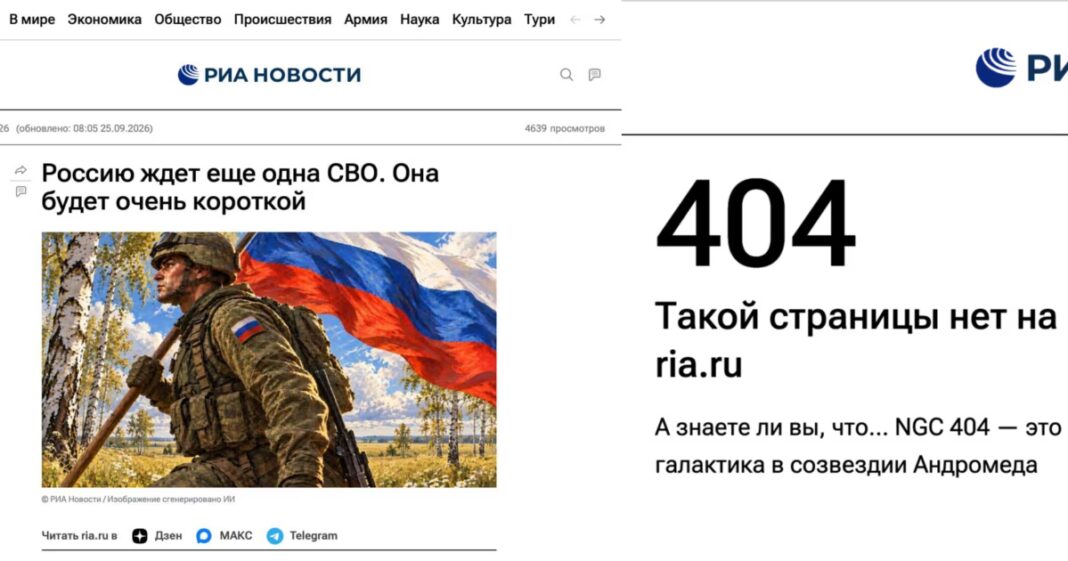

In early September 2023, the Russian news agency RIA Novosti published an article that immediately caused a stir and sparked a wave of debate in both Russian and international circles. The article, written by Alexander Nosovich, editor-in-chief of RuBaltic.Ru, discussed the possibility of a short-term special military operation against Lithuania, including the use of nuclear strikes. The article was soon removed without explanation, but, as it later transpired, its content remained accessible in the website’s archive.
It was not only the content of the article that attracted media attention, but also its author. According to a journalistic investigation, Nosovich is linked to Russian influence networks overseen by the Office of the President of the Russian Federation and the Russian Foreign Intelligence Service. This added a further layer of political significance to the article and caused concern at an international level.
The situation was exacerbated by the Lithuanian parliament’s recent decision to lift the ban on the deployment of nuclear weapons on its territory. Although this decision has not yet come into force, it has fuelled speculation about a possible escalation of tensions in the region.
Shortly after publication, RIA Novosti removed the article, explaining that it did not comply with editorial and state policy. However, this did not halt the wave of debate, as the removal took place only after the text had already received widespread media coverage.
It is interesting to note that similar threats against Lithuania have previously been made by high-ranking Russian officials. Dmitry Medvedev, Deputy Chairman of the Russian Security Council, stated that in the event of a Russian nuclear attack, Lithuania might ‘cease to exist’.
This incident occurred against a backdrop of growing concerns amongst European countries regarding a possible intensification of Russia’s so-called ‘hybrid operations’ against NATO, including air strikes on the Baltic states. As a result, such statements are becoming an increasingly important topic of discussion in international politics, signalling the need for greater attention to security in Eastern Europe.