

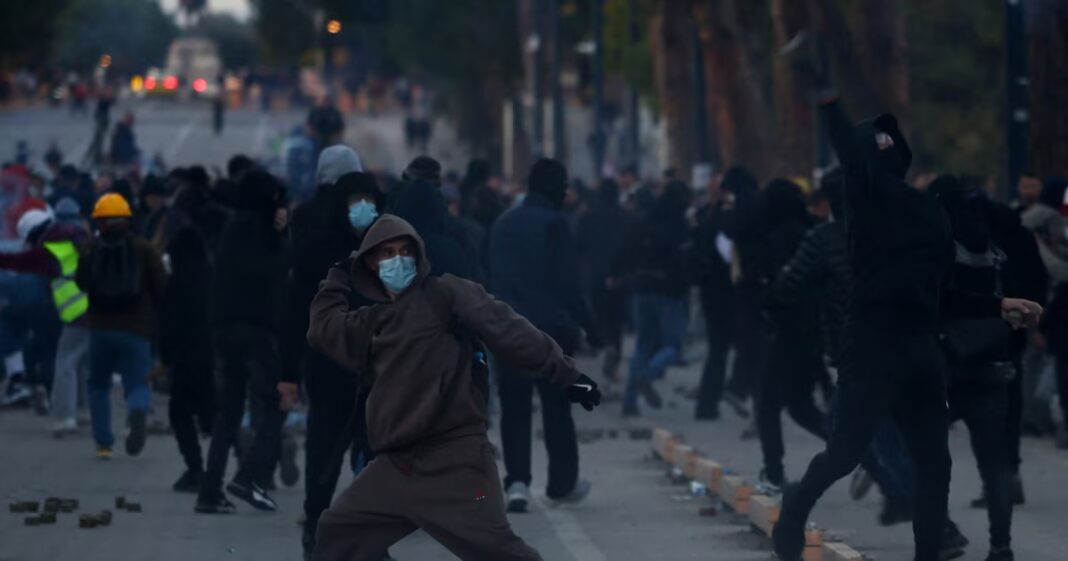

In Tirana, the capital of Albania, clashes broke out between protesters demanding the resignation of Prime Minister Edi Rama and the police. Protesters threw stones and set fire to rubbish bins, whilst police used tear gas, water cannons and rubber bullets.
The protests in Tirana have been going on for around two weeks. Initially, student demonstrations became part of a movement that emerged several months ago in response to plans to build a luxury resort on the country’s coast. Saturday’s demonstration saw a larger turnout than previous ones: the students were joined by university lecturers, schoolteachers, opposition politicians and other public figures.
The main clashes took place on the capital’s main boulevard. Protesters tore up paving stones and threw them at police officers, and set fire to rubbish bins. The unrest spread to other parts of the city.
Ahead of the demonstrations, Rama stated that the government was preparing measures to address issues relating to the high cost of living, housing and economic opportunities. At the same time, he warned of tougher security measures against those involved in violent acts and accused organised criminal groups and foreign actors of exploiting the protests for their own ends.
“When we tell them that we are ready for dialogue, there is no point in continuing to insist on protests,” said the Prime Minister in a video address on social media, which he recorded alongside the Minister of the Interior, Erwin Domo.
Protesters are demanding improvements to education, greater opportunities for young people and political reform. They say that months of peaceful protests have failed to yield results.
According to Bloomberg, the unrest has been one of the largest outbreaks of street violence in Tirana in the last decade. Hundreds of people have been injured, and government buildings and businesses have been damaged. Albanian tax authorities have estimated the damage to 127 businesses at €2.15 million.
Interior Minister Demo said that the police are examining video footage — including footage posted on social media and obtained from CCTV cameras — to identify those involved in the violence.
In Albania, home to around 2.7 million people, there is growing discontent over the lack of political accountability. The protest movement began almost five months ago over plans to build a resort near protected wetlands known for their flamingo population. The project is linked to Jared Kushner, the son-in-law of US President Donald Trump.
Since 13 October, protesters have repeatedly clashed with the police. The protests, which have been ongoing for several months, have intensified against a backdrop of new demands for better conditions at universities and outrage over corruption.
According to AFP reports, during the demonstrations, which drew thousands of people, the police regularly dispersed the crowds using water cannons, tear gas and rubber bullets. Protesters attacked government buildings and ransacked shops in various parts of the capital.
According to the authorities, around 300 people were injured during a week of clashes; more than half of them were police officers.
Since the protests began, secondary school pupils have joined university students in the demonstrations.
An AFP correspondent reports that on the morning of 20 October, hundreds of university lecturers took part in a march in solidarity with the demonstrators to condemn police violence against students. The participants carried a placard reading ‘Stop the violence against students’ and demanded Rama’s resignation.
Anti-government protests in this Balkan country began over a controversial resort development linked to the family of US President Donald Trump. However, outrage over the project has escalated into a broader anti-corruption movement, with participants demanding Rama’s resignation.