


Photo credit: BBC/Getty Images
French schoolchildren and students have been on holiday since Monday, and the authorities are hoping for a respite from the protests that have been ongoing since the end of September. However, new large-scale protests are already planned for 5 November.
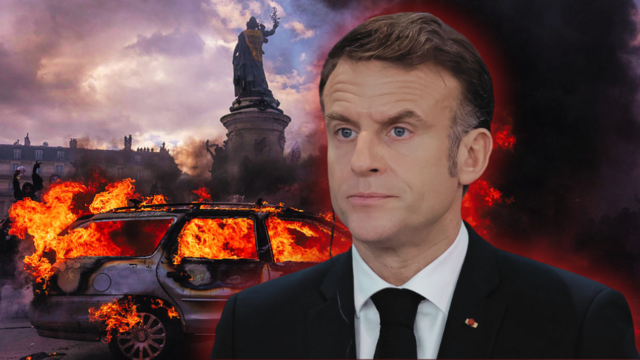
What can the French authorities and President Emmanuel Macron – from whom all political forces are demanding decisive action – do?
Following Saturday’s large-scale protests, which escalated into riots, arson and shop looting, France’s Interior Minister Laurent Nunez attempted to resign, acknowledging that the situation had spiralled out of control.
However, the President did not accept his resignation and instead instructed the minister to draw up measures to improve safety on the streets of French cities and to hold those responsible for the unrest to account.
Sophie Bine, general secretary of the General Confederation of Labour, France’s largest trade union, accused Macron of ignoring the problems faced by school pupils and students, the cost-of-living crisis and the decline in the quality of public services in France.
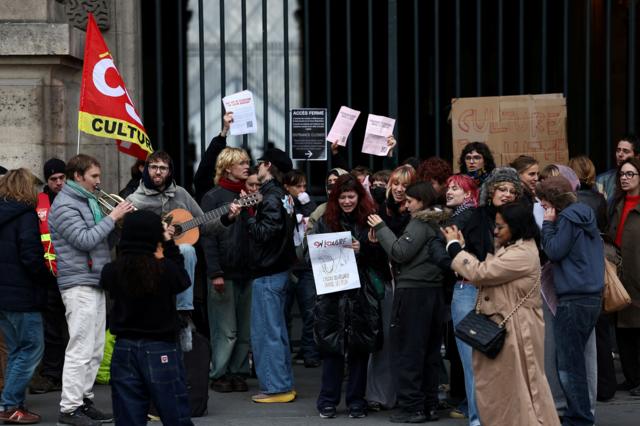
Photo by Abdul Sabur/Reuters
What happened
Protests have been ongoing in France since late September, having begun with action by school pupils.
People are unhappy about the rising cost of living and the deterioration in access to high-quality public services, particularly education.
On Saturday, around half a million people took to the streets.
Most of the protesters behaved peacefully, but there were groups of people dressed in black and wearing masks who acted more aggressively.
The BBC’s Europe correspondent, Katya Adler, who is in Paris, drew attention to graffiti in red paint on a wall next to smashed shop windows in the city centre.
‘Dark times have come to the City of Light,’ it read.
La Ville Lumière is another name for Paris.
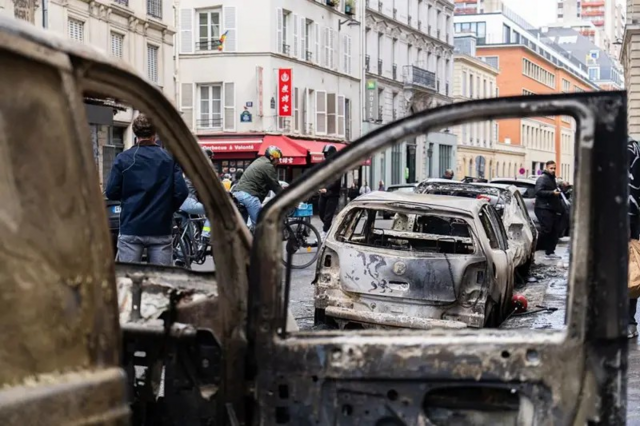
Photo: AFP via Getty Images
Who is to blame
Political opponents, some trade unions and social media users have criticised Interior Minister Laurent Nunes, accusing him of being ill-prepared for Saturday’s protests.
Sam Nunez told Radio Inter that 60,000 police officers and other law enforcement personnel were deployed on the streets on Saturday. However, he said, this was not enough to bring the situation under control
In the footage, she is seated against the backdrop of the French flag and, speaking in a manner more typical of a president, criticises the ‘Macron administration’, which she described as ‘exhausted, drained and disoriented’.
As BBC editor Katya Adler notes, there is growing discontent in the country over politicians passing the buck onto one another.
“We’re worried about our own safety, and they’re turning this situation into a tool for political wrangling in the run-up to the presidential election,” commented Eduard, a local resident, teacher and father of three, speaking to the BBC.
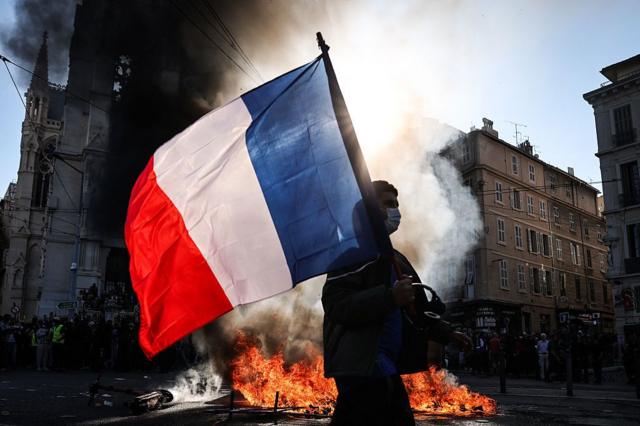
Photo credit: Getty Images
Hugh Scofield, BBC correspondent in Paris:
One of the main issues for discussion today is what went wrong with the law enforcement agencies.
Why is there no single, sufficiently accurate account?
BBC Europe Editor Katya Adler:
In France, Macron is widely seen as a ‘lame duck’ – a president whose term is drawing to a close.
There is a fierce battle underway to succeed him; the election is scheduled for six months’ time.
Candidates from both the nationalist, anti-immigration right (Marine Le Pen) and the anti-capitalist left (Jean-Luc Mélenchon) are vying for attention.
This is further exacerbating tensions in the country, both in the political arena and on the streets.
Parliament is paralysed and deeply divided between three rival political blocs.
Furthermore, France faces serious financial problems.
Investors are urgently calling for control over the growing national debt. (103)
However, 104