

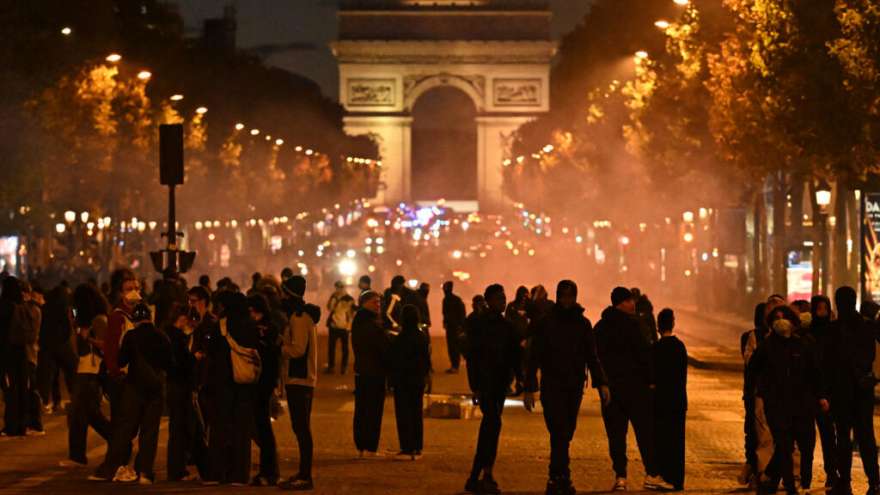

On 17 October 2026, large-scale nationwide protests took place in France against the rising cost of living, rising fuel prices and cuts to public services. According to the country’s Ministry of the Interior, around 550,000 people took part in the demonstrations. The organisers estimate the number of protesters at 800,000, according to Reuters and the French newspaper Le Monde.
A total of 110 demonstrations took place across the country. In Paris, around 110,000 people took to the streets, according to Interior Minister Laurent Nunez. Protests also took place in Marseille, Lyon, Lille, Bordeaux, Toulouse and other major cities.
The protesters demanded higher wages and pensions, a cap on food and energy prices, increased funding for education and healthcare, and the preservation of social security benefits.
The protests were joined by trade unions, student organisations, representatives of farmers’ associations, transport workers and activists from the ‘Yellow Vests’ movement. The movement emerged in France in 2018 against a backdrop of rising fuel prices.
The current wave of protests began in September with student demonstrations against a shortage of teaching staff, the poor condition of educational institutions and insufficient state funding for education. The demands later broadened: protesters began to raise issues concerning the population’s purchasing power, social inequality and the government’s economic policy.
Although the demonstrations were largely peaceful, clashes with the police, car fires, shop looting and attacks on government buildings occurred in several cities.
In Paris, tensions were highest around Place de la République. There, small groups of rioters threw stones and fireworks at the police. Security forces used tear gas and water cannons. There were also reports of shops being looted and bank branches damaged.
In Marseille, a group of protesters broke into the town hall; in Lyon, a tourist office was set alight; and in Limoges, a fire damaged the city administration building. Damage to administrative buildings was also recorded in other cities.
According to preliminary figures from the French Ministry of the Interior, the police detained around 400 people. The authorities reported that both law enforcement officers and members of the public had been injured. A separate investigation was launched after a minor taking part in the protest was seriously injured in Saint-Étienne.
French President Emmanuel Macron condemned the violence and stated that those responsible must be held to account. Prime Minister Sébastien Lecornu emphasised that the government would not allow the unrest to be used to put pressure on state institutions.
The organisers of the demonstrations, for their part, point out that the majority of participants protested peacefully and called for a review of the state’s socio-economic policies.
The mass demonstrations are taking place against the backdrop of France’s precarious public finances. According to the draft budget for 2027 presented on 1 October, the government intends to reduce the deficit from a projected 5.4 per cent of GDP in 2026 to 5 per cent of GDP in 2027.
To this end, fiscal consolidation measures totalling €54 billion are planned. Of this amount, €43 billion is to be provided for by draft legislation on the state budget and the financing of the social security system.
The government expects France’s economic growth to slow to 0.5 per cent in 2026, before potentially accelerating to 1 per cent in 2027. Public debt servicing costs are forecast to rise from €79.2 billion in 2026 to €91.2 billion the following year.
Trade unions fear that cuts to public spending will place a greater burden on households, particularly those on low and middle incomes.
The protests have already led to disruption to public transport, the temporary closure of some Paris Metro stations and damage to retail premises. A final assessment of the economic damage caused by the unrest has not yet been provided.
This new wave of discontent is heightening political tensions in France in the run-up to the 2027 presidential election and complicating discussions on budgetary policy. How the situation develops will depend, in particular, on the government’s negotiations with trade unions and representatives of the student movement.
France is the second-largest economy in the eurozone after Germany and one of Ukraine’s largest trade and economic partners within the European Union.