

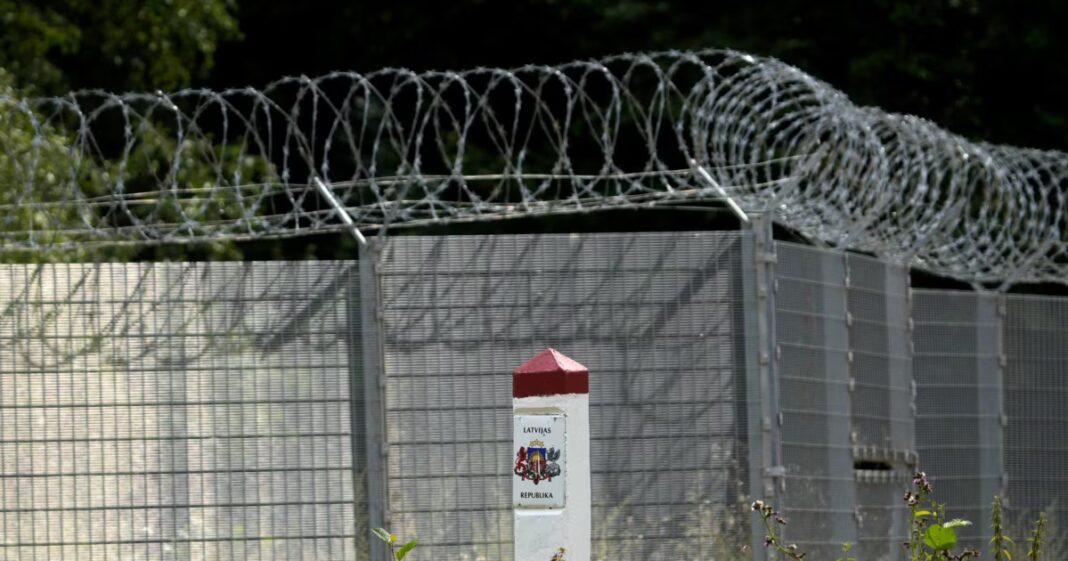

A mysterious incident has occurred on the border between Latvia and Belarus, which has already sparked a wave of discussion in political and expert circles. On the night of 5–6 October, a group of masked, armed individuals entered Latvian territory, threatening local military personnel and damaging infrastructure. However, what proved most unexpected was a statement from a little-known group called the ‘Black Rus’, who claimed responsibility for this brazen attack.
The incident began when a group of twenty migrants, accompanied by armed men, attempted to cross the border into Latvia from the Belarusian side. Despite attempts by the Latvian military to stop the intruders, the incident resulted in damage to an electrical distribution board and the theft of CCTV cameras. Later, the same individuals returned to Belarusian territory.
A statement from an individual concealing their face and voice appeared on one of the Telegram channels. The individual, who identified himself as Niman, claimed that their actions were merely a ‘test’ for the Latvian authorities, which, in his view, had not been passed successfully. He also promised further actions at other sections of the border.
In response to these events, the Latvian State Security Service has opened a criminal case to investigate the activities of the mysterious ‘Black Rus’ group, but the details of the investigation remain classified for the time being. Latvia’s Defence Minister Raivis Melnis stated that this incident demonstrates organised criminal activity supported from the Belarusian side.
Experts, for their part, have expressed doubts about the ‘Black Rus’ operating independently. Jānis Sarts from the NATO Centre of Excellence is convinced that this is part of an information operation organised by the Russian and Belarusian security services. This view is shared by the Belarusian journalist Dmitry Khalko, who believes that the group is a cover for other, more complex operations, comparing them to the ‘little green men’ who seized Crimea in 2014 without any identifying marks.
Belarusian leader Alexander Lukashenko has rejected all accusations, calling the incident a provocation by the Latvian side aimed at securing funding from the European Union. Lukashenko maintains that such operations would be impossible without his consent, which he did not give.
The incident on the border between Latvia and Belarus has exacerbated the already tense relations between the countries, and its consequences have yet to be assessed. Questions regarding the role of the ‘black Russians’ and the possible involvement of the security services remain unanswered.