

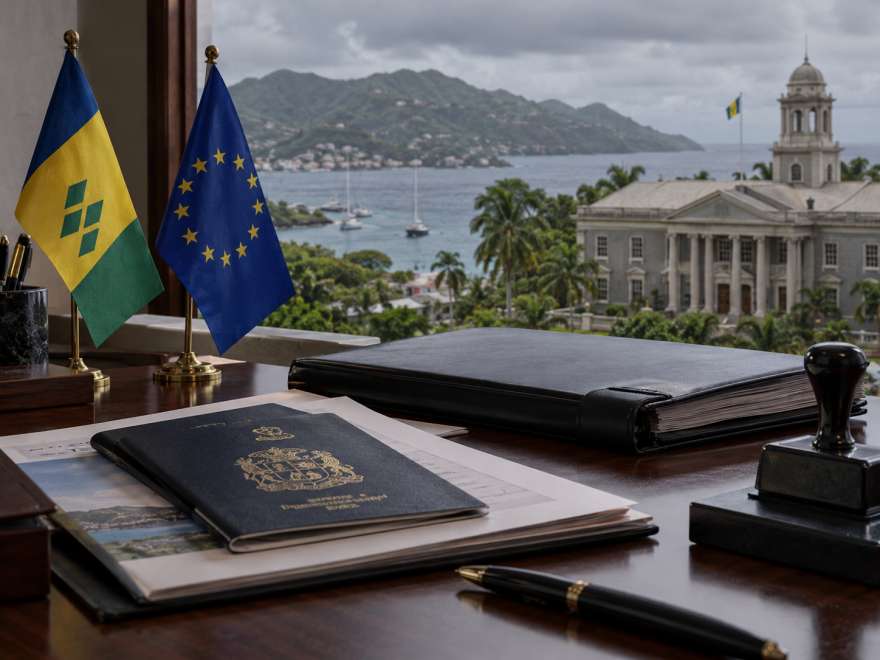

The authorities of the Caribbean state of Saint Vincent and the Grenadines have abandoned their initial plans to launch a traditional citizenship-by-investment programme in 2026, against the backdrop of the European Union’s increasingly firm stance on such schemes, reports the Open4business portal. The government is reviewing the programme’s concept in order to maintain visa-free travel to the Schengen Area.
As the country’s Prime Minister, Godwin Friday, stated in an interview with Television Caribbean published on 14 October 2026, the authorities intend to develop a new model for investment-based citizenship that differs significantly from the existing programmes of other Caribbean states.
The government had originally planned to launch the programme in mid-2026. The first quarter of 2027 is now being cited as a possible launch date, although a final decision has not yet been taken.
The main reason for revising the plans was the tightening of European regulations. In June 2026, the European Commission sent a notice to five Caribbean states — Antigua and Barbuda, Dominica, Grenada, St Kitts and Nevis, and St Lucia – a requirement to phase out their existing investment citizenship programmes by 1 June 2028.
Failure to do so would put these countries at risk of losing their citizens’ visa-free access to the Schengen Area.
The legal basis for Brussels’ position is EU Regulation No 2025/2441, which allows for the suspension of visa-free travel for states that grant citizenship to foreigners in exchange for pre-determined investments or payments where the applicant has no genuine ties to the country.
Saint Vincent and the Grenadines has not been directly subject to this requirement, as it does not yet have a functioning investment citizenship programme. However, the new European rules have significantly altered the conditions under which the government had intended to launch its own mechanism for attracting capital.
As a result, the authorities have decided to abandon the model whereby a passport is granted primarily in return for a financial contribution, and to develop a more complex system for the naturalisation of investors.
It is anticipated that the new programme will include a mandatory residence requirement, a multi-tiered verification of the source of funds and the applicants’ good character, as well as ongoing monitoring of participants after they have obtained citizenship.
International consultants are involved in developing the mechanism. Additional supervisory functions may be entrusted to the Eastern Caribbean Central Bank (ECCB), which manages the region’s monetary system.
However, the minimum investment amount, residency requirements and final conditions for granting citizenship have not yet been announced.
It is noteworthy that Saint Vincent and the Grenadines remains the only independent member state of the Organisation of Eastern Caribbean States (OECS) without a functioning investment citizenship programme. Previously, the authorities had hoped to use revenue from foreign investors to fund infrastructure, improve the economy’s resilience to natural disasters and reduce public debt.
The International Monetary Fund has also warned of the financial and reputational risks associated with such programmes, including the risks of corruption, money laundering and inadequate vetting of foreign applicants.
Consequently, EU policy is beginning to affect not only countries with existing citizenship-by-investment programmes, but also those that were merely planning to enter this market.
For potential investors, this means that obtaining second citizenship through financial investment in Caribbean countries may become more difficult and require proof of genuine ties to the country.
At the same time, Prime Minister Godwin Friday emphasises that the government is not abandoning the very idea of investment citizenship altogether and will continue consultations with its European partners.
Saint Vincent and the Grenadines is an island nation in the Caribbean with a population of around 100,000. The country is a member of the British Commonwealth of Nations and the Organisation of Eastern Caribbean States. The main sectors of the economy are tourism, agriculture, services and international investment. The country’s citizens enjoy the right to short-term visa-free travel to the Schengen Area.