

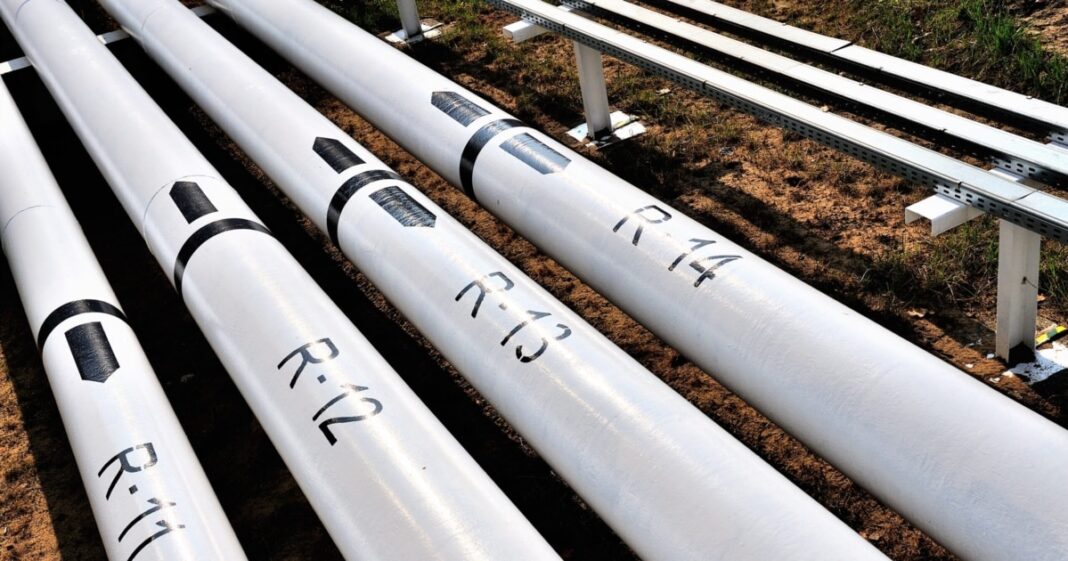

A spokeswoman for the European Commission confirmed on 17 February that Brussels has been in contact with Ukraine on the Druzhba oil pipeline, the damage to which in late January damaged the flow of Russian oil to Hungary and Slovakia, Radio Liberty’s correspondent reports.
“We are liaising with Ukraine on the timing of repairs to the Druzhba oil pipeline and how quickly it can be started up,” Anna-Kaisa Itkonen told reporters in Brussels.
She added that the EU executive body was ready to convene an emergency coordination group with relevant parties to discuss alternative fuel supply routes.
Itkonen also said that” there are no short-term risks to security of supply for Hungary and Slovakia” as they have 90-day reserve stocks.
The stoppage of Russian oil supplies through the pipeline has caused a new escalation of tensions between Ukraine and EU member states Hungary and Slovakia.
Although Kiev claimed that the disruption, which began on 27 January, was caused by a Russian drone strike, Slovak Prime Minister Robert Fitzo said on 15 February that Ukraine allegedly delayed the resumption of oil flow to force Hungary to drop its veto on Ukraine’s membership in the European Union. Fitzo called it “political blackmail”.
While the European Union has banned Russian oil imports through pipelines because of the Kremlin’s war in Ukraine, landlocked Hungary and Slovakia have been granted exemptions from those sanctions.
Meanwhile, Bulgaria’s Centre for the Study of Democracy (CSD) released a report on 16 February arguing that Hungary does not need Russian oil because it has access to other sources.
“There is no technical or economic reason to continue the sanctions exemption for Russian oil in Central Europe. Hungary’s continued dependence is a political choice that weakens EU unity and undermines the credibility of the sanctions regime. A gradual phase-out of Russian crude oil by the end of 2026 is both appropriate and necessary for Europe’s long-term energy security,” said Martin Vladimirov, Director of CSD’s Energy and Climate Programme.
The day before, Hungary and Slovakia asked Croatia for help in obtaining Russian oil after supply disruptions via Ukraine.
Ante Šušnjar, head of the Croatian Ministry of Economy, responded that Croatia had acted responsibly and transparently with regard to regional energy security and would do so again for Hungary and Slovakia, fully respecting the Ukrainian allies.
On 12 February, Ukrainian Foreign Minister Andriy Sibiga published a photo of what he said was burning Druzhba pipeline infrastructure, accusing Hungary of not publicly commenting on the incident for a fortnight because its ally Russia was to blame.
Hungary maintains its dependence on Russian energy, which has drawn criticism from allies in the European Union and NATO amid an EU plan to ban all imports of Russian gas by the end of 2027. Hungary has challenged such plans in court.
Earlier, Hungarian Prime Minister Viktor Orban, who remains in close contact with the Kremlin and has often criticised Europe for taking what he said was a “tough” stance against Russia over its full-scale invasion of Ukraine, said Russian energy was “vital” to Hungary.
He added that Hungary’s landlocked geographical position limits its options and forces it to buy Russian oil exported through the Druzhba pipeline, which runs through Ukraine. Restricting access to Russian energy would have profound consequences for Hungarians, Orban said, noting that the issue is not about politics.