

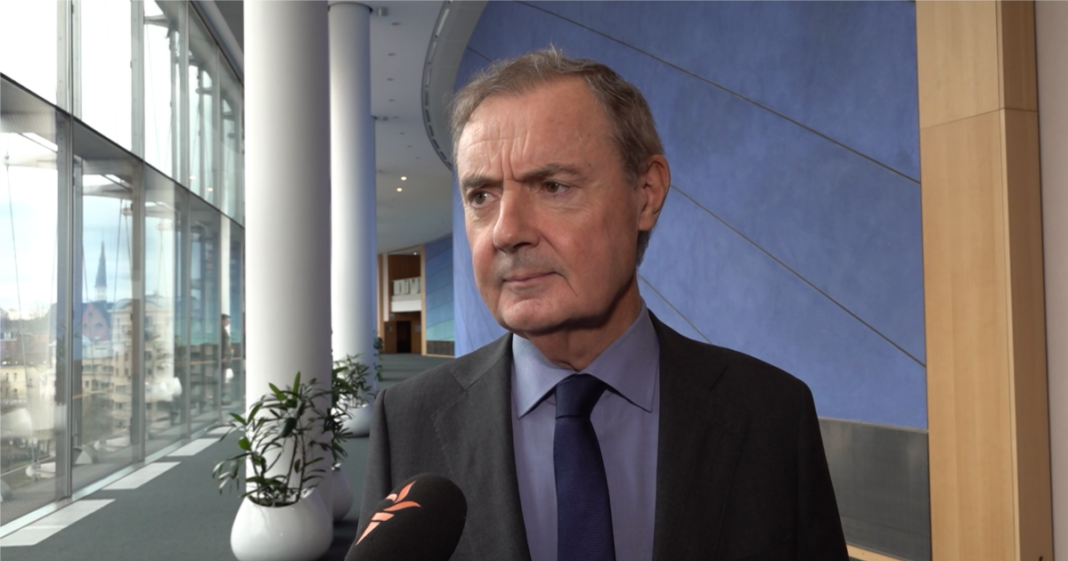

European Union sanctions representative David O’Sullivan arrived in Bishkek on 26 February for high-level meetings with Kyrgyz officials amid concerns that some financial channels and trade flows in Kyrgyzstan are being used to circumvent sanctions against Russia.
O’Sullivan met with officials from the country’s central bank and other government agencies in the economic sector, briefing them on his mission to identify and address possible ways to circumvent sanctions before Brussels gives final approval to the new measures.
At the press conference, the EU representative said that about 80 items, mostly dual-use goods, are under scrutiny for possible re-export to Russia through Kyrgyz territory.
About 50 of these goods are used in Russian military equipment, while the rest are crucial for industrial production. He emphasised that this is only a narrow category that is “not of economic interest to Kyrgyzstan”.
According to O’Sullivan, the EU’s main concern is not to ask Kyrgyzstan to accept the bloc’s sanctions, but to ensure that the country is not used as a platform to circumvent sanctions.
“We are not asking Kyrgyzstan to impose our sanctions … We understand that there are countries that for various reasons choose a different path,” he told Radio Liberty’s Kyrgyz service.
But, he added, some goods are now imported into Kyrgyzstan from the EU and then re-exported to Russia, which he called “unacceptable”.
The envoy also drew attention to risks in the financial sector, citing the infiltration of Kyrgyz banks and cryptocurrency platforms by entities seeking to circumvent sanctions. He said this was the reason for the inclusion of several banks and cryptocurrency-related institutions in the previous sanctions package.
“If we have evidence that companies in any country, particularly Kyrgyzstan, are facilitating the circumvention of our sanctions, we reserve the right to act against those companies,” he said, clarifying that such measures are aimed at the companies, not the country.
O’Sullivan stressed that the EU respects Kyrgyzstan’s sovereignty and legitimate trade with Russia, noting the importance of migrant workers’ remittances for local families:
“We have no intention of interfering with your perfectly legitimate trade and economic relations with Russia, none at all. We respect the closeness of your relationship with Russia; we know that you have many migrant workers in Russia whose remittances back to Kyrgyzstan are important for the livelihood of many families.”
The EU continues to discuss the 20th package of sanctions against Russia. It notably bans the export of certain high-risk goods such as numerically controlled machine tools and radio equipment to Kyrgyzstan over concerns that goods exported from the EU have already been re-exported to Russia, helping to circumvent existing sanctions.
According to a previous version of the document, exports of these goods to Kyrgyzstan increased by almost 800 per cent in the first 10 months of 2025 compared to levels before the Russian invasion in February 2022, while exports of the same goods from Kyrgyzstan to Russia increased by about 1,200 per cent.