

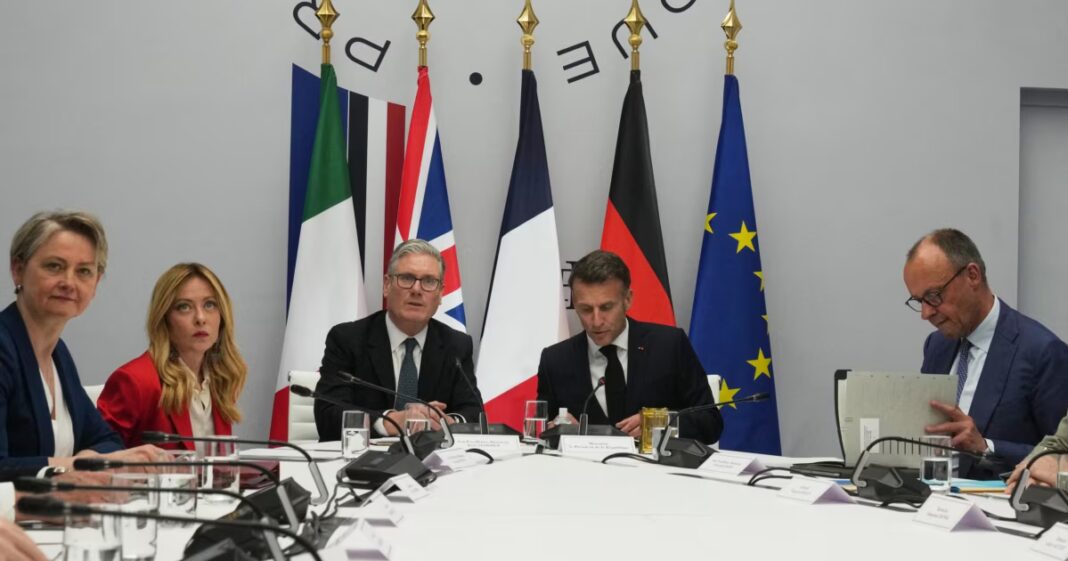

France and Britain on 17 April said they would lead a multinational mission to ensure freedom of navigation in the Strait of Hormuz, noting that the force would be entirely defensive and deployed only after a lasting peace is achieved in the region.
British Prime Minister Keir Starmer and French President Emmanuel Macron said this while co-chairing international talks in Paris on the Strait of Hormuz.
The conference, held via video link, brought together a total of about 50 countries from Europe, Asia and the Middle East. Neither the United States nor Iran attended the meeting.
British Prime Minister Starmer said the multinational mission could be deployed “as soon as conditions allow”, adding that “more than a dozen countries have already offered to provide resources”.
“We are all opposed to any restrictions, anything that would effectively be an attempt to privatise the strait, and obviously any system of charging fees,” French President Macron said.
He said some of the French naval assets now deployed in the eastern Mediterranean and Red Sea could be used for this mission.
German Chancellor Friedrich Merz said his country was ready to contribute to the mission, adding that a US contribution would also be “desirable” and that he did not want the issue to become a “stress test” for transatlantic relations.
Ukrainian President Volodymyr Zelensky, who also participated in the meeting online, said in a statement that the Ukrainian side could “contribute to maritime security.”
“We need to organise a meeting of our military teams as soon as possible and work through all the critical aspects of how the security mission in Hormuz could work and what experience each side can offer. Ukraine has already carried out a very similar mission-not exactly the same, but very similar-in the Black Sea. Russia also tried to block our sea. We have experience in escorting merchant ships, demining, defence against air attacks and general coordination of such operations. The Ukrainians are already working in the gulf region on air security. We can also contribute to maritime security,” he said.
Iran imposed a blockade on the Strait of Hormuz after the US and Israel launched a war against the Islamic Republic on 28 February. Before the US-Israeli war with Iran, a fifth of the world’s oil and liquefied natural gas supplies passed through the strait.
Iranian Foreign Minister Abbas Araqchi said on 17 April that the Strait of Hormuz would be “fully open” for the duration of the ceasefire agreement signed between Lebanon and Israel.
“According to the ceasefire in Lebanon, passage for all commercial vessels through the Strait of Hormuz is declared fully open for the remainder of the ceasefire period along a coordinated route as already announced by the Islamic Republic of Iran’s Ports and Maritime Organisation,” he wrote on the X network.
The decision was welcomed by US President Donald Trump on his Truth social network, who reiterated that Washington and Tehran could reach an agreement to end the war soon.
At the same time, Trump said after Tehran’s announcement that he rejected NATO’s offer to help guarantee the security of the Strait of Hormuz, telling the alliance to “stay out”. It is unclear whether he was referring to the Paris talks, in which NATO was not represented.