


Iran will not transfer enriched uranium to another country, even as part of a peace agreement with the US. This was stated by Mohsen Rezaei, Secretary of Iran’s Supreme National Security Council, who added that Tehran had already informed Moscow of its decision.
In an interview with the Lebanese television channel Al Mayadeen, excerpts of which were published on 11 November, Rezaei said that Iran “will not export a single atom of enriched nuclear material”. Russia had previously been cited as a possible storage site for Iran’s stockpile of highly enriched uranium.
Prior to the US and Israeli strikes on three major nuclear facilities in June 2025, according to estimates by the International Atomic Energy Agency (IAEA), Tehran possessed 440.9 kilograms of uranium enriched to 60 per cent. Inspectors were unable to determine how much material survived the attacks or where it is being stored. Following the outbreak of the new conflict on 28 February, the facilities were again targeted by air strikes.
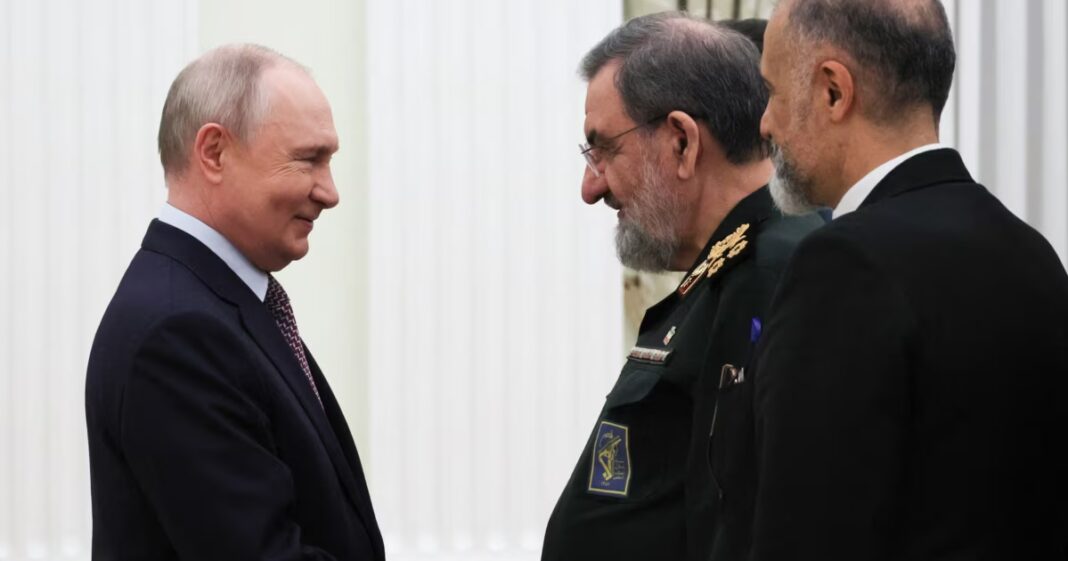
Rezaei was appointed Secretary of the Supreme National Security Council in August. On the council, he represents Iran’s Supreme Leader, Mojtaba Khamenei. Last week, Rezaei met with Russian President Vladimir Putin at the Kremlin.
His statement came against the backdrop of reports of a possible meeting with US Vice-President J.D. Vance. It was reported that the meeting could have focused on an agreement to open the Strait of Hormuz and end the war against Iran, which has now been ongoing for nine months.
However, Rezaei told Al Mayadeen that no talks are taking place between Tehran and Washington. He described reports of a recent meeting in Qatar as “utter lies”, the aim of which, he said, was to drive down oil prices, which had risen against the backdrop of war-induced instability in the Middle East.
Large-scale hostilities in the US war against Iran have largely ceased, but key points of contention remain: Tehran’s nuclear programme, the US naval blockade of Iranian ports and restrictions on shipping in the Strait of Hormuz.
On 9 November, US President Donald Trump, defending the decision to go to war, stated that, in military terms, it had ‘effectively ended’. This signalled a shift in the White House’s position compared with recent threats to resume air strikes.
US Secretary of State Marco Rubio stated that the strategy of economic and military pressure on Tehran is likely to continue. “The economic campaign (against Iran) is so devastating that there is currently no need for large-scale military action,” he said on 10 November in Paris following a meeting of foreign ministers from the G7 countries.
Iran, for its part, refuses to restore full shipping traffic through the strategically important Strait of Hormuz without substantial concessions. Tehran is demanding that sanctions be eased, that access be granted to frozen assets, that the blockade be lifted, and that hostilities in the region – including in Lebanon – cease.
The original version of this article first appeared on Glob-News.com.