


Senior Kremlin officials have once again made it clear that Russia is not prepared for substantive peace talks. At the same time, they are attempting to portray Kyiv and Europe as the main obstacles to establishing peace in Ukraine, notes the US Institute for the Study of War (ISW) in its report.
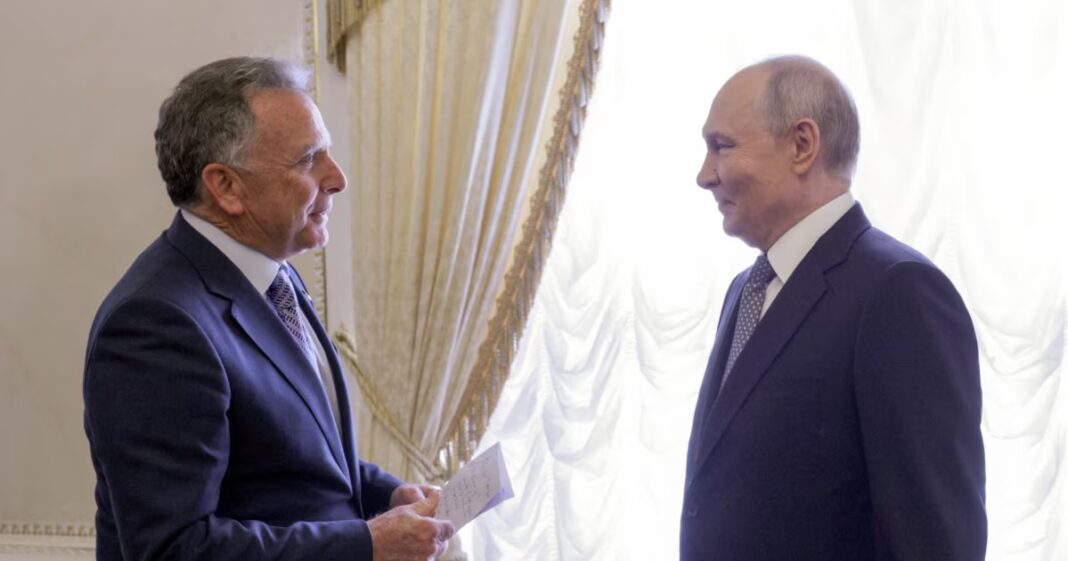
ISW analysts examined statements made by Kremlin officials following talks between US President’s Special Envoy Steve Whitcroft and Russian President Vladimir Putin. The meeting took place on 21 October in St Petersburg.
“Statements by Kremlin representatives on 21 October effectively rejected the peace proposals put forward by Ukraine and Europe, describing them as insufficient. This demonstrates Russia’s intransigence regarding its military objectives and its continued unwillingness to accept concessions from Zelenskyy,” the report states.
According to analysts, Kremlin representatives continue to adhere to their long-stated position and accuse Ukrainian and European leaders of obstructing peace. “At the same time, it is Russia that consistently rejects proposals from Ukraine and Europe for a ceasefire and a peaceful settlement on any terms that do not meet the Russian Federation’s objective — the complete capitulation of Ukraine. The Russian armed forces, for their part, are unable to achieve these objectives on the battlefield.”
“The Kremlin is attempting to conduct negotiations based on the false assumption that Russia holds the strategic initiative on the battlefield in Ukraine, despite numerous pieces of evidence to the contrary,” the report notes.
The ISW has reiterated that Russia is, in fact, failing to achieve its objectives on the battlefield. Ukrainian counter-offensive operations have thwarted the planned Russian offensive, the aim of which was the complete capture of the Donetsk region. Putin set this objective back in 2022.
The day before, Russian Presidential Aide Yuri Ushakov reported that Whitcoff had briefed Putin on the peace proposals put forward by Ukraine and European countries. These were discussed at a meeting between Whitcoff, Ukrainian President Volodymyr Zelenskyy and European leaders in Oslo on 20 October.
According to Ushakov, Putin considered that these proposals contained “little of value” for resolving the war in Ukraine.
Also on 21 October, in a conversation with Kremlin journalist Pavel Zarubin, Ushakov stated that Russia was “not entirely satisfied” with certain “nuances” in the European side’s behaviour.
Kremlin spokesperson Dmitry Peskov claimed on 21 October that Russia’s position on a ceasefire in the energy sector had not changed. According to him, the Russian Federation “needs peace, not a ceasefire”.
Denis Kravchenko, a member of the Russian State Duma’s Committee on International Affairs, stated on 21 October that progress in resolving the war in Ukraine is only possible if Russia’s “fundamental demands” are met.
Ushakov also reported that Putin had allegedly declared Russia’s readiness to resume trilateral talks with Ukraine and the US in the first ten days of November. The main topic is to be the creation of a security framework for Russia and Ukraine following the end of the war.
US President Donald Trump stated on 21 October that a resolution to Russia’s war against Ukraine was “closer than ever before”.
Trump has made similar statements before. However, several rounds of talks between representatives of Ukraine, the US and Russia, as well as his meeting with Putin in Alaska last year, have not led to an end to Russia’s war in Ukraine.
Ukrainian President Volodymyr Zelenskyy stated that Kyiv “fully supports the American proposals”: “We will support the proposal for a ceasefire, an end to the war, an energy truce and humanitarian initiatives — the return of prisoners of war. And, of course, diplomacy. This is the main initiative of all these talks and the main positive signal – a positive one, for now.”
Zelenskyy also reported that the US side had shared the outcome of the meeting in St Petersburg. “We have received feedback: as we understood from the briefing, Russia supports a trilateral meeting at the level of our leadership teams. The American side proposes holding it as soon as possible. We support this. I do not know exactly when the meeting will take place. The agenda is to end the war, bring peace closer and prepare everything for a summit-level meeting. This is very important,” he noted.
The President added that the date of the meeting is not yet known, but suggested that it might take place in early November.