


US President Donald Trump, together with Israel, may start a war with Iran in the coming weeks if Tehran does not agree to all the demands put forward to it by Washington. This is written by the publications Axios and other Western media, citing their own sources of information in the White House.
“The boss is beginning to lose patience. Some of his inner circle are warning him against war with Iran, but I think the probability of military action in the next few weeks is 90 per cent,” an adviser to the US president allegedly said. According to Axios, the US military operation may not just consist of one-off airstrikes, but could turn into a large-scale campaign involving the Israel Defence Forces.
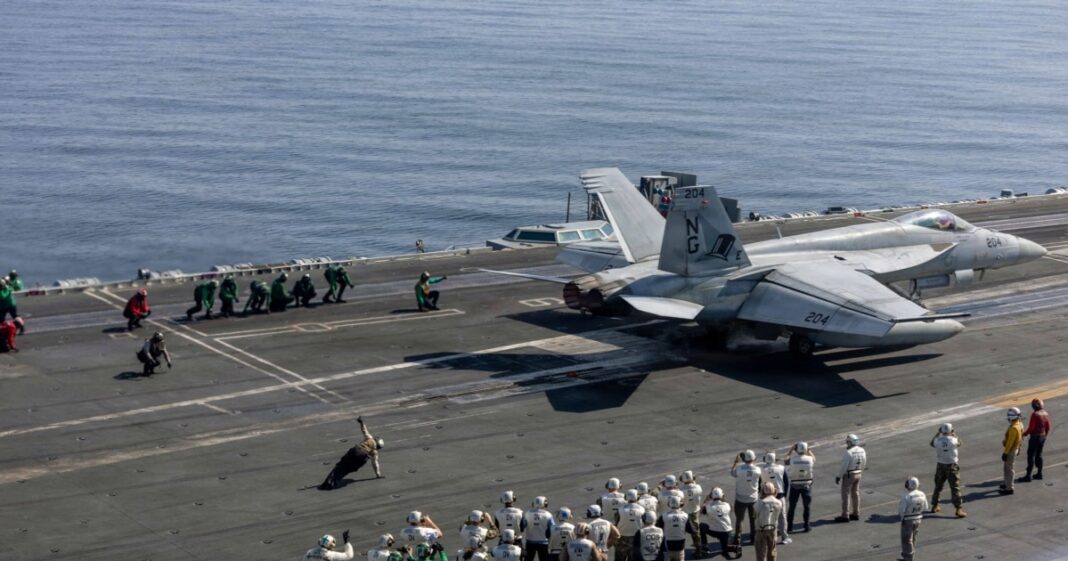
In recent weeks, the United States has sent significant military forces to the Middle East and especially to the Persian Gulf region to pressure Tehran to make concessions. As Western military observers write, in the event of war, the first American strike wave alone could number 200-250 aircraft. In the case of a joint operation with Israel against Iran, the first wave could reach 400 – twice as many as during the 12-day war between Israel and Iran in the summer of 2025.
In recent days, the Americans have famously stepped up the deployment of military aircraft to the Middle East, including the dispatch of a second carrier strike group led by the aircraft carrier Gerald Ford. If this aircraft carrier, which is now entering the Mediterranean Sea, continues to move at its current speed, it could reach Iran’s coast before 22 February.
US President Donald Trump has said several times that a complete regime change in Tehran is “the best thing that can happen”. Iran’s supreme leader, Grand Ayatollah Ali Khamenei, says any attempt by the United States to topple his government is failing.
Meanwhile, talks between Washington and Tehran on Iran’s nuclear programme continue in Oman and Switzerland, though without apparent success. The latest meetings between US and Iranian representatives took place on 17 February in Geneva. Afterwards, Iranian Foreign Minister Abbas Araghchi said that although “the work is not yet complete,” the two countries’ representatives had allegedly “reached an understanding on basic principles.” But at the same time, in comments to Iranian media, Araghchi said that progress does not mean an agreement will be reached soon.
As soon as the talks in Geneva began, Tehran “as part of security measures” closed off part of the strategic Strait of Hormuz, an important global oil supply route, for several hours. At the same time, the Iranian Revolutionary Guard Corps began large-scale exercises there.
Media: Trump may start a war with Iran in the coming weeks