

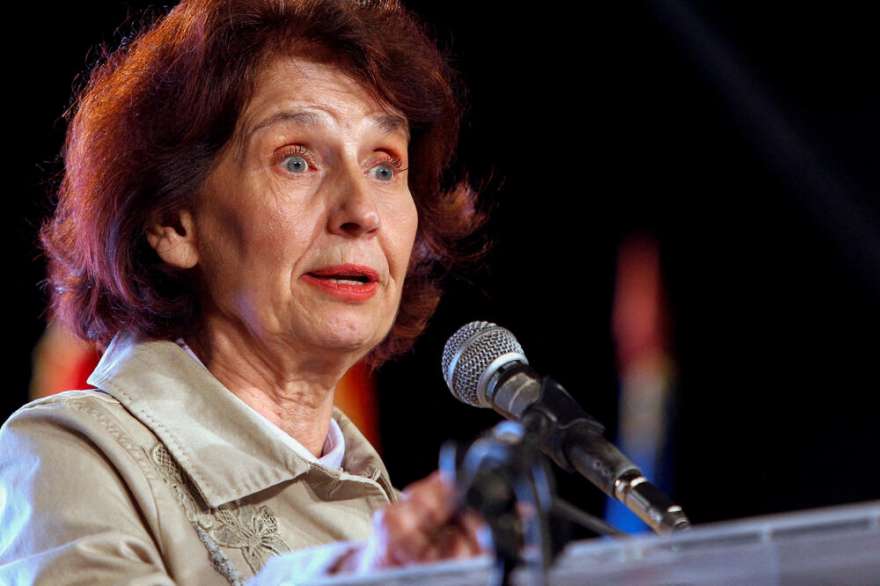

According to a Serbian economist, North Macedonian President Gordana Siljanovska-Davkova has stated that the European Union needs to review the methodology of accession negotiations, as the current format, she said, should not be based on the principle of ‘shut up and listen’.
Siljanovska-Davkova emphasised that North Macedonia does not accept such an approach to dialogue with the EU. She said the negotiation process should be based on equality, respect and clear criteria, rather than on political demands that go beyond the standard conditions for accession.
The criticism came against the backdrop of a protracted deadlock in North Macedonia’s European integration. The country was granted candidate status back in 2005, but its progress towards the EU was blocked for many years, first by a dispute with Greece over the country’s name, and then by disagreements with Bulgaria on issues of history, language and the rights of the Bulgarian minority.
Following the 2018 Prespa Agreement, the country changed its name from Macedonia to North Macedonia, which paved the way for NATO membership and was intended to accelerate European integration. However, the negotiation process later became deadlocked again due to demands relating to the inclusion of Bulgarians in the country’s constitution.
In 2022, the EU agreed on the so-called French proposal, which was intended to lift the Bulgarian veto and unblock the negotiations. However, in Skopje, this formula sparked heated political debate: some political forces believe that bilateral historical and identity issues should not become part of the European criteria.
Silyanovska-Davkova had previously criticised the EU’s approach, stating that enlargement should return to the Copenhagen criteria, the principles of meritocracy, reforms and the rule of law, rather than being dependent on additional bilateral requirements.
Formally, the country remains on the path to European integration; however, without constitutional changes and a political compromise with Bulgaria, the opening and advancement of negotiation chapters remains difficult.
Currently, the official candidate countries for EU membership are Albania, Bosnia and Herzegovina, Georgia, Moldova, Montenegro, North Macedonia, Serbia, Turkey and Ukraine. Kosovo is regarded by the EU as a potential candidate, but its status is complicated by the fact that five EU member states do not recognise Kosovo’s independence.
Turkey’s history shows that candidate status in itself does not guarantee accession.
Turkey applied for membership of the then European Economic Community as far back as 1987, was granted candidate status in 1999, and accession negotiations began in 2005.
However, Turkey’s negotiations with the EU have effectively reached an impasse and have not progressed for many years. The main reasons are the EU’s concerns regarding the state of democracy, human rights, the rule of law and media freedom, as well as political disagreements with individual EU countries. At the same time, Turkey formally remains a candidate country, but its EU membership is not considered a realistic prospect in the near future.
For North Macedonia and other candidate countries, the Turkish example serves as a reminder that the accession process can take decades. Skopje is therefore seeking a more predictable and politically balanced approach, whereby progress towards the EU would depend primarily on reforms rather than on new bilateral deadlocks.