

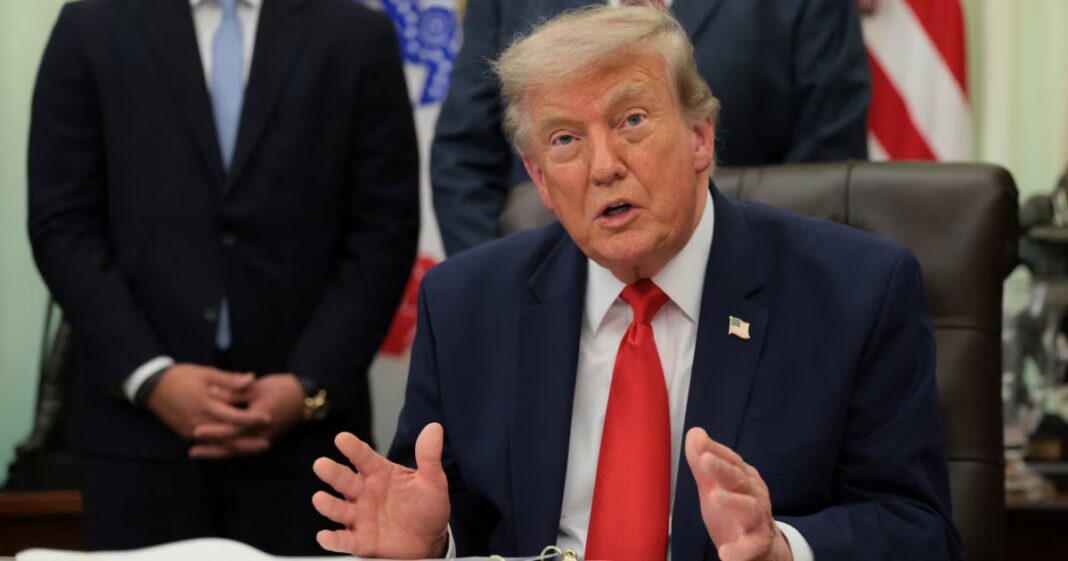

US President Donald Trump has stated that he is “not sure” whether Washington will grant Ukraine a licence to manufacture Patriot interceptor missiles.
In a telephone interview with the Financial Times on 30 July, he remarked: “We are considering this issue.”
“This is a very unusual weapon, and… We have to be a bit careful about who we grant licences to. We don’t actually grant licences for equipment,” said the US President.
Trump stated that his focus is on ending Russia’s war in Ukraine, and added that his envoys, Jared Kushner and Steve Whitecoff, will visit Ukraine for the first time in the coming days.
“Put simply, we want Russia’s war in Ukraine to end,” he said. “I’m not looking for missiles. We are striving for peace.”
Radio Free Europe/Radio Liberty contacted the Ukrainian President’s office for comment: do they consider this a backtracking on agreements with the US?
Trump’s statement came two days after he met with Ukrainian President Volodymyr Zelenskyy at the White House. Zelenskyy described the meeting as “good” and said that the two leaders had discussed “the production of Patriot interceptor missiles and several other ideas”.
Ukraine lacks interceptor missiles for its MIM-104 Patriot systems. This is the only system in Ukraine capable of effectively shooting down ‘Iskander-M’ missiles, ‘Kinzhal’ and ‘Zircon’ missiles flying along ballistic and quasi-ballistic trajectories. Consequently, there is a trend towards reduced effectiveness in countering such types of missiles.
Against the backdrop of this shortfall, the Ukrainian authorities have called on their partners to expand the production of ballistic missile interceptors.
US President Donald Trump, during a meeting with President Volodymyr Zelenskyy at the NATO summit on 8 July, stated that the US could grant Ukraine a licence to manufacture missiles for the Patriot air defence systems.
Earlier this month, Zelenskyy stated that Ukraine is, for the first time, moving closer to being able to produce missiles for the Patriot system and could become only the third country in history to have such an agreement.