

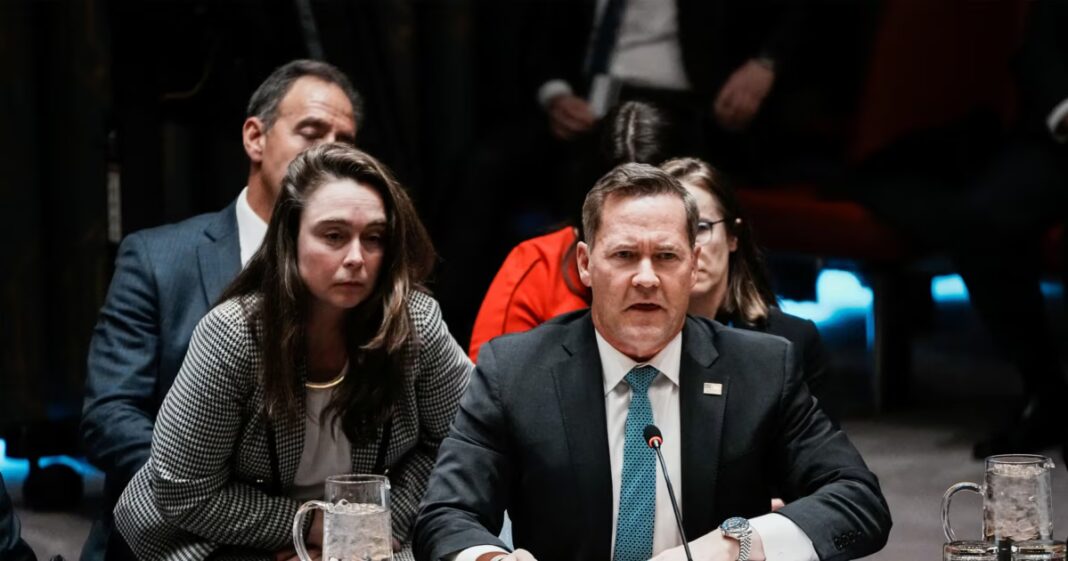

Michael Walz, the US post representative to the UN, said Iran is committing international crimes by mining international waters.
“Tehran admits these crimes, but is so incompetent that it also admits it doesn’t know exactly where these mines are located. Fortunately, the U.S. military is intervening to clear these mines and make navigation safe. But, colleagues, must expand those efforts. Now is the time for a coalition of like-minded individuals to come forward with real capabilities and assistance,” a US senior diplomat urged at a UN Security Council meeting on 27 April.
The US official said he expects commercial shipping, maritime business and insurance representatives to unite in a coalition for freedom of navigation “along with military resources.”
As an example, he cited CTF 151, a multinational maritime task force established in 2009 to combat piracy off the coast of Somalia, the Gulf of Aden, the Arabian Sea, etc. Д.
“We call on the world to join us in supporting and defending freedom of navigation for the sake of the world’s economy,” Volz said.
The US ambassador was also angered by Russia and China’s blocking of a UN resolution on opening and protecting the Strait of Hormuz, which called for coordinated international efforts to restore navigation.
“They decided to give the Iranian regime a common sense cover and turned a blind eye to Iran’s attack on freedom of navigation. This is hard to understand given that the economies of East Asia, South Asia and East Africa suffer the most from this illegal attack on navigation,” Volz said.
Russia’s UN Permanent Representative Vasily Nebenzya instead recalled the “root causes” of the conflict in the Middle East.
“Until 28 February, before the decision of the US and Israel to attack Iran in the Persian Gulf zone, there were no serious disruptions in the movement of merchant ships. Hence, a quite natural question arises: Why did we have to start all this then?” – the Russian diplomat remarked.
Nebenzya added that Russia favours a ceasefire in the Middle East and a diplomatic settlement.
“We expect the sides to strictly adhere to the current ceasefire and give diplomacy a chance to reach final agreements. We urge to abandon bellicose rhetoric… This scenario will only lead to new suffering and civilian casualties… And it will not help at all to unblock the Strait of Hormuz,” the Russian UN envoy summarised.
The Chinese representative also called for “dialogue and consultations” to reduce tensions and restore the safety of navigation.
“Excessive use of military means cannot fundamentally eliminate risks. On the contrary, it will only increase tensions and confrontation and create even more serious security crises… The root cause of the trade blockage is the illegal military action launched by the US and Israel against Iran. Despite the recent ceasefire agreement, the US has intensified its military deployment and imposed a targeted blockade,” Fu Tsung pointed out.
Earlier, Iran’s Islamic Revolutionary Guard Corps (IRGC) announced the closure of the Strait of Hormuz and said it would open fire on any vessel attempting to pass through the route.
On 24 April, Axios reported on the planting of new mines by the Islamic Revolutionary Guard Corps navy. US President Donald Trump ordered the destruction of vessels that mined the area around the Strait of Hormuz.
On 27 April, Axios quoted its sources as saying that Iran had submitted a new proposal to the US to reopen the Strait of Hormuz and end the war.
Iran’s blockage of the Strait of Hormuz, an important waterway through which one-fifth of the world’s oil trade normally passes, has driven up energy prices and undermined confidence in maritime transport.