


Since the beginning of September, Russia has been systematically attacking Ukrainian car dealerships and telecoms hubs. According to reports from the Ministry of Digital Transformation, Russian strikes have caused internet connectivity issues for 100,000 households in Kyiv and the surrounding region in particular.
Experts predict similar attacks on other regions.
What can Ukrainians expect? Will telecoms and internet services be disrupted, and is it possible to prepare for this?
Why attacks on data centres are dangerous
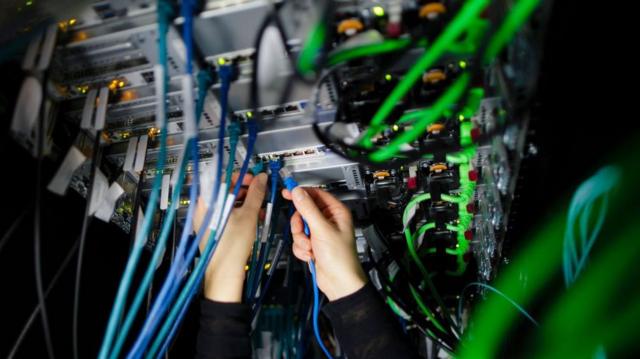
A data centre is a specialised facility housing powerful servers that ensure the continuous operation of the digital infrastructure.
If we imagine the internet as a city’s integrated infrastructure, data centres act as its digital archives, banks and communication hubs.
It is on these servers that news websites, company databases, mobile apps, government registers and online banking services are hosted.
They are equipped with backup power systems, stand-alone generators and powerful cooling systems to ensure round-the-clock access to information.
Attacks on data centres could paralyse the digital infrastructure of many sectors.
For example, on 23 September, the High Qualification Commission of Judges of Ukraine reported damage to providers’ infrastructure.
“Our website and email are temporarily out of service. We are continuing to take measures to restore them as soon as possible,” the organisation stated.
Unlike targeted cable damage, the physical destruction or power cut at a server site leads to the simultaneous shutdown of hundreds of websites, government services, delivery services and retail chains.
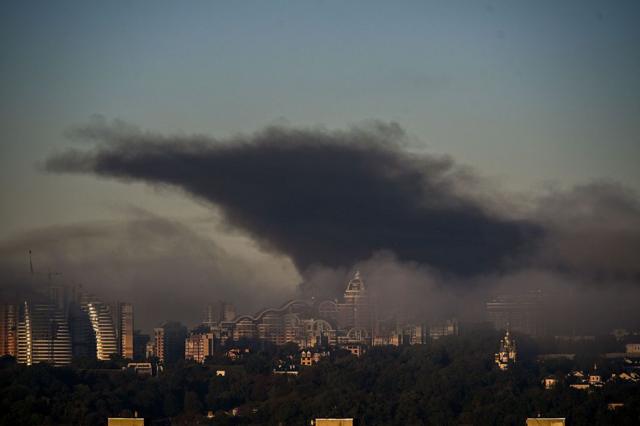
Photo credit: Evhen Kotenko/Ukrinform/NurPhoto via Getty Images
MP Oleksandr Fedienko, speaking on Obschestvennoe TV, claims that the Russians are attacking motor centres to sow panic: (7:2) amongst the civilian population, because the military have their own communication channels and networks; they do not use civilian infrastructure. “It should be emphasised that we are currently managing to keep the situation under control,” Fedienko said.
He emphasised that mobile operators in Ukraine are private companies.
Each company assesses the risks it faces for itself.
But I would point out that Ukraine is the only country in Europe – perhaps even in the world – that has not only an extensive communications network but also a huge number of small and medium-sized operators.
So, perhaps things aren’t so bad after all?
Despite the severity of the attacks on digital infrastructure, industry experts assure us that it is virtually impossible to destroy data permanently.
Most modern companies use geographically distributed servers, redundancy and the continuous creation of backups.
The main problem lies in the cost of lost equipment and physical disconnections, which are what lead to temporary disruptions. However, once the hardware has been restored, the data can be recovered.
Data centres are, first and foremost, points where the networks of many operators and services physically interconnect. It is precisely this proximity that ensures the speed and convenience of the modern internet to which everyone has become accustomed: from instant video streaming to sorting out any task in just a few clicks.
‘Therefore, attacks affecting data centres are not so much about destruction or collapse, but rather about short-term disruptions in unexpected places, and in the longer term – the gradual degradation of the entire infrastructure back to conditions seen in years gone by. It’s easy to imagine. Just think back to how simple things used to be. That’s the direction we’d head in if major nodes were to be destroyed,” explained one industry expert in a comment to BBC News Ukraine.
According to experts, it is almost impossible to shut down the internet, but its quality may deteriorate.
Can you prepare for disruptions?
The simplest piece of advice Ukrainians are currently being given is to have cash and paper documents to hand, in case the internet does go down for a while.
Anatoliy Frolov, a representative of an internet exchange point, told Obshchestvennoye that connectivity could be lost for anywhere from a few hours to half a day.
“If it’s absolutely essential for you to stay connected 24/7, start with your mobile operator and make sure you have at least two SIM cards. Most phones support this option. If one operator goes down, you’ll have a second one. You can also have a backup home internet connection,” said the expert.
On social media, some users were outraged by this approach, as using several providers simultaneously is, at the very least, expensive. Currently, mobile services in Ukraine cost an average of 300–400 hryvnias a month, and prices may well rise.
According to Alexander Polyudov, owner of the provider UTELS, keeping tariffs at the current level of 300–350 hryvnia a month is becoming a difficult task
The main reason is the colossal costs involved in ensuring network stability: large-scale purchases of batteries.
‘We must expect an increase in the cost of internet services. Providers ensuring network stability, backup power supplies and backup communication channels will no longer be able to offer internet access for 300–350 hryvnias. There will be a significant price rise,” Polyudov told dev.ua.
He noted that companies which refuse to adapt their infrastructure and attempt to undercut prices risk simply disappearing from the market.
There is a delay in new connections due to long queues.
“When the winter power cuts begin, there will once again be a lot of extra work for everyone regarding power supply. Everyone is preparing, but equipment is running out and wearing out: in some places, generators will break down and need replacing; in others, batteries will degrade or run out of capacity.”
He adds that the more problems there are, the harder it is to operate and the more expensive it becomes to maintain services to the required standard.
“But it’s not the case that a single shelling would cause service prices to rise sharply for everyone.”
What is known about the attacks on car centres in Kyiv
On 23 September, following the shelling, a wave of internet disruptions was recorded.
Due to damage to a data centre and a power cut affecting key equipment, some subscribers of the Kyiv-based providers ‘Pautina’ and UTELS were temporarily left without internet access.
KyivLink and Crazy Network also reported issues. The infrastructure of the provider Etherlink was damaged.
“Due to damage to the main hub, there is currently no internet access. The network core will be relocated; we are currently looking for a suitable location. The timeframe for restoration is as yet unknown. We will provide further updates as soon as we have precise information. Thank you for your understanding,” the provider stated in a message.
The Russians also launched attacks on the sites of hosting providers MiroHost and Cityhost.
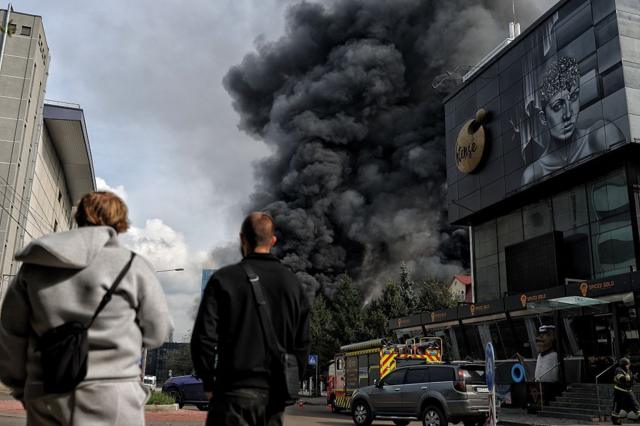
Photo credit: Yan Dobronosov/Global Images Ukraine via Getty Images
A few days ago, mobile operator Kyivstar reported attacks on its equipment – specifically, on the building where the equipment is housed.
The National Commission for the State Regulation of Electronic Communications (NCCEC) also reported possible temporary problems with the internet and mobile networks.
According to the regulator, specialists are working to repair the damage caused by the shelling and stabilise the networks. Internet service providers and mobile operators affected by the disruptions on 23 September are now finalising emergency repair work to fully restore services to users.
On 24 September, Foreign Minister Andriy Sibiga confirmed that Russia had carried out strikes on major Ukrainian car dealerships in Kyiv.
The Starlink incident in Poland
Meanwhile, incidents affecting infrastructure that impacts the internet and communications in Ukraine are also occurring beyond its borders.
On 23 September, a Starlink satellite internet ground station caught fire in the village of Wola Krobowska in the Masovian Voivodeship.
According to the Polish broadcaster RMF FM, the emergency services received a call from the owner of the plot of land where the infrastructure was located. At the scene of the fire, a distribution cabinet, several antennas and a generator were damaged.
Firefighters managed to extinguish the blaze, but the police are investigating the possibility of arson.
Another possible cause is a short circuit.
The Polish Internal Security Agency (ABW) and the Central Bureau of Police Investigation (CBŚP) have been brought in to assist with the investigation. Forensic experts are working at the scene, whilst special police units are patrolling the area around the site.
The base station in Wola Krobowska is a key element of the network: together with a similar base near Kaunas in Lithuania, it provides satellite internet to a significant part of Central and Eastern Europe, including Ukraine.