


Photo credit: Kyiv City State Administration
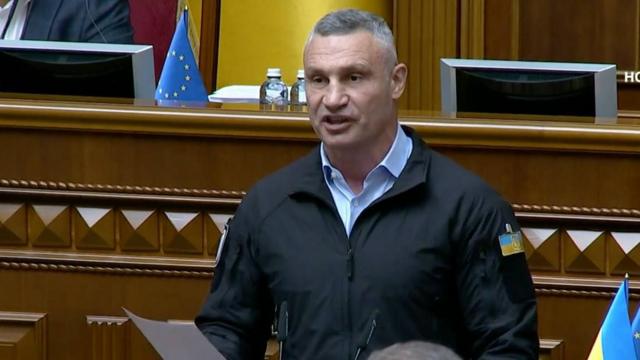
On 14 October, the Mayor of Kyiv, Volodymyr Klitschko, addressed the Verkhovna Rada and responded to recent criticisms from Volodymyr Zelenskyy that Kyiv was not prepared for winter. At the same time, the President announced certain personnel decisions, which some interpreted as a possible change in the city’s leadership.
In recent days, against a backdrop of intensified shelling of the capital and problems with electricity, water and transport, he has faced a growing number of criticisms regarding the city’s preparations for a harsh winter, with some even calling on people to take to the streets to protest against the mayor’s actions.
In effect, the long-standing standoff between the president and the mayor of Kyiv – which began immediately after Volodymyr Zelenskyy’s victory in the 2019 presidential election – has intensified. This is exacerbated by the de facto dual authority in the capital – the mayor heads the city’s executive body, the Kyiv City State Administration (KCSA), whilst the president appoints district heads, effectively creating his own chain of command.
During martial law, the president has also appointed the head of the city’s military administration, though he has little practical authority.
The current crisis is not the first of its kind, and it escalates every time the situation in the city becomes critical during the war.
Previously, Klitschko had pointed out that the central authorities were putting a spanner in the works for the city, whilst the President had repeatedly stated that the mayor’s chain of command was failing in its preparations for winter and the construction of shelters – an issue that had already been raised back in the summer.
Klitschko’s main arguments during his speech in the Rada centred on the fact that Kyiv was preparing, and continues to prepare, for winter; however, this process is being complicated by constant Russian shelling and frozen payments from the central government.
MPs from the ruling party were unable to put questions to Klitschko; consequently, the debate between the Mayor of Kyiv and Volodymyr Zelenskyy has now boiled down to yet another round of exchanges by correspondence, with no clear winner.
What Klitschko said in the Verkhovna Rada
Vitali Klitschko explained that the city authorities are doing everything in their power to ensure the city’s vital functions continue, despite the setbacks the central government is trying to inflict.
He emphasised that the constant Russian shelling is affecting the water supply system, the operation of electric transport and other services. In particular, there have already been 50 strikes on the city’s power supply system this year.
And this is against the backdrop of the charade the authorities have staged with their ‘resilience plan’ – a campaign of lies claiming that Kyiv is not functioning and nothing is getting done – coupled with the freezing of funds, which has halted numerous energy resilience projects and delayed their implementation, not only in the capital. This situation is prevalent in many local authorities where payments have been suspended. The accusation is that the heating season, which has not even begun, has been disrupted,” said Klitschko.
He also noted that Kyiv had been preparing for the heating season and continues to do so.
According to him, Kyiv has prepared nearly 700 generators of various capacities for heating and water supply facilities, 70 mobile boiler units, and has built three diesel power stations and a backup water intake. Kyivvodokanal currently has 103 generators and is awaiting the delivery of large-scale generator systems for the water supply.
Klitschko also stated that, thanks to the city’s energy resilience programmes, more than 6,000 items of equipment (generators, inverters, batteries) have been procured.
All educational institutions have generators of varying capacities, including 285 high-capacity units. The capital’s hospitals are equipped with backup power sources.
Yet, from all the naysayers and others, we keep hearing that things in Kyiv aren’t as they should be, that something has been done poorly, and that we seem to be living somewhere back in 2019. You can say whatever you like – you could even pin the Third World War on Klitschko – but this is not just my concern, but Ukraine’s: the protection of Ukrenergo’s facilities. Where are the billions that were allocated for this? – the mayor stated.
Earlier, the head of government and the energy minister acknowledged that the Russians are cutting the high-voltage line from the Rivne Nuclear Power Station to the capital, as well as important substations near the city, which is also causing a critical situation with the electricity supply in Kyiv. On the other hand, Klitschko is being criticised for the fact that facilities under the city’s responsibility are also inadequately protected.
Klitschko also told the Verkhovna Rada that the central authorities are attempting to destroy local self-government, and not just in Kyiv.
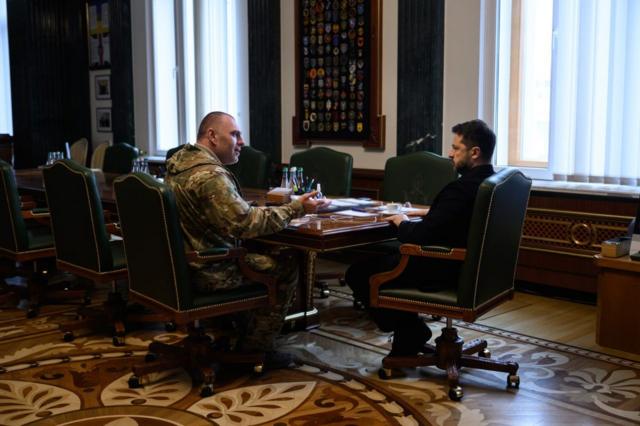
Photo credit: Volodymyr Zelenskyy
The situation is worse than in previous winters
The day before, on 13 October, Volodymyr Zelenskyy said that Kyiv is not really prepared for winter.
Every Kyiv resident can see that the city is genuinely unprepared. Now, already in October, the situation is, unfortunately, worse than in previous winters of this war. When, due to isolated air strikes, the electricity and water are cut off. There are many other issues as well; they do exist, unfortunately. As for shelters, the preparation of schools, the construction of protective structures… the operation of transport, and the preparation of homes in Kyiv for winter… Kyiv is lagging behind our other regions in implementing resilience plans,” said Zelenskyy.
He also noted that solutions and faster progress are needed, and that he had spoken with community representatives.
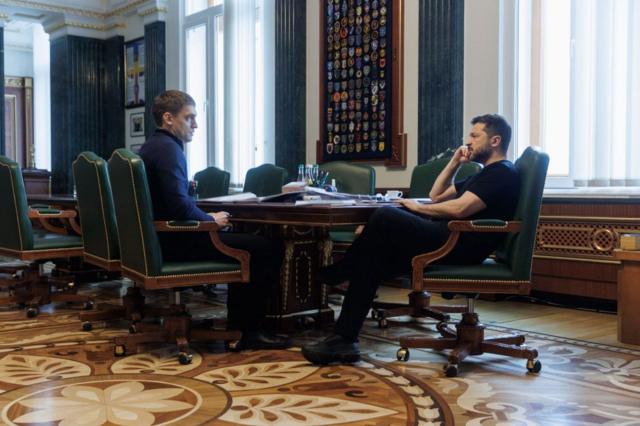
Photo credit: Volodymyr Zelenskyy
He spoke with representatives from the security sector, the business community and local government, in particular with former SBU Chairman Vasyl Malyuk, Zaporizhzhia Oblast civil defence coordinator Ivan Fedorov, and Kharkiv Mayor Ihor, who put forward proposals, for which he is grateful. I will be holding further consultations and meetings that are already scheduled. Vitali Klitschko; however, the President did not issue the relevant decree at that time. After all, there are significant doubts as to the legality of such a move
. We are summoning such clowns to the council so that we can put questions to them. Specifically, so that they answer, rather than reading from a script,” said Bezugla.
At the same time, Klitschko is supported by his coalition allies in the Kyiv City Council – the European Solidarity faction.
Yaroslav Zheleznyak, a councillor from the Voice party, said that over the course of the year, the central government and Klitschko had been passing the buck and pointing fingers at one another. He also called for the First Deputy Prime Minister and Minister for Energy, Denys Shmyhal, to be summoned to give an account.
Does the President bear personal responsibility for preparing the capital for winter? Definitely yes. Do the local authorities and the mayor bear the same responsibility? Absolutely so, too,” said Zheleznyak.
Protests against Klitschko?
Meanwhile, a demonstration has been announced in Kyiv for Saturday, 17 October, demanding the resignation of the city’s mayor, Vitali Klitschko.
The rally was initiated by veteran Dmytro Koziatynskyi, who had previously been one of the organisers of the protest against the resignation of Defence Minister Mykhailo Fedorov. Koziatynskyi announced this on his Facebook page.
He explained his decision by citing the capital’s inadequate preparations for the autumn-winter period, noting that Klitschko had failed to prepare Kyiv even for autumn and should therefore step down.
This idea was quickly taken up by representatives of the president’s party.