

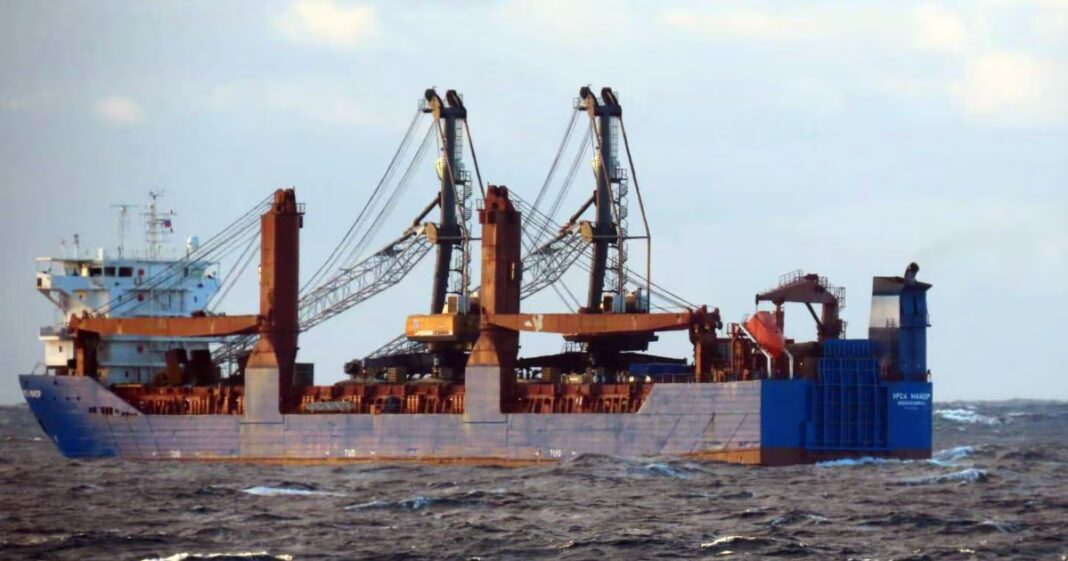

The Russian ship Ursa Major, which sank in December 2024 in the Mediterranean Sea, was likely carrying nuclear reactor components for North Korea. The ship itself may have been struck by a Western torpedo, according to a CNN investigation. The TV channel suggests it could have been “a rare and risky intervention by Western militaries aimed at preventing Russia from transferring advanced nuclear technology to its key ally, the DPRK.”
The wreck of the Ursa Major in international waters between Spain and Algeria in the Mediterranean Sea was reported on 24 December 2024. Before that, as reported by the Spanish media, there was an explosion in the engine room on board the ship, after which it gave a distress signal. Two crew members were missing, while 14 crew members were rescued and taken to the port of the Spanish city of Cartagena.
The ship’s owners, Oboronlogistica Group, soon announced that the Ursa Major had been subjected to a “targeted terrorist attack”. According to crew members, on the afternoon of 23 December, the ship “experienced three consecutive explosions from the starboard side in the aft area.” The Ursa Major was said to be sailing from St Petersburg to Vladivostok with a cargo of 806 tonnes. On board were two gantry cranes, two crane buckets, two ship’s bilge covers, a 20-foot container with cover equipment and 129 empty containers. Media outlets noted that the dry cargo ship had been carrying supplies to supply the Russian military group in Syria for years.
The CNN television channel tried to reconstruct the chronology of the shipwreck:
- “Ursa Major” left port on 11 December 2024. Two months before that, Oboronlogistika reported that its ships had received a licence to transport nuclear materials. “The Ursa Major travelled along the coast of France and then Spain, escorted by the Russian ships Ivan Gren and Alexander Otrakovsky.
- On 22 December the ship, being in Spanish waters, sharply slowed down. Spanish rescuers contacted the crew and asked if everything was all right, they said yes. But about 24 hours later, the ship veered sharply off course and at 11:53 a.m. on 23 December gave an urgent signal for help, according to an investigation conducted at the request of the Spanish government. Three explosions occurred on the starboard side of the ship (presumably near the engine room), killing two crew members. The explosions caused the vessel to lurch violently.
- 14 Crew members were evacuated to lifeboats, soon they were picked up by a Spanish rescue boat. At 19: 27 a Spanish military vessel arrived to help, but half an hour later the Russian ship “Ivan Gren” demanded from the ships nearby to stay away from the “Ursa Major” and immediately return the rescued crew. Spanish maritime rescue authorities insisted a rescue operation was necessary.
- According to an SNN source close to the investigation, the “Ursa Major” did not give the impression of a vessel that was about to sink. However, at 21:50, the “Ivan Gren” fired a series of red flares over the scene, followed by four more explosions. The Spanish National Seismic Network told reporters that seismic signals resembling underwater mine explosions were recorded in the area at the time of the explosions.
- At 23: 10 it was announced that the ship had sunk.
The rescued crew members (all of whom were Russian) were brought ashore in Cartagena, where they were questioned by Spanish police and investigators. The ship’s captain, Igor Anisimov, was reluctant to say what the dry cargo ship was carrying, “fearing for his safety,” but, according to CNN’s source, “under pressure” said that the Ursa Major was carrying, among other things, “components of two nuclear reactors similar to those used on submarines.” Spanish investigators have assumed that we are talking about reactors model VM-4sg, which are often installed on Russian nuclear submarines of the project 667-BDRM, but there is no confirmation of these data, noted in the material. According to the captain, the vessel was to be sent to the North Korean port of Rason.
“Oboronlogistika” reported that after three explosions “during an external emergency inspection of the vessel” was found a hole measuring approximately 50 by 50 centimetres, “the edges of the hole were torn and directed inside the vessel”, and the deck of the ship was strewn with shrapnel. The Spanish investigation believes that such damage could have been caused by a Barracuda-type torpedo. They are in service with the US, several NATO countries, Russia and Iran. A source with knowledge of the investigation believes such a torpedo could have made a silent impact that caused the ship to suddenly slow down.
Some of the experts CNN interviewed questioned this version. They believe that such a hole in the ship could have been left by a magnetic mine embedded in the hull.
A few days after the rescue, the crew was returned to Russia. Shortly after the Ursa Major wreck, the vessel Yantar, often referred to as a “spy ship” by Western countries, arrived at the site. It spent five days at the site, after which there were four more explosions. They could have been