

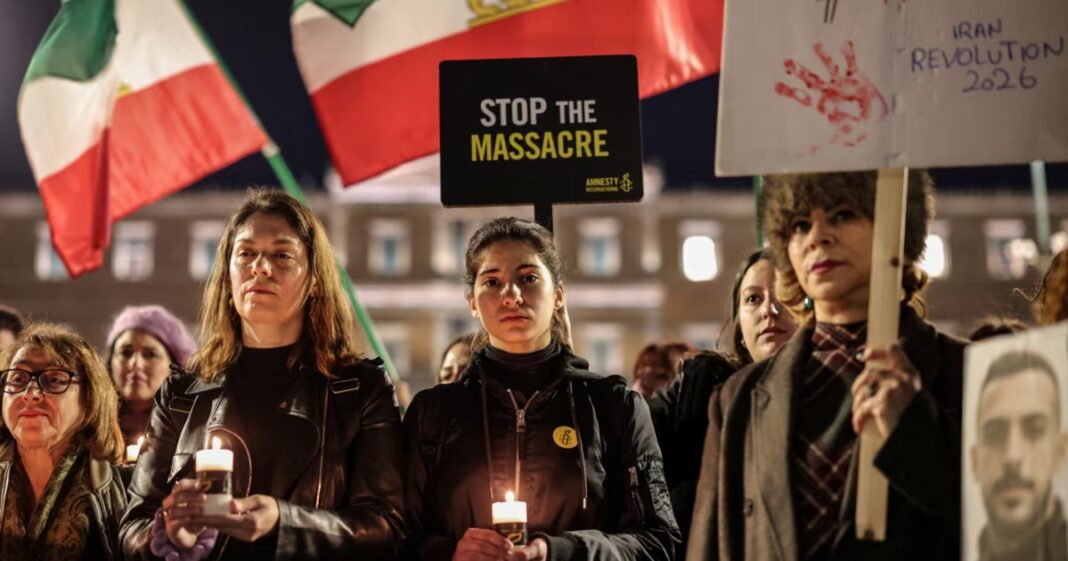

The Council of the European Union decided to expand sanctions because of “serious human rights violations in Iran,” its press service reported on 16 March. The bloc imposed restrictive measures against 16 more individuals and three organisations.
These are people and organisations that played a key role in the suppression of street protests in January 2026, which “led to thousands of civilian deaths”, the bloc specifies.
In particular, the EU Council agreed sanctions against Iran’s deputy interior minister for security and law enforcement, as well as a number of commanders of local branches of the Islamic Revolutionary Guard Corps (IRGC) directly involved in the brutal crackdown on protests.
Also listed were Mohammad Rasulullah’s Corps, which is responsible for coordinating the Quir and Basij paramilitary forces in Tehran, and Imam Reza’s Islamic Revolutionary Guard Corps, which is the local branch of the Quir in Khorasan-Razavi province, where the crackdown on protests was particularly brutal.
Read also: the Captain of the Iranian women’s national football team refused asylum in Australia-USMoney
Also today the Rada listed members of the judiciary involved in the prosecution of peaceful protesters, activists, including women human rights defenders, as well as journalists and political activists who criticise the authorities.
“Some of the people on the list are responsible for extorting confessions under duress, violating fair trial guarantees and imposing harsh sentences on peaceful activists,” the EU said in a statement.
In particular, the list includes the head of Iran’s Prisons, Security and Educational Activities Organisation, during whose time in Iranian prisons serious human rights violations were documented. According to the EU, these include torture and other forms of cruel, inhuman or degrading treatment or punishment, execution of juvenile offenders, arbitrary detention and physical violence against political dissidents and persons belonging to ethnic and religious minorities, cases of sexual violence and coercion against women prisoners.
Sanctions were also imposed on Naji Research and Developer Company (NRDC), an Iranian IT services and consulting company responsible for developing the Nazer mobile app, which is used by Iran’s law enforcement forces as a surveillance tool to monitor and control citizens.
The head of Tehran’s cyber police, which plays a key role in internet filtering, censorship, social media content control and “unfairly targeting citizens for digital content,” was added to the list.
In total, 263 individuals and 53 organisations are subject to EU sanctions because of human rights abuses in Iran. The assets of these individuals have been frozen and EU citizens and companies are banned from providing them with funds, financial assets or economic resources. The sanctioned people are also banned from entering the EU. In addition, there is a ban on exports to Iran of equipment that could be used for repression, as well as telecoms monitoring equipment.
Nationwide protests in Iran erupted in December 2025. In response, authorities launched a brutal crackdown that human rights groups say has left thousands dead.
- Radio Liberty
EU Council imposes sanctions against 16 more Iranian officials over human rights violations