

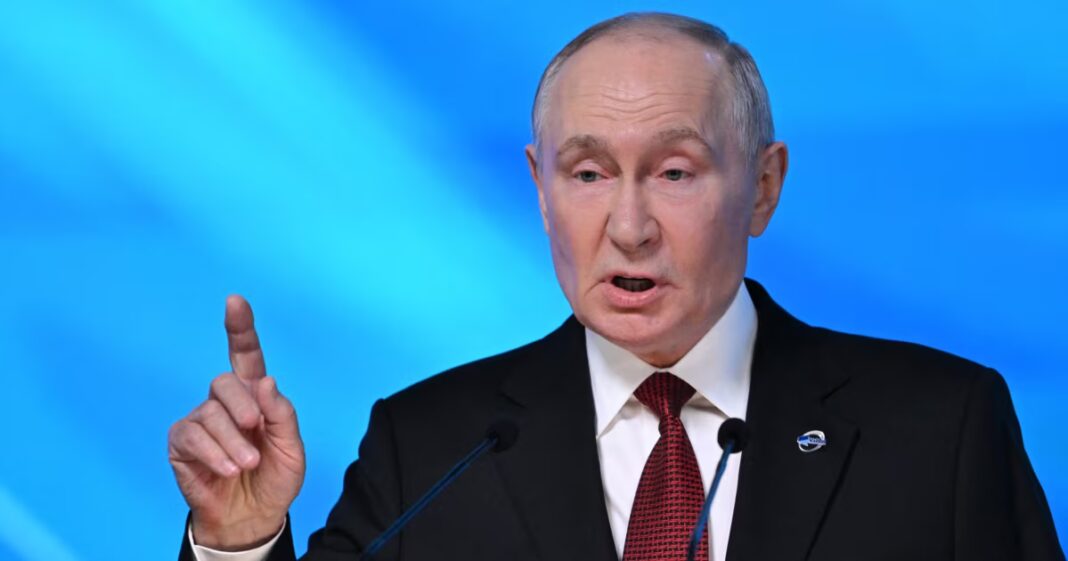

The Kremlin has commented on a telephone conversation between Russian leader Vladimir Putin and Finnish President Alexander Stubb and Norwegian Prime Minister Jonas Gar Støre. They stated that Putin had referred to the ‘root causes’ of the war – this is how the Kremlin describes its demands that Ukraine abandon its aspirations to join NATO and disarm its armed forces, as well as other demands which Kyiv rejects. Russia is at war with Ukraine and has accused the European Union and NATO of pursuing a “confrontational policy”.
“It was emphasised that a just and long-term peace is possible only if the legitimate interests of the Russian Federation are fully and unconditionally taken into account. At the same time, attention was drawn to the confrontational policies of the EU and NATO, which are leading to a protracted conflict,” the Kremlin stated.
According to the statement, the participants welcomed the agreement to resume trilateral talks between Russia, Ukraine and the US in Abu Dhabi in the first half of November. These talks will “focus, in particular, on ensuring the security of Russia and Ukraine following a complete cessation of hostilities”.
The Kremlin press service added that the leaders had agreed to continue maintaining direct contact by telephone.
On 27 October, it emerged that Finnish President Alexander Stubb and Norwegian Prime Minister Jonas Gar Støre had spoken by telephone with Russian leader Vladimir Putin about the Russian Federation’s war against Ukraine. A statement from Stubb’s office said that the conversation followed on from a meeting held on 20 October in Oslo and took place in consultation with Ukraine.
Stubb and Støre initiated the conversation themselves to discuss Russia’s war of aggression against Ukraine, as well as diplomatic efforts to bring it to an end and to strengthen peace and stability in Europe, the Finnish President’s office said.
“Finland and Norway share a border with Russia and strongly support Ukraine. The aim of the conversation was to convey to President Putin the position regarding future negotiations that could help bring the war to an end. Upcoming meetings in Abu Dhabi were discussed. Stubb and Støre took part in the conversation as leaders of their respective countries and did not speak on behalf of Europe as a whole,” the statement said.
Following Støre and Stubb’s conversation with Putin, Ukrainian President Volodymyr Zelenskyy spoke on the phone with European representatives.
Since February 2022, when Russia launched a full-scale war against Ukraine, the leaders of Western European countries have largely avoided contact with Putin.
The Kremlin has repeatedly accused European governments of fuelling the war, citing arms supplies to Ukraine. The Russian side has contrasted this stance with the approach of US President Donald Trump, who maintained contact with Putin and sought to facilitate a peace agreement, though this has not yet been achieved.
Last week in Oslo, Støre and Stubb met with US President’s Special Envoy Steve Whitcoff and Ukrainian President Volodymyr Zelenskyy. Whitcoff then travelled to Russia and met with Putin in St Petersburg.
Following Putin’s talks with Whitcroft, the Kremlin stated that Russia was prepared to resume peace talks with Ukraine as early as November, with the US acting as mediator — for the first time since February. The meeting is expected to take place in Abu Dhabi (UAE).
In this regard, Ukrainian President Volodymyr Zelenskyy stated that the terms of security guarantees for Ukraine in the event of a ceasefire cannot be dictated by the Russian side. Restrictions on the Ukrainian army and issues of the country’s sovereignty, he said, are not up for discussion. Zelenskyy also spoke out against any easing of international sanctions against Russia.
Earlier, the US Institute for the Study of War stated that the Kremlin’s interest in negotiations is merely feigned: their aim is not to end the war in Ukraine, but to secure economic concessions from the US so that Russia can continue to finance the hostilities.
According to the ISW’s assessment, Russia remains unprepared for constructive negotiations and has no intention of making concessions to end the war, whilst seeking Ukraine’s capitulation.