

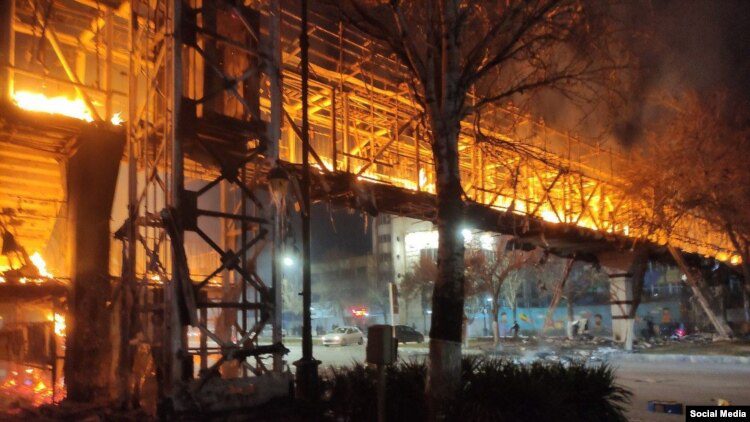

Iranian President Massoud Pezeshkian said that the authorities are ready to listen to the demands of citizens who came out to protest, but at the same time accused some of the protesters of attempts to destabilise the country. His statement came amid protests sweeping the Islamic Republic due to the deteriorating economic situation.
“People have concerns, we should sit down with them and, if it is our duty, solve these problems. But the supreme duty is not to let a group of rebels come and destroy the whole society,” Pezeshkiyan told state television in an interview on 11 January.
The protests have been going on for more than two weeks. According to human rights activists, at least 116 people have been killed in the clashes and some 2,600 others have been detained. The most mastabe rallies have taken place in Tehran.
Amid internal tensions, Iranian officials have also made strong statements about the event. Parliament Speaker Mohammad-Bagher Ghalibaf threatened that US and Israeli forces would be “legitimate targets” in the event of a US strike on Iran. His statement came amid cries of “Death to America” from MPs.
Earlier, US President Donald Trump said Iran seeks freedom, Washington is ready to help.
“Iran yearns for freedom, perhaps more than ever before. The US is ready to help,” he wrote on social network X.
Trump did not specify what that help might consist of.
The day before, the US president said if Iranian authorities started killing people, Washington would intervene.
“This does not mean boots on the ground (“boots on the ground”, a sustained expression that can be translated as” the introduction of troops” – ed.), but it means a very, very strong blow to them where it hurts,” Donald Trump emphasised.
Earlier, US Secretary of State Marco Rubio said that the United States “supports the brave people of Iran”.
The protests began late last year amid economic difficulties in the country. Their main driving force was initially street vendors. They were then joined by students and other city dwellers, mostly young people.
On 3 January, Iran’s Supreme Leader Ayatollah Ali Khamenei commented on the mass protests for the first time, saying that tough measures should be taken against the “rebels.” At the same time, Khamenei, as well as other representatives of the Iranian leadership, called the fears of street vendors in connection with the devaluation of the national currency justified.
“We will talk to the protesters, but dialogue with the rebels is useless. The rebels should be put in their place,” he said.
The protests in Iran are in their 15th day, but there is still no accurate information on the number of detainees in different cities. HRANA, an agency covering human rights-related news, said at least 2,311 people have been arrested in the first 13 days of the protests and rallies have been held in 512 locations in 180 cities and towns amid an almost complete internet blackout.
There is also no exact information on the death toll from the protests. Between 45 and 65 deaths have been reported. Radio Farda (the Iranian service of Radio Liberty) had earlier confirmed the identities of 35 of them.