


Russian officials are signalling that Russia will not be satisfied with territorial concessions alone and have reaffirmed their commitment to Russia’s original military objectives, which include the collapse of the NATO alliance, the Institute for the Study of War (ISW) wrote in a report.
The analysts drew attention to a statement by the Russian embassy in Belgium, which noted on 17 February that Russia would require NATO to legally enshrine a non-expansion clause under a “draft treaty” that Russia created in December 2021. ISW noted that the embassy was referring to Russian ultimatums given to the United States and NATO before a full-scale invasion of Ukraine. “These ultimatums amounted to the destruction of the current NATO alliance by calling on NATO to cease deploying forces or weapons systems in member states that joined the alliance after 1997,” it said.
The ultimatums were also intended to force the West to abandon its “open door” policy, rule out eastward expansion and abandon partnerships on NATO’s eastern flank, particularly with Ukraine, the analysts added.
“These demands on Ukraine and NATO are part of Russia’s initial military demands, and the Russian embassy’s reiteration of these demands amid the current negotiations continues to signal that Russia will not be satisfied with an agreement that does not concede all of these demands on Ukraine, NATO, and the United States, even if the agreement meets some of Russia’s territorial demands,” ISW said.
The Institute for the Study of War emphasised that Kremlin officials have consistently reiterated a commitment to achieving their initial military objectives militarily or diplomatically and have shown no willingness to compromise on these objectives to achieve peace in Ukraine.
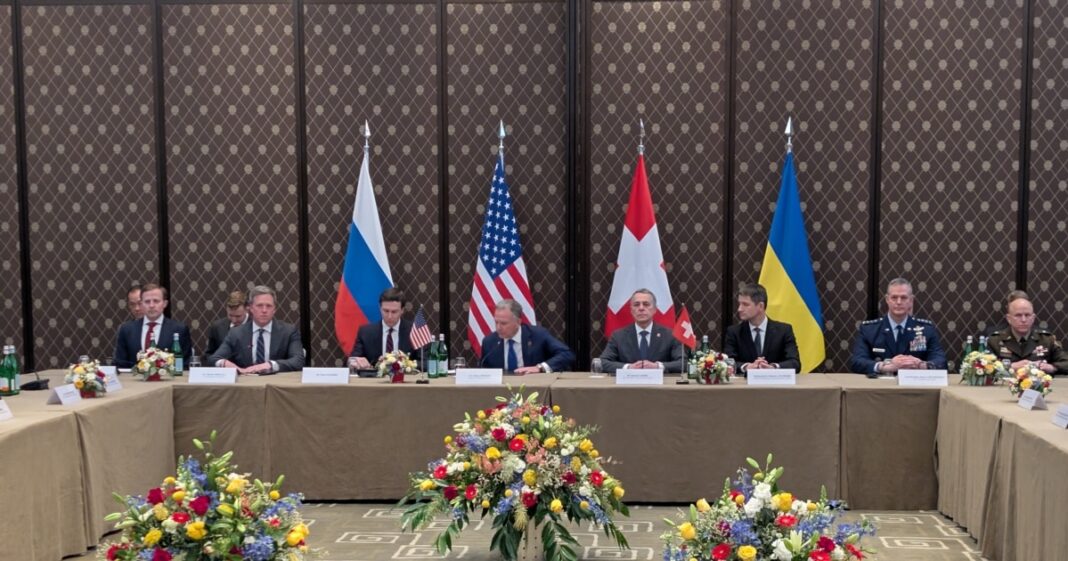
President Volodymyr Zelensky said that the next round of trilateral talks with the United States and Russia on ending Russia’s war against Ukraine will again be held in Switzerland. He said this in an interview with Piers Morgan, published on YouTube on the evening of 18 February. The head of state did not give the planned date of the talks, but emphasised the importance of holding the negotiations exactly in Europe.
Earlier, at the conclusion of the talks between Ukraine, the US and Russia in Geneva, Switzerland, which lasted 17 and 18 February, Zelensky said that there had been progress in military aspects, but that “sensitive issues” remained in the political spheres. “While the positions are different, because the negotiations were not easy … That is, in the military direction I heard progress, in the political direction – there was dialogue, they agreed to go further, agreed to continue. I have not heard such progress as in the military direction,” the president added, noting that he would know the details upon the group’s return to Ukraine.
Meanwhile, Kremlin spokesman Dmitry Peskov said that it was “too early” to assess the results of the talks. There was no previous comment from U.S. officials.
Speaking to Russian state media after the official talks ended on 18 February, Moscow’s chief negotiator Vladimir Medinsky said the talks had been “difficult but businesslike” and that there would be further meetings.
Before that, White House chief envoy to Geneva Steve Whitkoff said “significant progress” had been made. “Both sides agreed to provide updates to their respective leaders and to continue working toward an agreement,” he wrote in a message on X.
Details of the talks were not disclosed.
The talks, which lasted two days in Geneva on 17 and 18 February – the third round of trilateral meetings held over the past month – focused on two of the most difficult obstacles to ending Russia’s war against Ukraine: territorial claims and security guarantees.
The meetings took place a week before the fourth anniversary of Russia’s full-scale invasion, which has killed or wounded nearly two million people on both sides.
Despite U.S. efforts to mediate an end to the war, Russia has shown no willingness to back down from its tough demands, which include Ukraine’s relinquishment of Donbass territories.
Meanwhile, Ukraine insists on strong security guarantees from the U.S. and European allies to help protect it from future Russian aggression.