

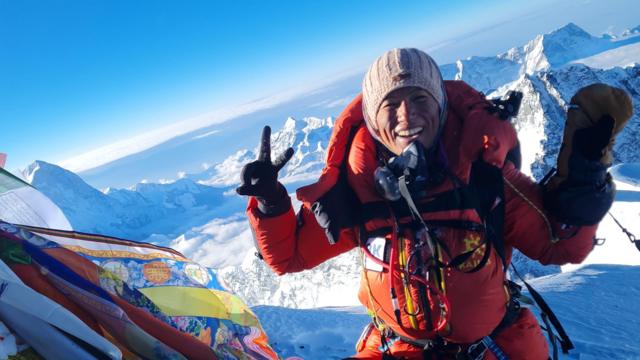

After an gruelling 13-hour climb, Purnima Shrestha finally reached the summit of Everest. Standing at the highest point on Earth, she gazed in awe at the snow-capped mountain ranges.
But when Purnima reached for her last oxygen cylinder — the source of air without which she could not have survived at such an altitude — her triumph instantly turned into a nightmare. The cylinder was faulty; there was no more oxygen.
In a matter of seconds, panic replaced her joy and relief.
“At that moment, I realised that staying there for even a single second longer was dangerous,” she told the BBC.
Purnima found herself in the so-called ‘death zone’ – the section of Everest at an altitude of over 8,000 metres. There, the human body can barely function normally without supplementary oxygen.
“That is why this area is called the ‘death zone’,” explains Dr Nima Namgyal Sherpa. “Without supplementary oxygen, a person can develop severe forms of altitude sickness within about half an hour, which often prove fatal.”
According to records dating back to the 1920s, Everest has claimed the lives of more than 300 people. In the most recent climbing season alone, which ended in May, at least five climbers died on the mountain.
Earlier this month, a Nepalese guide went missing at an altitude of around 7,500 metres. He was found alive only six days later. Dawa Sherpa said he survived by chewing ice and eating a few sweets he had accidentally found in his pocket.
“I was sure I was going to die,” he told BBC Nepali.
So what happens to the human body in the ‘death zone’, and why is it so dangerous?
Where air becomes a luxury
Purnima has climbed Everest five times. But even that experience did not protect her from mortal danger.
“That day, I just wanted to survive,” she recalls.
The higher a person climbs, the lower the atmospheric pressure becomes. This means that less oxygen reaches the lungs.
Up to an altitude of around 8,000 metres, the body usually still has time to adapt to the lack of oxygen. The heart beats faster, breathing becomes deeper and more frequent, and the digestive system slows down to conserve energy.
But in the ‘death zone’, mountaineers receive only about a third of the oxygen available at sea level.
According to experts, even a healthy person with extra oxygen can survive here for only 16–20 hours. After that, the body begins to fail.
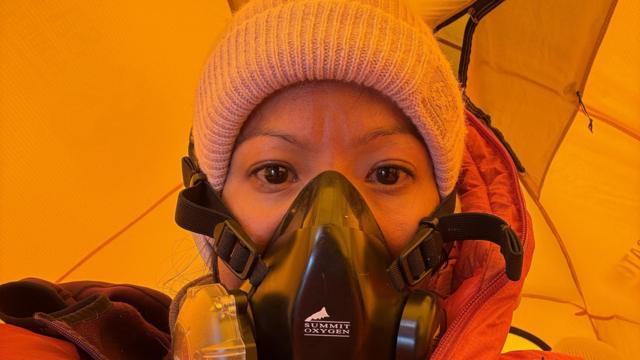
Photo by Purnima Shrestha
The situation is compounded by extreme conditions. Temperatures on Everest can drop to minus 40 degrees, whilst strong winds make staying on the mountain even more difficult.
One of the most common effects of this exposure is frostbite.
“When body temperature drops, the body triggers a defence mechanism. Blood flows from the hands and feet to the vital internal organs. Due to a lack of oxygen, the cells begin to die,” says Nima, an emergency doctor specialising in mountain medicine.
He also trains Sherpas, experienced local guides who accompany tourists and often carry their equipment.
The lower the temperature and the longer a person remains in the cold, the more serious the consequences of frostbite can be.
Symptoms include:
In severe cases, the affected part of the body has to be amputated.
When altitude clouds the mind
, to survive in the ‘death zone’, climbers usually ascend gradually, giving their bodies time to acclimatise.
And, according to Dr Nima, even the most experienced climbers can face serious problems during the final push to the summit.
One of the most dangerous conditions is high-altitude cerebral oedema (HACE). This is a rare but extremely severe form of altitude sickness, in which the brain begins to swell with fluid.
Due to the increased pressure, a person may lose their sense of direction, speak incoherently, have poor coordination and even experience hallucinations.
‘In the mountains, we often hear stories about how a foreign climber or a Sherpa suddenly loses their mind at high altitude,’ says Dr Nima.
“In such cases, people become extremely agitated and lose the ability to assess the situation rationally. Sometimes they break away from the safety ropes and may fall into a chasm.”
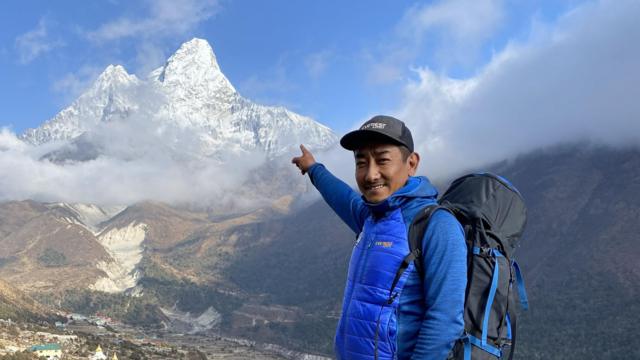
Photo by Nima Namgyal Sherpa
Another common problem on Everest is severe headache. This is most often caused by dehydration and a lack of oxygen to the brain.
Altitude can also cause another life-threatening condition, acute high-altitude pulmonary oedema (AHAPO), when fluid begins to accumulate in the lungs.
Symptoms include:
This usually happens when the body does not have time to acclimatise to a rapid ascent.
At the first signs of ALE, the person should be brought down as quickly as possible and given supplementary oxygen.
Even experienced people have their limits
Climbing becomes a serious challenge even for those born and raised in the Himalayas.
Dr Nima comes from a family of Sherpas and grew up in the village of Kumjung at an altitude of around 4,000 metres above sea level.
In 2013, he climbed Everest himself to see first-hand what happens to the human body at such an altitude.
‘Yes, we do have a certain genetic advantage because we were born and raised high in the mountains. But that merely helps the body adapt better to the altitude. It doesn’t make the climb any easier — the challenge is just as difficult for everyone,’ he says.
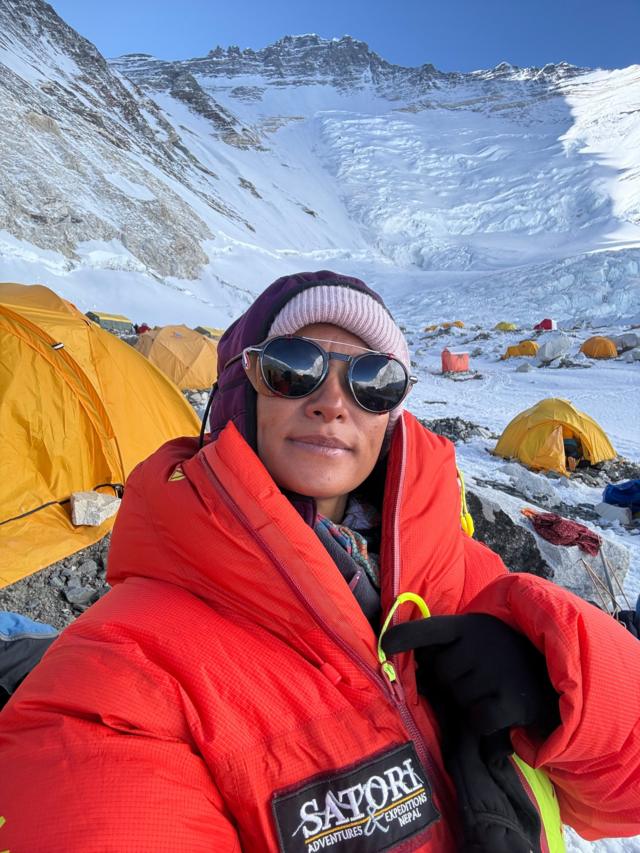
Photo by Purnima Shrestha
Whilst Purnima was at the summit, wondering whether she would survive, she noticed a crowd below near a towering rock formation known as Hillary Step.
This section, about 12 metres long, is the final obstacle on the way to the summit. It can only be crossed one at a time.
Purnima recalls hearing words of despair from one of the Sherpas: ‘I have three children. I won’t make it out of here.’
Such high-altitude bottlenecks can be deadly. Whilst people wait their turn, they risk running out of oxygen before they reach the summit or begin their descent.
This season, more than a thousand people have reached the summit of Everest. According to the Nepal Tourism Board, this is a record figure for the entire history of record-keeping.
This influx of climbers has once again raised the question of how many people the world’s most famous mountain can accommodate, and whether such ascents remain safe.
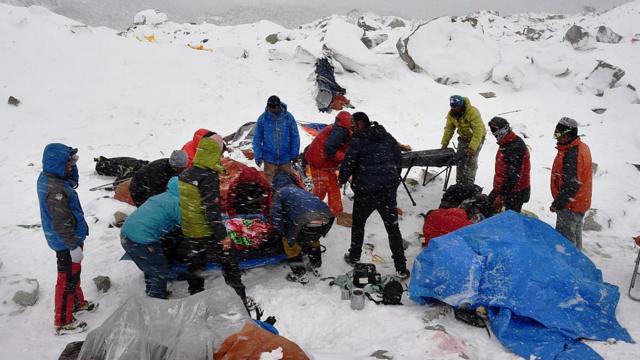
Photo credit: AFP
In the ‘death zone’, it is not just the altitude itself that is dangerous. Providing medical assistance here is extremely difficult.
In 2005, a French pilot became the first person to land a helicopter on the summit of Everest. However, most rescue helicopters cannot fly higher than 6,500 metres.
At this altitude, rescuers have almost no way of helping an injured person, so oxygen is often the only means of survival.
Sometimes we use medication to treat cerebral oedema or anti-inflammatory painkillers for frostbite. But in such extreme conditions, medicine does not always help,’ says Dr Nima.
“Any rescue operation in the ‘death zone’ puts the rescuer’s own life at risk.”
Purnima was rescued by a local Sherpa, who shared the last of his oxygen with her during the descent. Further down the route, other guides helped her.
But despite all the dangers, Everest continues to attract people.
“I often think about the struggle for every breath and every step in the ‘death zone’ when I reflect on the most memorable moments of my life,” says Purnima.