

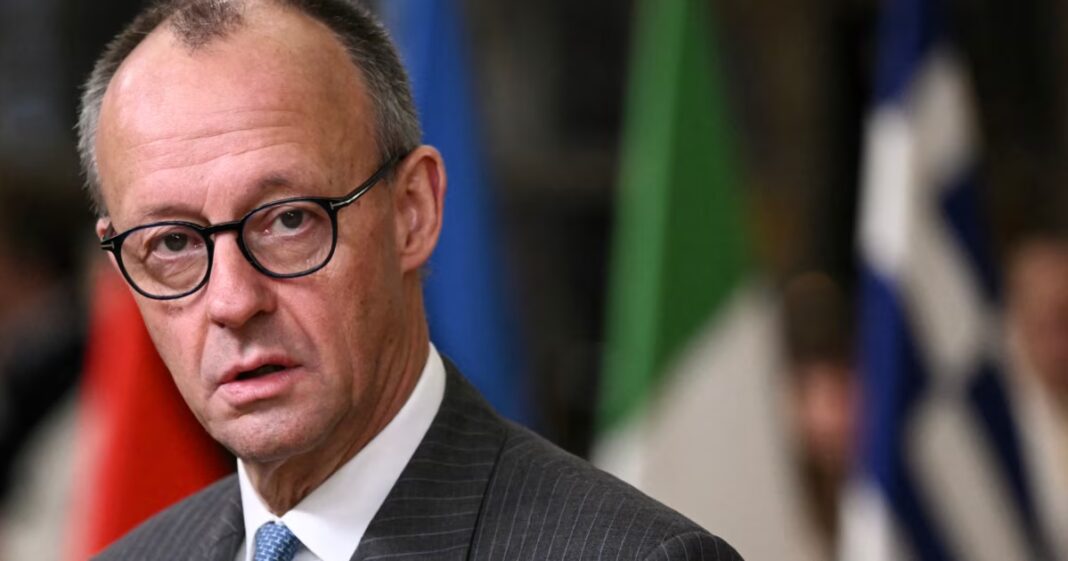

The German chancellor has proposed immediate “innovative solutions” for Ukraine on the way to its EU membership. Their essence is set out in a letter that Friedrich Merz wrote to the leaders of the European Commission, the European Council and the president of Cyprus, which currently holds the EU Council presidency. The document appeared at the disposal of Radio Liberty.
In it, the head of the German government points to the geopolitical need for EU enlargement, but the process, in his opinion, “is taking too long.” Therefore, Merz considers “understandable” the frustration among both candidate countries and member states.
The German chancellor calls for “fast progress” with Ukraine’s membership as “one of the main leaders among the candidate countries” and suggests “innovative solutions” in view of the fact that full accession will take too long.
“We will not be able to finalise the accession process anytime soon due to the numerous obstacles as well as the political complexities of the ratification procedures in different member states. However, given the peace process we have no time for further delays,” Merz remarks.
The German leader calls for the opening of all negotiation clusters “immediately and without delay”, and to continue discussing the idea of “associate membership” for Ukraine. According to Merz, it would help it on its way to full membership and speed up the accession process by incentivising negotiations.
“My idea is to take a unique step already now to directly involve Ukraine in the essence and structures of the EU, given the special situation in which the country finds itself… This would not require ratification of the Accession Treaty under Article 49 of the Treaty on European Union or changes to the constituent treaties, but only a strong political agreement,” Merz writes.
The Chancellor details what associate member status might include:
- Participation in meetings of the European Council (at leader level) and the EU Council (at ministerial level) without the right to vote;
- Associate membership of the European Commission without portfolio (i.e. without its own European Commissioner);
- Associate membership of the European Parliament without voting rights;
- Associate judge at the European Court of Justice (formally an assistant rapporteur);
- Gradual utilisation by her of the EU budget in line with progress in negotiations and with safeguards;
- Member States’ political commitment to security guarantees for Ukraine through the application of Article 42. 7 of the EU Treaty providing for mutual defence;
- A “quick-return” mechanism in case of a setback in reforms.
“Through such an approach, Ukraine would take a huge step forward, in fact immediately approaching full membership. We would already be offering Ukraine a substantial membership equivalent that far exceeds what we can provide in the medium term through the current accession methodology,” writes Chancellor Merz.
The head of the German government admits that the proposal will provoke a number of discussions regarding political, legal and technical feasibility. At the same time, he is convinced that a constructive approach will settle these issues.
“My proposal reflects the special situation of Ukraine-country at war. It will help to promote peace talks as part of a settled peace solution… It is also quite clear to me that it should not and will not affect the other candidate countries,” the chancellor summarises, also calling for innovative solutions for those states that have been preparing for EU accession for a long time.
Merz hopes that the idea will be discussed in the European Council, i.e. at the level of EU leaders. Their next summit will be held in Brussels on 18-19 June. According to Merz, the details can be worked out by a special working group, which will be set up for this purpose after the relevant political agreements are reached.
Ukrainian President Volodymyr Zelenskyy rejected the idea of Ukraine’s “associated” membership in the EU and emphasised that the idea, which excludes Kiev’s access to the common budget and voting rights, is unacceptable.
European Commissioner for Enlargement Marta Kos said in an exclusive commentary for Radio Liberty on the sidelines of the Munich Security Conference earlier this year that Ukraine’s membership in the EU is traditionally seen as an element of security guarantees and can be discussed in the context of future peace agreements.