

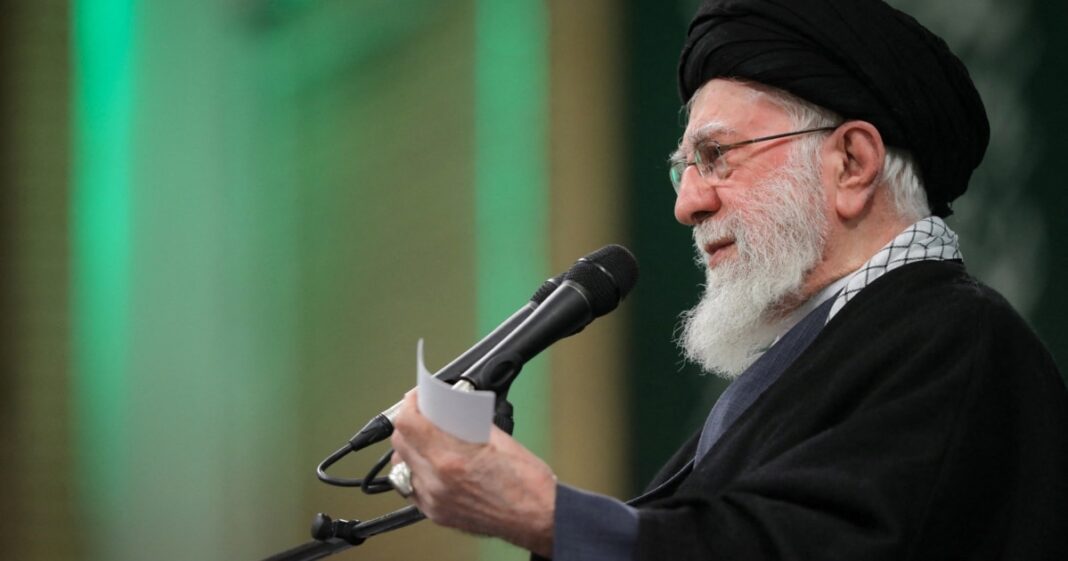

Israeli Prime Minister Benjamin Netanyahu said there are “many indications” that Iran’s supreme leader Ayatollah Ali Khamenei may have been killed in Israeli-U.S. strikes.
Netanyahu said in a video message on February 28 that morning strikes in Iran had killed commanders of the Islamic Revolutionary Guard Corps as well as senior officials on the nuclear programme.
“And we will continue. We will strike thousands more targets of the terrorist regime in the next few days,” he added.
The Iranian side has not yet confirmed the death of Ayatollah Ali Khamenei. Earlier, Iranian Foreign Ministry spokesman Esmail Baghaei told the BBC that he “cannot confirm” whether the senior leaders targeted by the recent US-Israeli strikes remained unharmed.
Meanwhile, the head of public relations in the office of Iran’s supreme leader accused the country’s enemies of “psychological warfare” after Israel reported the assassination of Ayatollah Ali Khamenei, Iranian state media reported. “The enemy is resorting to psychological warfare, everyone should know this,” the media quoted the official as saying.
Meanwhile, US President Donald Trump told Axios publication that he has several “ways out” of Operation Epic Fury, the US military campaign against Iran launched on the morning of 28 February.
“I can go ahead and take control, or I can end it in two or three days and say to the Iranians: see you in a few years if you start rebuilding (their nuclear and missile programmes – ed.),” Trump said in a telephone interview.
“Either way, it’s going to take them a few years to recover from this attack,” he predicted.
In comments to NBC News, commenting on reports that Iran’s supreme leader Ali Khamenei was killed in airstrikes, Trump said: “We believe that’s a true story.”
He added that “most” of Iran’s top leadership “have been killed”, saying: “the people who make all the decisions, most of them are dead.”
On the morning of 28 February, the Israeli military struck Iranian territory. Hours after Israel announced what it called a “pre-emptive strike”, US President Donald Trump said Washington had launched “massive combat operations” against Iran.
Iranian media reported explosions in several cities, notably Tehran, Tabriz, Isfahan, Qumi, Lorestan and Chabahar. In Tehran, the strikes targeted Iran’s top leadership. Missiles reportedly hit the homes of Supreme Leader Ayatollah Ali Khamenei and President Massoud Pezeshkian in the city centre. News agencies, citing informed sources, wrote that both leaders had been moved to safe places.
Meanwhile, Reuters, citing two sources familiar with Israeli military operations and a regional source, reported that Iranian Defence Minister Amir Nasirzadeh and Islamic Revolutionary Guard Corps commander Mohammad Pakpour were believed to have been killed in the Israeli attacks. The Times of Israel reported earlier that Israeli officials estimated that Pakpour, Nasirzadeh and Iran’s intelligence chief were probably killed in the strikes.
Iran’s Islamic Revolutionary Guard Corps responded to the US and Israeli strikes by launching several waves of drones and ballistic missiles at Israel.
Iran also launched missiles at several Middle Eastern countries where US Armed Forces bases are located. Explosions were reported in Bahrain, UAE, Qatar and Saudi Arabia.
Trump has accused Tehran of trying to rebuild its nuclear programme after the United States bombed key sites during the 12-day war between Iran and Israel last June. He said the United States was also seeking to destroy Iran’s missile capabilities and “flatten” its navy.
In announcing the military operation on 28 February, Trump said his goal was to “protect the American people by eliminating imminent threats from the Iranian regime”.
The strikes came just days after nuclear talks between the US and Iran, casting doubt on the planned continuation of talks next week in Vienna as Washington steps up its military presence in the region.
- Radio Liberty
Images from Tehran after the US and Israeli strikes on 28 February show queues at petrol stations. Protests and traffic jams in the streets of the Iranian capital have also been recorded, particularly of people seeking shelter during the attack. Netanyahu said there were “many signs” that Iran’s supreme leader Khamenei “is no more”