

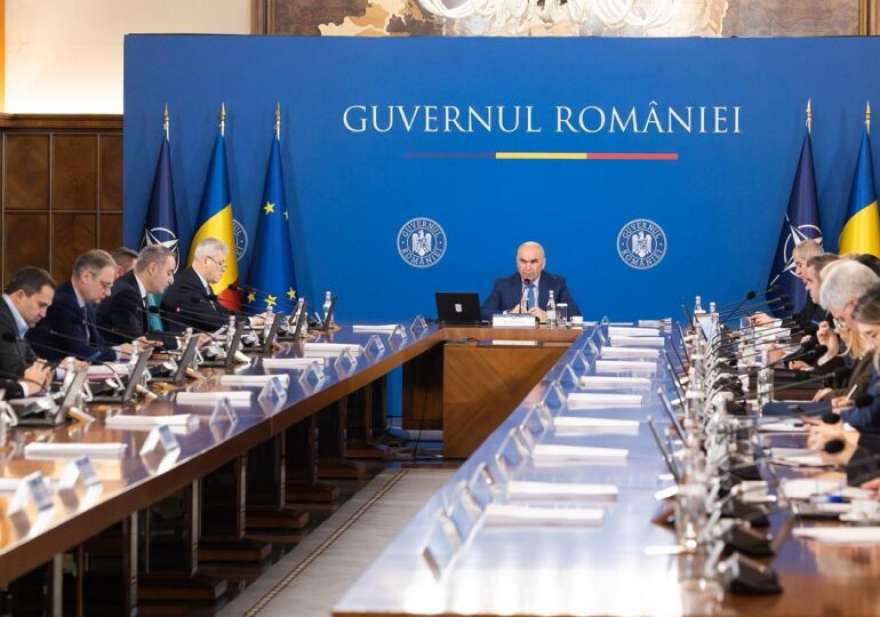

Romania’s parliament has backed a vote of no confidence in the government of Prime Minister Ilie Bolhogan, bringing down the pro-European cabinet and opening a new phase of political uncertainty in one of the key countries on the eastern flank of the EU and NATO.
The vote of no confidence was 281 MPs in favour of the vote of no confidence, against the required minimum of 233 votes. Only four MPs opposed it. This result was one of the largest no-confidence votes in the history of Romanian parliamentarianism.
The political crisis escalated after representatives of the Social Democratic Party (PSD) left the government. After that, the Social Democrats, together with right-wing and far-right forces, initiated a vote of no confidence at a joint session of the Chamber of Deputies and the Senate. Immediately after the results of the vote were announced, Bolojan left the parliament building and returned to the government residence.
One of the causes of the crisis was disagreements over budget austerity measures. Bolojan’s cabinet pursued a course of deficit reduction, tax increases and spending cuts, which provoked resistance from the Social Democrats. With the PSD’s withdrawal from the coalition, the government effectively lost its stable majority.
Bolhogan remains acting prime minister until a new government is formed, but his powers will be limited. Romanian President Nicusor Dan is to begin consultations with the parties to find a new cabinet formula. Possible scenarios include the re-establishment of a pro-European coalition with a modified composition, the appointment of a technocratic prime minister, or the formation of a new minority government.
The political situation is complicated by the fact that the Romanian parliament remains highly fragmented. In the parliamentary elections of 1 December 2024, no party won a majority in either the Chamber of Deputies or the Senate.
In the Chamber of Deputies, the largest force was the Social Democratic Party (PSD), which won 86 seats. This was followed by the right-wing nationalist Alliance for the Unification of Romanians (AUR)-63 seats, the National Liberal Party (PNL) – 49 seats, the liberal Union for the Salvation of Romania (USR) – 40 seats, the far-right S. O. S. Romania-28 seats, the Party of Young People (POT) – 24 seats, and the Democratic Union of Hungarians of Romania (UDMR) – 22 seats. Another 19 seats are held by representatives of national minorities.
In the Senate after the elections, PSD won 36 seats, AUR-28, PNL – 22, USR – 19, S. O. S. Romania – 12, UDMR – 10, POT-7 seats.
From the political point of view, the parliament is now conditionally divided into three blocs. The first is moderate pro-European parties: PSD, PNL, USR, UDMR and representatives of national minorities. Theoretically they can form a new majority, but they have serious disagreements on the budget, taxes and social policy. The second bloc-nationalist and Eurosceptic flank, primarily AUR, S. O. S. Romany and Pot. Third-situational groups and individual MPs, whose role increases during narrow votes.
The crisis in Bucharest has not only domestic but also regional significance. Romania remains one of the most important countries for Ukraine’s logistics, exports across the Danube and Black Sea, hosting NATO infrastructure, and maintaining security on Europe’s eastern flank. Any prolonged political uncertainty could complicate budgetary, defence and infrastructure decisions.
The economic block of risks is also significant. Political instability increases concerns about Romania’s sovereign ratings, access to EU funds and the sustainability of the national currency. Bucharest must meet reforms and budget deficit reduction targets to maintain access to significant funds from European recovery funds.
According to the Experts Club think tank, the fall of the Romanian government poses three main risks for the region: slowing fiscal consolidation, increased volatility in financial markets, and weakening political predictability in support of Ukraine.
“It is important for Ukraine and the region that Romania’s political crisis does not devolve into institutional paralysis. Romania is not a peripheral player, but one of the key nodes of Eastern European security, Danube logistics and interaction with the EU. If the new government is formed quickly and remains pro-European, the effect will be limited. If the crisis drags on, it may affect infrastructure projects, defence coordination and the investment climate in the entire region,” said Maxim Urakin, founder of the Experts Club.
According to him, the factor of the far-right forces that supported the vote of no confidence has a separate significance.
“The vote of no confidence itself does not mean Romania’s turning away from the EU or NATO. But it shows that the protest against fiscal austerity and social pressure can be used by forces favouring a more conflictual and less predictable foreign policy. For neighbouring countries it is a signal: economic fatigue of the population is becoming a security factor,” said Uraquin.
Experts Club believes that the main scenario remains an attempt by the president and moderate parties to restore a manageable pro-European configuration without the participation of the far right.