

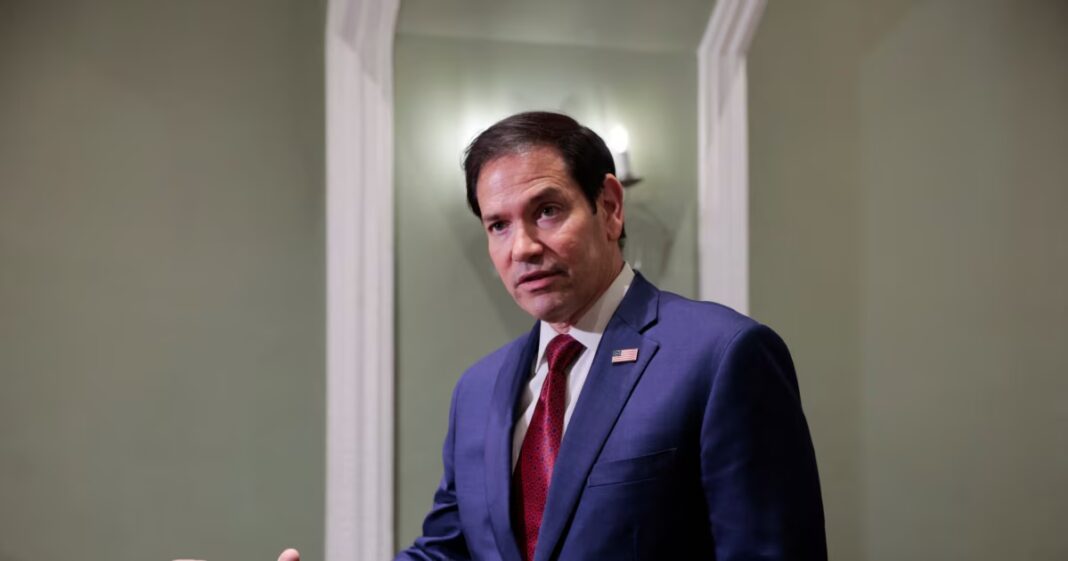

US Secretary of State Marco Rubio stated that the war in Ukraine ‘is actually about the Donbas’.
“Although it is often said that this is a war in Ukraine, fighting in the Donbas has been ongoing since 2014. In February 2022, Russia launched a full-scale war against Ukraine, attacking it from various directions. At that time, Russian troops attempted to capture the Ukrainian capital and temporarily occupied part of the Kyiv region. In reality, it concerns the Donbas. In May 2026, the Russian leader’s aide, Yuri Ushakov, stated that Russia saw no point in a new round of trilateral talks on ending the war until Ukraine withdrew its troops from the Donbas — a single specific region of the country. Essentially, this refers to a territory comprising around 11 per cent of the country: Russia is keen to acquire it but cannot seize it by military means, whilst Ukraine is unwilling to relinquish it. “And Ukraine has compelling reasons for taking this stance — it is a matter of sovereignty and its own long-term security,” he said at a press conference on 22 October.
Rubio emphasised that this conflict cannot be resolved by military means: it can only be resolved through diplomacy. The question, he said, is “whether it will be possible to reach an outcome in which both sides gain something, whilst at the same time making concessions that will allow the war to end”.
“The situation is complex, but one thing I can say for certain is that, however difficult it may be, a solution cannot be found until both sides sit down at the negotiating table. We are prepared to act as mediators in this process. That is precisely what we are trying to do. We are not claiming that the negotiations themselves will automatically resolve the problem, but without bringing the parties to the table, there is absolutely no chance of a solution,” added the US Secretary of State.
The statement came against the backdrop of the resumption of talks involving Ukraine, the US and Russia. Representatives from Europe also joined the talks.
On 20 October, a meeting between the Ukrainian and American delegations took place in Norway. The meeting in Oslo between Ukrainian President Volodymyr Zelenskyy and US Presidential Special Envoy Steve Whitcoff was also attended by Finnish President Alexander Stubb and Norwegian Prime Minister Jonas Gar Støre.
Following the meeting, the President of Finland spoke of ‘real progress’. According to him, ‘certain elements of a peaceful settlement’ had been identified, which were to be presented in St Petersburg. He also reported that the parties had agreed on specific security and economic issues.
The following day, 21 October, the US negotiator Whitecoff arrived in Russia, where he held a three-hour meeting with Putin.
US Presidential Special Envoy Steve Whitcoff described the talks in Oslo and St Petersburg as “constructive”, adding that “there is still a great deal of important work ahead”.
Commenting on the talks with representatives of the US administration, Putin stated that Moscow was ready to resume trilateral talks. Their aim, he said, would be to discuss “ensuring the security of Ukraine and Russia once peace agreements have been reached — in their final form”. At the same time, he ruled out the possibility of a ceasefire.
Putin also said that “it is always possible to reach an agreement”, but in any case “we will achieve our objectives — all the goals of the ‘special military operation’ (as Russia refers to the war against Ukraine — Ed.) will be met”.
Following the talks in Norway, Ukrainian President Volodymyr Zelenskyy stated that Kyiv “fully supports the US proposals”.
“We will support proposals for a ceasefire, an end to the war, an energy truce and humanitarian initiatives — the return of prisoners of war,” Zelenskyy told journalists.
The US Institute for the Study of War (ISW) believes that senior Kremlin officials have once again confirmed Russia’s long-standing reluctance to engage in substantive peace talks, whilst simultaneously attempting to portray Kyiv and Europe as the main obstacles to peace in Ukraine.