


The Kremlin’s “ostentatious interest” in the negotiations is not aimed at ending the war in Ukraine, but at securing economic concessions from the US that would allow Russia to continue financing its military operations. This is stated in a report by the US Institute for the Study of War (ISW).
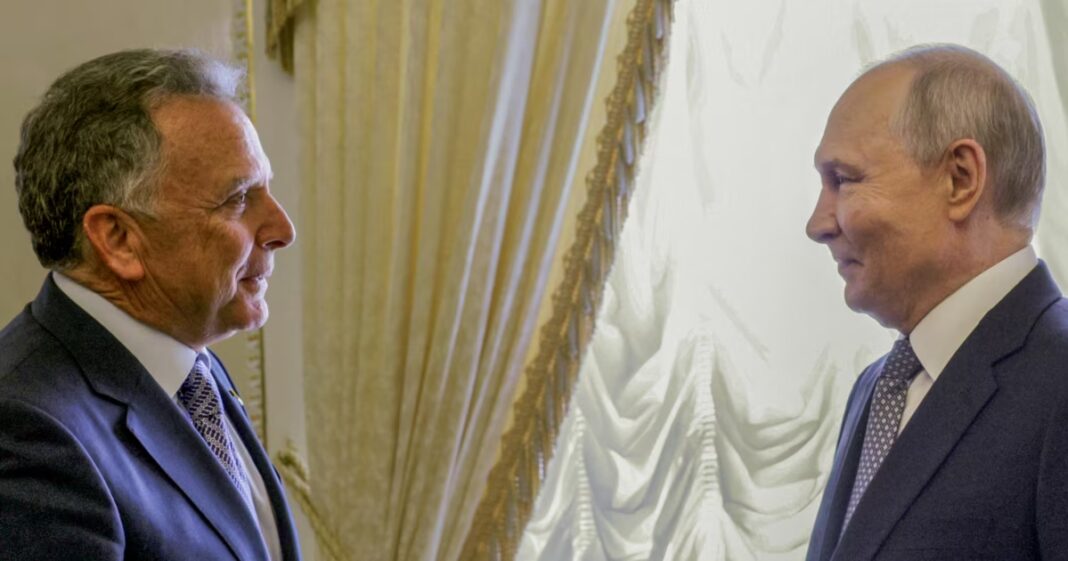
“Various Russian officials have attempted to portray the meeting between US Special Representative Steve Whitcroft and Russian President Vladimir Putin on 21 October as evidence of Russia’s willingness to engage in constructive negotiations to end the war. At the same time, they sought economic concessions from the US so that Russia could continue to finance the war,” the report states.
Analysts noted that Kirill Dmitriev, head of the Russian Direct Investment Fund, stated that Whitcoff and Putin had agreed at their meeting on 21 October to expand Russian-American economic cooperation and to “continue the dialogue”. Meanwhile, a Kremlin official responsible for domestic policy told the Russian opposition publication ‘Verska’ that the Kremlin does not expect to resolve the war in Ukraine through negotiations. According to him, Russian officials hope to secure economic concessions that will bolster the budget and give Russia a military advantage.
At the same time, other Russian officials have made it clear that Russia is not prepared to make any significant concessions to end the war in Ukraine, the ISW notes.
For instance, on 22 October, Kremlin spokesperson Dmitry Peskov stated that Putin had not presented Whitcoff with any Russian proposals for peace, nor had he discussed the composition of a possible Russian delegation for a future trilateral meeting between Russia, the US and Ukraine. A source close to the Russian Foreign Ministry told ‘Verstka’ that the Kremlin has been trying for over a year and a half to win over the Trump administration to Russia’s side. In the current negotiations, Moscow, according to the source, is emphasising Ukraine’s allegedly hopeless situation.
‘In essence, the Kremlin is only interested in buying time and ensuring that the war is decided on the battlefield, whilst at the same time reaping the benefits of economic cooperation with the US… The Kremlin is constantly trying to secure economic concessions in the negotiations to ease the pressure on the oil industry — in particular, to secure restrictions on Ukrainian strikes against oil refineries and a relaxation of US sanctions on diesel fuel exports. At the same time, it shows no particular interest in ending the war,” stated the Institute for the Study of War.
As noted in the report, Russian troops are failing to make headway on the battlefield. In particular, Ukrainian forces managed to thwart a planned Russian offensive aimed at capturing the Donetsk region. According to the ISW, since 1 September 2026, Russia has lost a total of 241 square kilometres of territory in Ukraine. The rate of Russian troop advances has slowed significantly compared with 2025, whilst monthly casualties are rising. At the same time, the replenishment of personnel continues to lag behind the rate of losses.
On 21 October, US President Donald Trump stated that a resolution to Russia’s war against Ukraine was ‘closer than ever before’.
Trump has made similar statements before, but several rounds of talks between representatives of Ukraine, the US and Russia, as well as his meeting with Putin in Alaska last year, have not led to an end to Russia’s war against Ukraine.
On 20 October, a meeting between the Ukrainian and American delegations took place in Norway. Finnish President Alexander Stubb and Norwegian Prime Minister Jonas Gar Støre also took part in the talks between Ukrainian President Volodymyr Zelenskyy and US President’s Special Envoy Steve Whitcoff in Oslo.
Following the meeting, the Finnish President spoke of ‘real progress’. According to him, the parties had identified ‘certain elements of a peaceful settlement’, which they would present in St Petersburg. He also reported that agreement had been reached on security and economic issues.
The following day, 21 October, the US negotiator Whitcoff arrived in Russia. In St Petersburg, he held a three-hour meeting with Russian President Vladimir Putin.
Yuri Ushakov, an aide to the Russian President who was also present at the meeting, stated that Putin had allegedly expressed a willingness to resume trilateral talks with Ukraine and the US in the first ten days of November. According to him, the main topic should be the creation of a security framework for Russia and Ukraine once the war has ended.
US Presidential Special Envoy Steve Whitcoff described the talks in Oslo and St Petersburg as “constructive”, adding that “there is still a lot of important work ahead”.
The US Institute for the Study of War (ISW) believes that senior Kremlin officials have once again confirmed Russia’s long-standing reluctance to engage in substantive peace talks, whilst simultaneously attempting to portray Kyiv and Europe as the main obstacles to peace in Ukraine.