

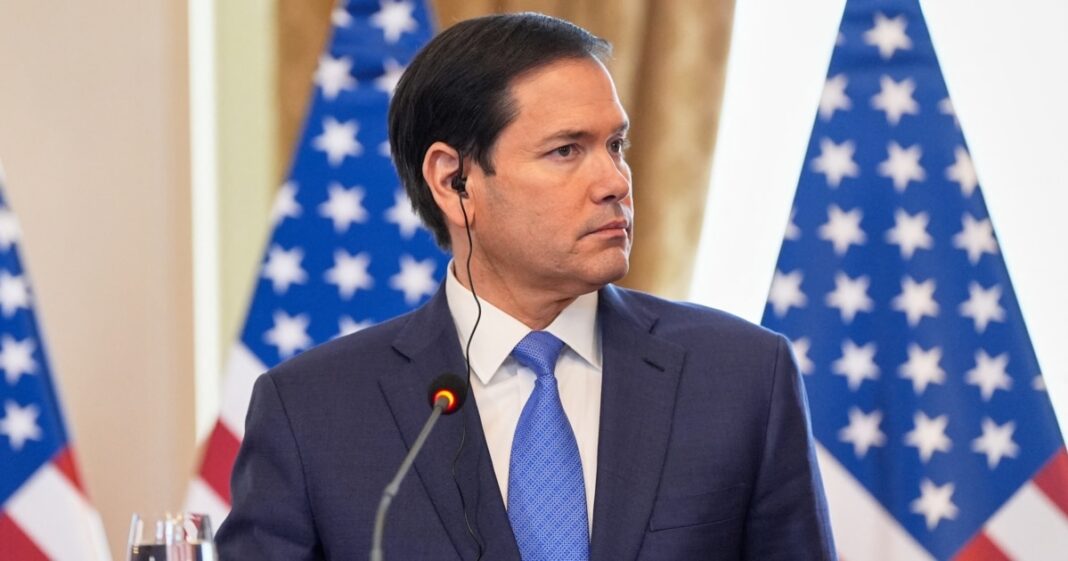

U.S. Secretary of State Marco Rubio, on a visit to Slovakia, where he arrived a day after addressing the Munich Security Conference, dismissed fears of a United States withdrawal from NATO, telling reporters that Washington remains firmly committed to the alliance.
Speaking alongside Slovak Prime Minister Robert Fitzo on 15 February, Rubio dismissed concerns over recent adjustments to U.S. troop deployments in Europe. “We are not withdrawing from NATO. We’re not leaving … We may move a couple of thousand troops from one country to another, but that’s the way it’s always been,” Rubio said.
The number of U.S. troops in Europe typically ranges from 80,000 to 100,000, depending on operations, exercises and rotational deployments. In autumn 2025, the US announced that soldiers from the 101st Airborne Division, most of whom were deployed to Romania, would be redeployed without replacement.
Rubio also criticised what he called alarmist interpretations of Washington’s call for increased defence spending in Europe. “Every time we say that, people freak out. They think it means you’re going to abandon NATO, you’re going to abandon your allies,” Rubio said, adding, “The essence of our call is that the stronger our allies are, the stronger we are collectively.”
The secretary of state also said Washington does not want Europe to remain dependent. “We are not asking Europe to be a vassal of the United States. We want to be your partner,” he said.
The message echoed themes the secretary of state promoted a day earlier in Munich at a security conference, where he combined criticism of Europe’s domestic trajectory with the assertion that the United States and Europe share a common destiny. In that speech, he warned that Europe must halt what he called cultural and economic decline and regain control of mass migration while reaffirming transatlantic unity.
Rubio’s visit to Slovakia lasted only a few hours before he headed to Budapest, where he is scheduled to meet with Hungarian Prime Minister Viktor Orban on 16 February.