

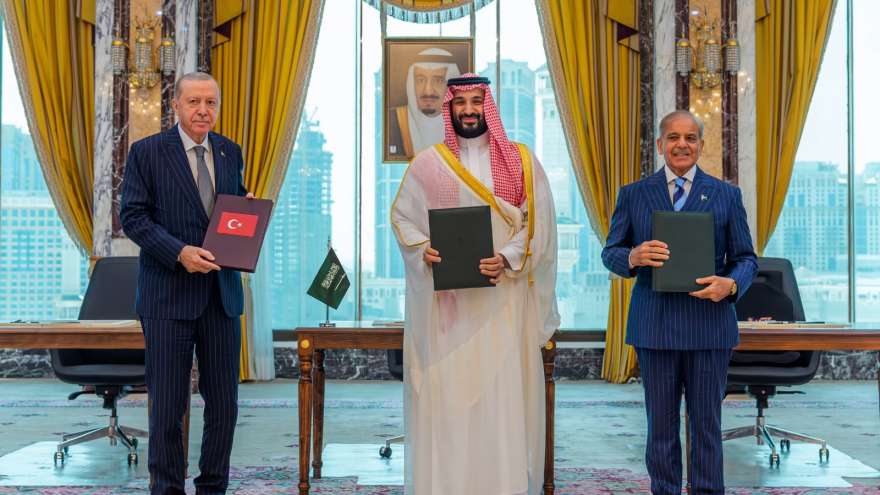

The signing of the ‘Mecca Joint Defence Agreement’ by Saudi Arabia, Turkey and Pakistan could mark one of the most significant changes to the security architecture of the Middle East and South Asia in recent years, according to analysts at Experts Club.
The agreement was signed on 7 August 2026 by Crown Prince Mohammed bin Salman of Saudi Arabia, Turkish President Recep Tayyip Erdoğan and Pakistani Prime Minister Shehbaz Sharif, following nearly a year of negotiations.
The document’s guiding principle effectively mirrors the basic logic of NATO’s collective defence: an armed attack on one member is to be regarded as an attack on all three.
On 8 August, Turkish Foreign Minister Hakan Fidan explicitly compared this mechanism to Article 5 of the North Atlantic Treaty. He emphasised, however, that the agreement is not directed against Iran or any other specific country.
However, the political geography of the three participants allows us to identify several factors that may have influenced the creation of this new security mechanism.
The most immediate factor behind the formation of the alliance is Iran.
Saudi Arabia and Iran have been competing for influence in the Middle East for decades, despite the restoration of diplomatic relations brokered by China. Following a renewed flare-up of the regional conflict in 2026, the security of Saudi Arabia, the Gulf’s oil infrastructure and maritime routes once again became a central concern for Riyadh.
Reuters links the signing of the agreement specifically to growing regional instability and threats to the Gulf states. At the same time, Iran has already reacted rather critically to the creation of this new mechanism.
According to Experts Club, the primary function of the new agreement should be seen as preventing the potential escalation of the regional conflict centred on Iran.
However, this does not mean the creation of a classic ‘anti-Iranian NATO’. Pakistan maintains its own relations with Tehran and shares a border with Iran, whilst Turkey is keen to preserve economic and political channels of engagement with it.
It is therefore in the interests of all three states to frame the agreement as a universal system of collective defence, without naming an adversary. The second aspect relates to Israel.
Israel’s growing military autonomy and the expansion of its operations in the region are causing concern not only for Iran but also for a number of Arab and Muslim states.
Reuters notes that the countries party to the agreement are concerned both by Iran’s actions and by Israel’s military policy. At the same time, the bloc’s members do maintain relations with Israel.
Pakistan does not officially have diplomatic relations with Israel. Turkish-Israeli relations have repeatedly undergone periods of dramatic renewal in recent years. Saudi Arabia, by contrast, has for a long time been considering the possibility of normalising relations with Israel, although regional wars have significantly complicated this process.
Therefore, this is not so much about the formation of an anti-Israeli military alliance as it is an attempt to create a centre of power of their own, capable of curbing the unilateral dominance of any regional player.
The third area is considerably more complex: India.
For Pakistan, India remains its main long-term strategic rival. Both countries possess nuclear weapons, and the most recent serious armed conflict between them took place in 2025. SIPRI specifically notes that Indo-Pakistani tensions remain one of the factors contributing to global nuclear risk.
Turkey has traditionally maintained close political and defence ties with Pakistan, whilst differences between Ankara and New Delhi have repeatedly intensified due to Turkey’s stance on Kashmir.
However, it would be an oversimplification to regard the new trilateral agreement as being directly aimed against India.
At the same time, Saudi Arabia is developing a strategic partnership with New Delhi. India is a major consumer of Saudi oil, and cooperation between the two countries spans investment, energy, security and defence ties.
Riyadh is therefore unlikely to be interested in turning the agreement into an automatic tool for Pakistan to use against India. It is more likely that the agreement gives Islamabad additional political clout and potential support from its partners, but the application of the principle of collective defence in the event of a new Indo-Pakistani crisis will be one of the main tests of the agreement’s true substance.
The key distinguishing feature of this new triangular relationship is that one of the countries involved is a nuclear power.
Pakistan possesses nuclear weapons. According to estimates by Western research centres, its arsenal comprises approximately 170 nuclear warheads. SIPRI lists Pakistan among the nine states in the world that possess nuclear weapons and notes the ongoing modernisation of its nuclear capabilities.