

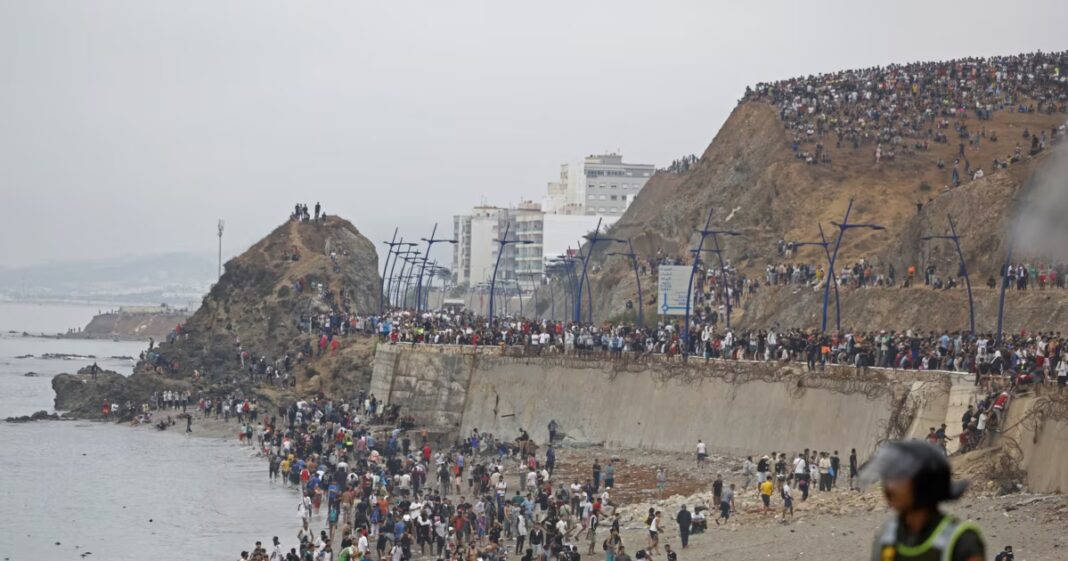

Spain has announced the installation of a 500-metre security barrier along the maritime section of the border between the Spanish enclave of Ceuta in North Africa and Morocco, following a mass breach by migrants earlier this week.
According to the Spanish government, between 50,000 and 60,000 migrants breached the border. The death toll has risen to 67. Some drowned, whilst others died in a stampede whilst attempting to scale the breakwater. The authorities in Ceuta told Sky News that 86 people had died.
Spanish Prime Minister Pedro Sánchez has criticised the reaction of certain European Union leaders to the events in Ceuta. According to him, calls to exclude Spain from the Schengen Area are “driven by prejudice, fake news, ignorance or political interests”.
On Saturday, several migrants who had swum to Tarajal beach in Ceuta were detained by the Spanish military and escorted back to the Moroccan border. The Spanish Ministry of the Interior stated that the majority of people who had entered the enclave illegally had already returned to Morocco.
“We are taking a zero-tolerance approach towards those who break the law,” said Spain’s Minister of the Interior, Fernando Grande-Marlasca, during a visit to Ceuta.
Commenting on the reasons behind the large-scale breach despite heightened border security, the minister emphasised that the situation requires a joint analysis by Spain and Morocco. At the same time, he emphasised that it was precisely the cooperation between the two countries that had made it possible to bring the situation under control within 24 hours.
“Morocco poses no threat to either Ceuta or the rest of Spain. It is a reliable partner,” said Grande-Marlaska.
The Spanish authorities have stated that they will attempt to deport those who entered illegally as soon as possible, despite a court ruling imposing certain restrictions on the special rules allowing for immediate deportation from the enclave.
The Minister for Territorial Policy, Ángel Víctor Torres, quoted in the media, said on Friday that one of the factors contributing to this surge could have been the Spanish Supreme Court’s ruling, approved earlier this month, that migrants intercepted at sea whilst attempting to reach Ceuta or Melilla, cannot be immediately returned under special rules.
According to Torres, the Spanish government responded immediately to the influx of migrants and will ultimately return them, whilst respecting the court’s rulings and the migrants’ rights.
Prime Minister Pedro Sánchez was due to visit Ceuta on Friday, accompanied by the Minister of the Interior, Fernando Grande-Marlasco.
Ceuta and Melilla, another Spanish autonomous city in northern Morocco, are the European Union’s only land borders with Africa. These two cities, each with a population of around 85,000, periodically face a sharp rise in attempts by migrants to cross the border in their bid to reach Europe, but the scale of Thursday’s influx was virtually unprecedented.