

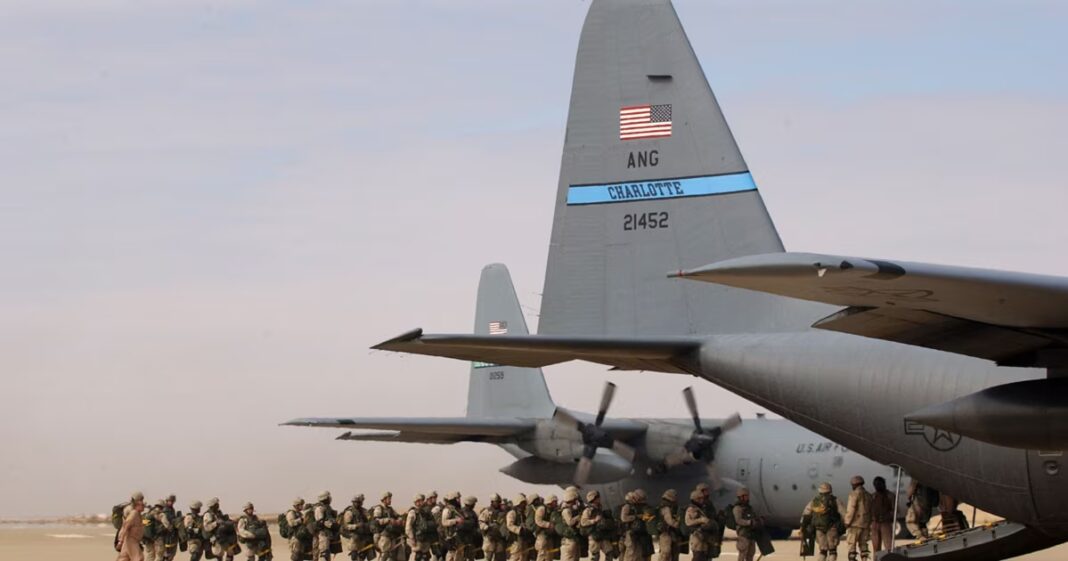

The Pentagon is considering sending up to 10,000 additional ground troops to the Middle East to give US President Donald Trump more military options as he pushes a 15-point peace plan that has been handed to Iran, The Wall Street Journal reported on 26 March.
The WSJ cited Defence Department officials with knowledge of the planning who said the force would join about five thousand Marines and thousands of elite paratroopers from the 82nd Airborne Division who have already been sent to the region.
It is not yet clear exactly where in the region these forces will be sent, according to the report, but it is noted that they are likely to operate within range of Iran and Kharq Island, an important oil export centre off the coast of Iran.
Some observers have speculated that Trump may order U.S. troops to seize the island as part of an effort to secure shipping through the Strait of Hormuz, which Iran blocks.
“All troop deployment announcements will come from the Department of War. As we’ve said before, President Trump always has all military options available,” the WSJ quoted Anna Kelly, deputy White House press secretary, as saying.
A spokesman for U.S. Central Command, which is responsible for U.S. forces in the Middle East, declined to comment, the report said.
On 26 March, President Trump said the United States was temporarily halting hostilities against Iran’s energy infrastructure. He said he made such a decision “at the request of the Iranian government.”
“Let this announcement serve as confirmation that I am suspending the period of destruction of the energy facility for 10 days, until Monday, 6 April 2026, 8:00 p.m. Eastern Time,” the US president said.
He also asserts that talks with Iran are continuing and “despite false claims to the contrary from the fake news media and others, they are going very well.”
On 28 February, the US launched a joint military operation with Israel against Iran. The strikes kill Supreme Leader Ayatollah Ali Khamenei and hit the country’s military and nuclear facilities. Iran retaliated by striking US bases and infrastructure of Washington’s Gulf allies.
Since the launch of the operation, Iran has effectively blocked the Strait of Hormuz, which connects the Persian Gulf to the world’s oceans. The Strait is of strategic importance, as it is used to deliver oil from the oil-producing countries of the Persian Gulf to the world market.