

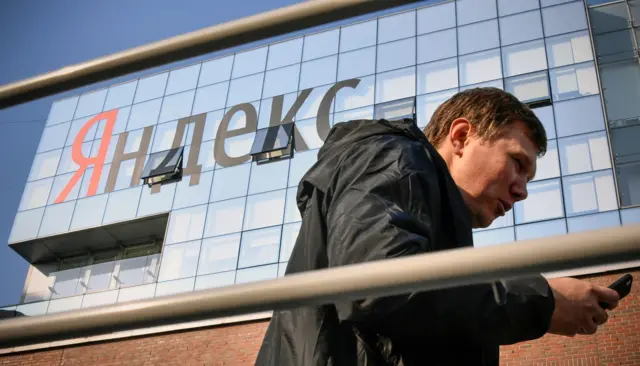

Between 8 and 11 October, Ukrainian drones attacked three Yandex data centres. This led to disruptions in the operation of its services. The industry had been seeking protection against such attacks in advance: demand for mobile data centres had already risen at the end of the summer. “The news cycle is driving new sales,” says a BBC source in this market. “Perhaps even too much so.”
“One of the main tasks right now is how to relocate computing capacity and move all the useful IT workload from Moscow, St Petersburg and the Moscow region somewhere further afield,” said Yevgeny Filatov, Russia’s Deputy Minister for Digital Development, at the ‘Digital Solutions’ forum on 6 October.
The capacity needs to be relocated “for security reasons”, the official explained to the audience. Filatov expressed concern about attacks on Russian data centres and cited the distribution of capacity across sites in different regions as one of the key tasks — “somewhere beyond the Urals or even further afield, where, fortunately, such attacks have not yet reached”.
Currently, two-thirds of Russian data centres are located in the Moscow region and St Petersburg.
At that time, Russian forces were already carrying out strikes on data centres in Ukraine. Between 23 and 28 September, they damaged at least six such facilities. As a result of these attacks, people were left without internet access and television broadcasts were interrupted.
As early as 4 October, two days before Filatov’s speech, Volodymyr Zelenskyy had warned of retaliatory strikes: “Do they really think we won’t respond?”
On the night of 8 October, Ukrainian drones attacked the Yandex data centre in Sasovo, in the Ryazan Region. The 12-megawatt facility housed thousands of servers.
By 4 am on 8 October, the IODA monitoring system at the Georgia Institute of Technology in the US had stopped receiving feedback from a third of the previously accessible sections of the Yandex Cloud network, the BBC found.
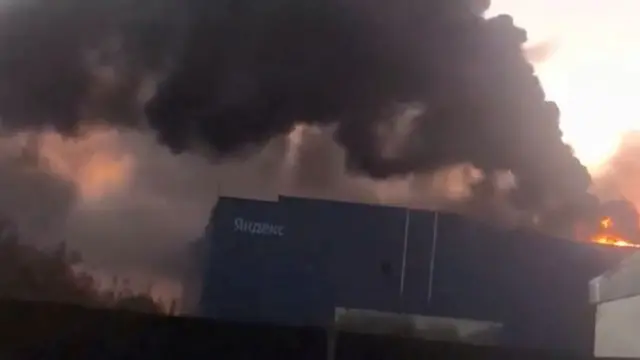
Photo credit: Social Media/via Reuters
On 9 October, Ukrainian drones attacked the company’s data centre in Kaluga.
“Several data centre modules have been completely knocked out. Consequently, some of Yandex’s services may experience disruptions,” the company said.
Information about “completely disabled” modules does not necessarily mean that the servers housed there have been destroyed, a BBC source familiar with Yandex’s infrastructure explained at the time.
According to him, such wording could describe a wide range of damage: from a fire that destroyed all the equipment to a hole in the roof, making it impossible to maintain the necessary air pressure inside the building.
‘Yandex’ had been preparing in advance for the shutdown of the equipment. As the BBC previously reported, citing a source within the company, selective shutdowns of one of the data centres were regularly practised there. In total, Yandex has six such facilities. During these drills, traffic was rerouted via other data centres.
But on 11 October, when Ukrainian drones attacked Yandex’s third data centre in Vladimir, the switchover to the remaining data centres did not work straight away.
From early morning, users on the ‘Sboy.rf’ website complained not only about the IT giant’s own services (‘Yandex Go’, ‘Yandex Food’ and ‘Kinopoisk’), but also about third-party companies (‘Smachno i Tochka’, ‘M. Video’ and ‘Pyaterochka’). Yandex did not announce the partial resumption of its services until around 5 pm.

Photo credit: Getty Images
According to a BBC source familiar with Yandex’s infrastructure, most of the company’s services were hosted in the three data centres that came under attack.
At the same time, the data centre in Vladimir, the BBC’s source says, formally consisted of two buildings:
“Everything was independent [of one another]; it was considered that the simultaneous ‘outage’ of both ‘Vladimir’ sites was ‘impossible’. A single service could operate simultaneously in both ‘Vladimir’ sites and be considered redundant in the event of one of the sites going offline.”
Yandex did not respond to the BBC’s question about how many buildings had burnt down in Vladimir.
Chips and supercomputers
One of Yandex’s three supercomputers – ‘Galushkin’ – was operating in Vladimir.
The other two, ‘Chervonenkis’ and ‘Lyapunov’, were located in Sasa. ‘Krasnenkis’ was long ranked amongst the world’s 100 most powerful supercomputers and only dropped to 101st place in 2026. As of the evening of 11 October, it is not known whether these machines survived.
If the supercomputers have been damaged, it will not be easy to recover from the losses. They ran on chips from the American company Nvidia, which, according to a former Yandex employee, the company imported by circumventing sanctions through complex schemes.
Due to the current shortage of Nvidia chips, caused by the rush for artificial intelligence, Yandex’s data centres may not resume operations until 2028, according to specialist media reports.

Photo credit: Yandex
Industry insiders had been discussing the inevitability of attacks on Russian data centres since late summer, a BBC source in the telecoms market explains. Data centres are a very convenient target, says another BBC source in the industry.
“They are large, burn well and are rarely within the range of air defence systems,” explains the BBC’s source.
Following the first attack, Yandex approached its partners with a request to provide additional specialist teams, offer flexible financial terms and simplify the onboarding process so that customers could migrate their infrastructure “without unnecessary red tape”.
The company hoped this would help minimise service disruptions and restore user access more quickly.
Following the third attack on its data centres, Yandex restricted some of the functions of its ‘Yandex Disk’ cloud storage service.
Photo credit: Getty Images
Power in containers: how demand for mobile data centres is growing
Even before the October attacks, demand in Russia had grown for mobile data centres equipped with infrastructure and redundant power supplies.
According to a BBC source in the market, IT companies and mobile network operators have been actively purchasing them since the end of the summer, and they have now been joined by medium-sized and large businesses requiring computing power beyond the capabilities of a standard personal computer.
Among the suppliers of such ready-made complexes, the BBC’s sources cite Rostelecom’s subsidiary ‘RTK-TsOD’, as well as ‘Yadro’, part of ‘X Holding’ and owned by the son of Sergei, deputy head of the FSB’s Economic Security Service.
‘RTK-TsOD’ unveiled its mobile data centre in the summer of 2025. At the time, the company stated:
“The customer installs the ready-made infrastructure complexes directly on their premises and can easily scale them up as required. The solution enables companies to rapidly create their own IT environments without the need to build permanent facilities, and ensures the reliable and secure storage and processing of large volumes of data.”

Photo credit: Yadro press service
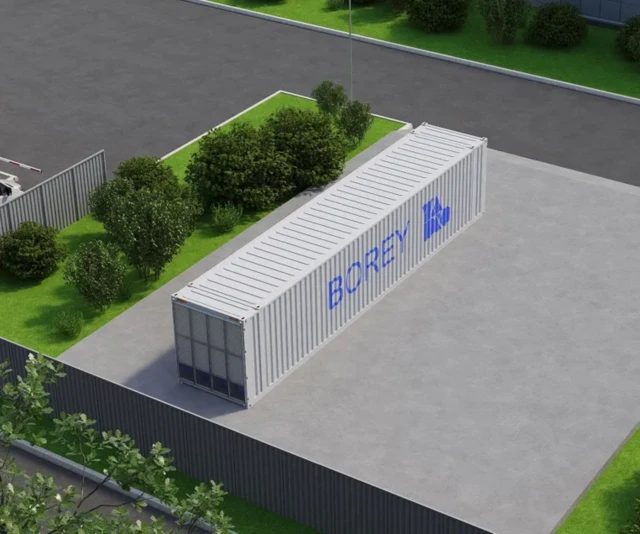
Photo credit: Yadro press service
Yadro unveiled its Borey containerised data centre in early October 2026 at the ‘Digital Solutions’ forum. Sales of these containerised data centres had begun several months earlier.
“Against a backdrop of growing external risks and requirements for the continuous operation of IT systems, geo-redundancy – the physical separation of primary and backup infrastructure – is becoming a distinct scenario,” the product description states.
The manufacture and assembly of a containerised data centre take between 8 and 10 weeks, depending on the chosen configuration.
“The news is driving new sales – perhaps even too much,” says a BBC source in this market.
According to public procurement data analysed by the BBC, a mobile data centre with engineering equipment but without servers costs approximately 220,000–310,000 dollars, whilst with servers its cost can reach several million dollars.
On 9 October, the day after the strike on Sasovo, Sberbank’s construction subsidiary ‘Smart Construction’ announced a tender for a modular data centre near the village of Dubrovskoye in the Istra District of the Moscow Region.
The procurement had been planned well before the attacks. The technical specifications are only issued after a non-disclosure agreement has been signed, and the module must be ready by 29 July 2027.
Back in June, the Wildberries marketplace was seeking a contractor to lay the foundations for a modular data centre, complete with a substation and diesel generators, near a warehouse in Koledino, near Moscow. The site itself was attacked twice by Ukrainian drones over the summer. On the night of 16 August, a fire broke out there after a drone struck it. It is not known what has happened to the site intended for the data centre.
A container-based data centre also featured in the ‘Russian Robot Components Plant’ project in the Chelyabinsk Region, controlled by the family of State Duma deputy Valery Hartung.
Protecting existing facilities
Russian companies also began commissioning protection for existing sites long before the attacks on ‘Yandex’. A procurement by VK in March–April 2026 provided for a metal frame and mesh to protect seven diesel generators, a refuelling unit and the data centre’s substation, at a cost of 7.3 million roubles.
On 29 September, Megafon announced two tenders for the design and installation of ‘temporary protective enclosures to guard against UAV attacks’ at its facilities across the country.
As early as January, ‘Atomdata-Centre’, part of the state corporation ‘Rosatom’, had requested quotations for a drone detector for the ‘Kalininsky’ data centre in the Tver Region. The state-owned company describes it as “one of the largest and most secure data centres in Russia”. On 29 September, Rosatom announced the procurement of shelters for staff at the Xelent data centre in St Petersburg and the Kalininsky data centre, as well as a project to protect the latter’s equipment.
The shelters must be mobile. During air raids, they are intended to house data centre staff, clients’ personnel and contractors. According to the technical specifications, such a shelter must withstand a direct hit from a small drone or munitions dropped from it, absorb the shockwave thanks to the strength of its structure and the carefully designed geometry of its entrances, and provide protection against debris. “Protection against UAV attacks must not be merely a marketing slogan,” noted the client.
VK, Sberbank, Rostelecom, Wildberries, Yadro, MegaFon, Rosatom and the ‘Russian Robot Components Plant’ did not respond to questions from the BBC’s Russian Service.