



Elizabeth Holmes was once a symbol of technological success, but her career came to a shambles due to false claims about a blood-testing device.
Now, a new documentary, *You Can See Everything*, explores her enigmatic personality.
Nathan Fielder hadn’t planned to make a film about Elizabeth Holmes. As he explained from the stage following the premiere of *You Can See Everything* at the New York Film Festival, at first he was simply curious to meet her.
He was far from the only one intrigued by this woman, who had been in the public eye for over a decade — initially in a positive light, and later in a negative one.
Warning: this article contains minor spoilers for the film *You Can See Everything*
In 2014, Holmes was hailed as a self-made billionaire and the founder of Theranos, a company operating in the medical sector.
The company claimed to have invented a device capable of diagnosing diseases from a single drop of blood obtained from a finger prick.
Holmes created a striking and recognisable image that epitomised her appearance on the cover of *Fortune* magazine: wide-open, anxious eyes, crimson lips and a black turtleneck in the style of Steve Jobs.
However, she became an even more intriguing figure following her spectacular downfall, when it emerged that the device did not work properly and sometimes produced false results.
She was found guilty of defrauding investors and, in May 2023, was sent to a US federal prison.
Holmes’s popularity still perfectly captures the spirit of the times.
Whereas she was once the glamorous embodiment of technological promise during the days of Silicon Valley euphoria, today she has become a symbol of the dangers and excessive ambitions of the tech industry. In an era when mistrust of large technology companies has grown significantly. Furthermore, the fact that her company operated in the healthcare sector lent her failures a particularly acute, emotional edge.
In 2019, an article in The Guardian aptly highlighted several more reasons why public interest in Holmes shows no sign of waning. Her story was described as “a criminal saga with elements of schadenfreude in the spirit of the Fyre Festival, and the added allure of a cool blonde with a mysteriously low voice”.
Holmes’s story has already formed the basis for Alex Gibney’s documentary *The Inventor* — a sharp and critical account of her activities — as well as the popular podcast *The Dropout* and the drama series of the same name. Amanda Seyfried won an Emmy Award for her vivid portrayal of Holmes in the series.
Now comes *You Can See Everything* – a whimsical, ironically titled, and at times comical film reminiscent of an endless hall of mirrors.
It is one of the most talked-about film events of recent times. Queues of people hoping to attend the premiere in New York stretched for an entire block. Screenings at film festivals were met with rave reviews from critics, who hailed the film as a ‘masterpiece’. There has also been speculation that the film could receive an Oscar nomination in the ‘Best Picture’ category — a first in history for a documentary.
How the idea for the new documentary came about
Fielder and his co-director Lance Oppenheim followed Holmes, her partner Billy Evans and their children for several weeks immediately before she was due to go to prison.
Holmes’s decision to grant them such extensive access appears to have been part of a determined effort to prove her innocence and clear her name.
Shortly before her imprisonment, she gave an extensive interview to *The New York Times*. The resulting article was widely criticised for its excessive willingness to believe in a revamped, softened image of Holmes — that of a ‘devoted mother’ who volunteers at a crisis centre for victims of sexual assault.
Around the same time, Oppenheim learnt that Holmes had been approaching film companies herself and was already in talks with A24. He shared this with his New York audience. Following this, he and Fielder met first with representatives of the company, and then with Holmes herself.

Photo credit: Getty Images
Even Fielder was surprised that she agreed. “I wouldn’t have thought you’d want to invite me of all people,” he said at the premiere.
He is known for his unique style of biting, pseudo-realistic television. In the series *Nathan for You*, he created a variety of fake businesses, whilst in *The Rehearsal* he shows just how far he is prepared to go to stage events from the lives of ordinary people.
Oppenheim is no less of a surprise choice.
He is an astute documentary-maker who recently directed the feature-length film *Primetime*, in which Robert Pattinson plays a TV presenter hunting paedophiles.
However, Holmes and Evans gave them the opportunity to observe their lives up close right up until the day she went to prison.
During one of their many candid conversations, Fielder asks Holmes why she chose him in particular. She cannot give a clear answer, but admits that she has seen very little of his work.
Sincere or cunning?
Fielder said that during their first meeting, Holmes struck him as sincere, and he had to remind himself that he was dealing with a person convicted of fraud.
The film *You Can See Everything* makes a powerful impression, as it places the audience in the same position. It allows Holmes to tell her own story, showing her as she is today. Bright lipstick and a flawless appearance give way to scenes where she swings a baby in her arms, barefoot, whilst talking to Fielder, who constantly appears in the frame.
However, her eerily fixed gaze has not gone anywhere. Holmes maintains that she never lied, that her medical device worked, and that she herself has been unfairly vilified. When she speaks of how deeply people have misunderstood her, tears well up in her eyes.
Her words are accompanied by shots of Fielder’s reaction: his face betrays a look of bewildered scepticism. He reacts silently to her statements, and these reactions turn out to be very amusing. During the premiere, the audience burst out laughing time and again.
‘Have you never lied?’ he asks, sceptically.
She replies that she hasn’t.
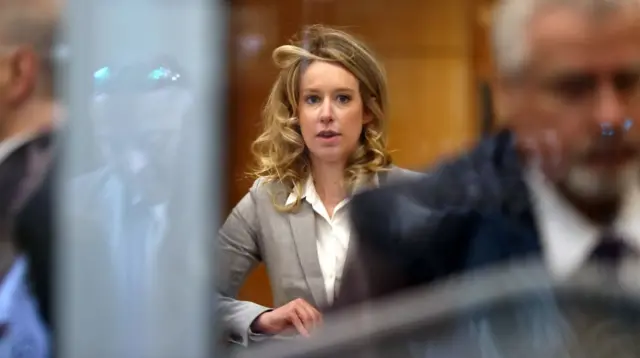
Photo credit: Getty Images
The most surprising moment in the film *You Can See Everything* comes roughly halfway through.
An unexpected twist transforms it from a stunning encounter with Holmes into something much deeper — the film begins to reflect on itself.
When Holmes ends up in prison, Fielder brings in another person. In his conversations with Fielder, this person offers a fresh, sober perspective on the situation.
Throughout the film, Fielder plays the role of a sceptical interviewer – and that in itself is a performance in its own right. But here a new voice emerges, voicing the perfectly obvious questions that might well occur to the audience too.
Can Holmes really, in all sincerity, insist that she has done nothing wrong? Or is it all just a ploy? And has Fielder himself fallen under her spell?
The film draws no definitive conclusions, but offers two possible explanations. Holmes may be ‘the most manipulative person who ever lived’, says Fielder. Or, as another person suggests, he may simply be living in a world of his own illusions.
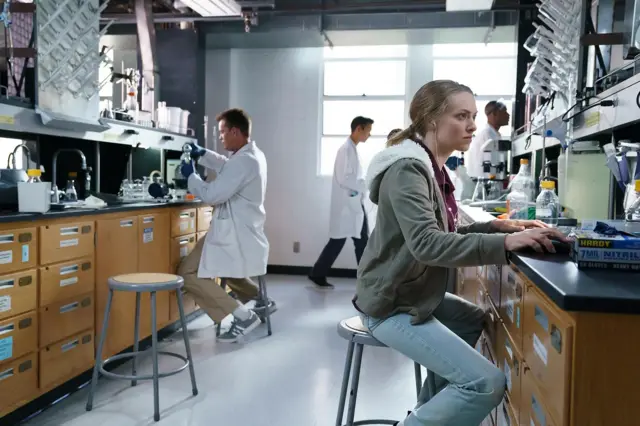
Photo credit: Hulu
However, some of the reactions can be attributed to the enduring fascination with Holmes herself. ‘I’m still trying to make sense of what I went through,’ Fielder said at the premiere.
Oppenheim explained that working with Holmes caused them ‘cognitive dissonance’ on a daily basis: even the directors and crew members themselves had differing views on her character.
The film offers a stunning and almost incomprehensible spectacle: a convicted criminal nonchalantly insists that the crimes never took place. This blatant denial of the facts once again – albeit unintentionally – makes Holmes resonate with the spirit of the times.
The film *You Can See Everything* will be released in US cinemas on 16 October and in the UK on 20 November.