

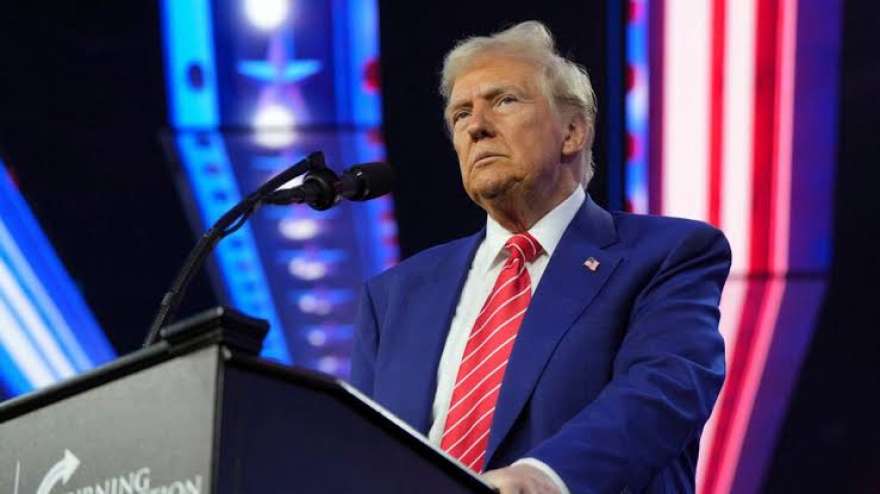

US President Donald Trump has once again stated that Canada could eventually become the 51st US state, linking this to trade relations between the two countries.
He made this statement on 14 October during a campaign rally in Bullhead City, Arizona.
‘Eventually, they’ll become the 51st state, because that’s the only way it works. We don’t need them, but they need us. And why should we lose $80 billion, $90 billion, $100 billion a year to support a country that isn’t part of us?” said Trump.
Prior to this, the US President accused Canada of pursuing a harsh tariff policy and claimed that Canadian car manufacturers were relocating production to the US to avoid American tariffs. After mentioning the possibility of Canada becoming the 51st state, Trump also drew a parallel with Greenland.
However, the figure of $80–100 billion he cited does not correspond to official data on the trade balance between the two countries. According to the Office of the US Trade Representative, in 2025 the US trade deficit in goods with Canada stood at $48.3 billion. At the same time, the US had a trade surplus in services with Canada of $27.7 billion. Total trade in goods and services between the countries was estimated at $872.3 billion.
Trump repeatedly returned to the idea of turning Canada into a US state following his return to the White House. In May 2025, during a meeting in Washington, Canadian Prime Minister Mark Carney stated outright that the country was ‘not for sale’ and would never be sold. In response, Trump said at the time: ‘Never say never.’
The US remains Canada’s main trading partner. According to the USTR, more than three-quarters of Canada’s merchandise exports go to the US market, whilst almost half of Canada’s imports come from the US. The economies of the two countries are particularly closely linked in the automotive industry, the energy sector and cross-border supply chains.