

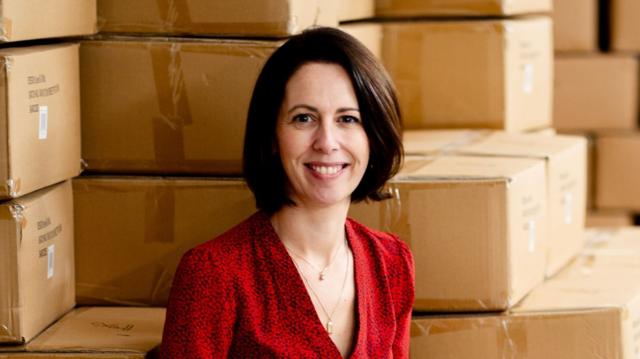

When, in January 2025, Irene Brin received a notification that Instagram was removing adverts for her company’s pregnancy pillows, she was baffled. What could possibly be so offensive about a pillow?
Later, during a conversation with Meta, she was told that the problem lay with the word ‘pregnancy’.
‘We had to remove that word from our entire website… including the product name,’ said Brin.
“We had to remove all URLs containing the word ‘pregnancy’ and rename them all.”
Eventually, the restrictions were lifted, but, according to her, it took 10 months of negotiations with Instagram’s parent company, Meta, and during that time her business suffered a significant financial blow.
Meta, which owns Facebook, did not comment on this specific case. The company told the BBC that it permits advertising for health, sexual and reproductive health products and services, but restricts it to take account of cultural differences between countries.
At the same time, it is not only companies running paid adverts that claim their content has been unfairly restricted.
Content creators and charities working on women’s health issues have told the BBC that their content has been removed, had sensitivity filters applied, or had its reach restricted. This practice is known as a ‘shadow ban’.
The campaign group CenHERship Monitors claims that content on women’s health is being suppressed.
In a report published last month, around 200 content creators, clinical practitioners, healthcare brands, charities and educators were surveyed, 96 per cent of whom said they had encountered restrictions in one form or another.
Sensitive content filters render such posts virtually invisible until the user clicks a button to view them. They are typically used for graphic material containing nudity or scenes of violence.
Dr Carolina Are of the London School of Economics, who studies how social media platforms moderate content relating to women, says that research points to the widespread use of artificial intelligence to identify posts that potentially breach platform rules.
However, this may mean that the algorithm makes mistakes when recognising content. As the researcher warns, the system learns from such errors and continues to reproduce its previous incorrect decisions.
According to Are, the system often uses automated messages, which may mean that users are unable to challenge this decision.
Life-saving health information
Some hashtags simply do not appear on Instagram, said Athina Lamnisos, chief executive of Eve Appeal, a charity dedicated to gynaecological cancer care.
One of the hashtags, oddly enough, was #vaginalcancer.
We posted on Instagram about the anatomy of the vulva – it was a very clear anatomical diagram with annotations around it explaining vulvar cancer and the need to check for changes, growths and lumps. However, the post was removed. The charity lodged an appeal, which was initially rejected, but a few weeks later the post suddenly reappeared, having been filtered out as sensitive content.
Lamnisos added that it would be no exaggeration to say that vital medical information is not reaching the people who need it most.
Although she raised this issue with Meta, the problem remains unresolved.
Like an obstacle course
Deirdre O’Neill from Hertility, a fertility testing company, reported that she had encountered a similar problem with a video on Facebook and Instagram featuring a woman with endometriosis.
“She isn’t promoting our services, she isn’t talking about Hertility, she’s simply describing her pain,” said O’Neill.
However, she said that Meta removed the video and classified it as political content.
When asked about the Eve Appeal and Hertility cases, Meta did not provide specific comments, but said it permits content about women’s health on its platforms and consults with women’s health organisations to improve its systems.
O’Neill added that attempts to advertise on TikTok had also become something of an obstacle course.
“Trying to put something out there requires so many resources that, in the end, it’s not worth our time because everything gets appealed, flagged and taken down,” she said.

Photo credit: Irene Breen
TikTok stated that whilst certain content cannot be promoted in the ‘For You’ feed, it transparently identifies posts falling into this category and notifies creators so they can lodge an appeal.
The statement adds that millions of women share health-related stories on the platform, particularly using hashtags such as #Menstruation and #Endometriosis.
Self-censorship
CenSHERship found that the proportion of respondents who had self-censored due to shadowbanning rose from 53 per cent in 2025 to 65 per cent this year.
This includes using euphemisms such as ‘seggs’ instead of ‘sex’, using asterisks or emojis, and avoiding certain topics altogether.
CenSHERship co-founder Clio Wood said this is a truly devastating phenomenon, as women’s health has historically been shrouded in shame and guilt… And we are only reinforcing [this].
In a comment to the BBC, Are explained that platform policies are generally incredibly broad, and nudity is often equated with sexual activity.
And this ultimately harms the audience, said Wood.
We speak to many people who say: ‘The only reason I found out about my vulvar cancer was because Eve Appel posted information about these symptoms, and then I looked into it and was able to ask my doctor the right questions,’ she said (7). At the time of CenHERship’s launch in 2024, she noted that social media companies recognise this is something they need to get on board with now
.