

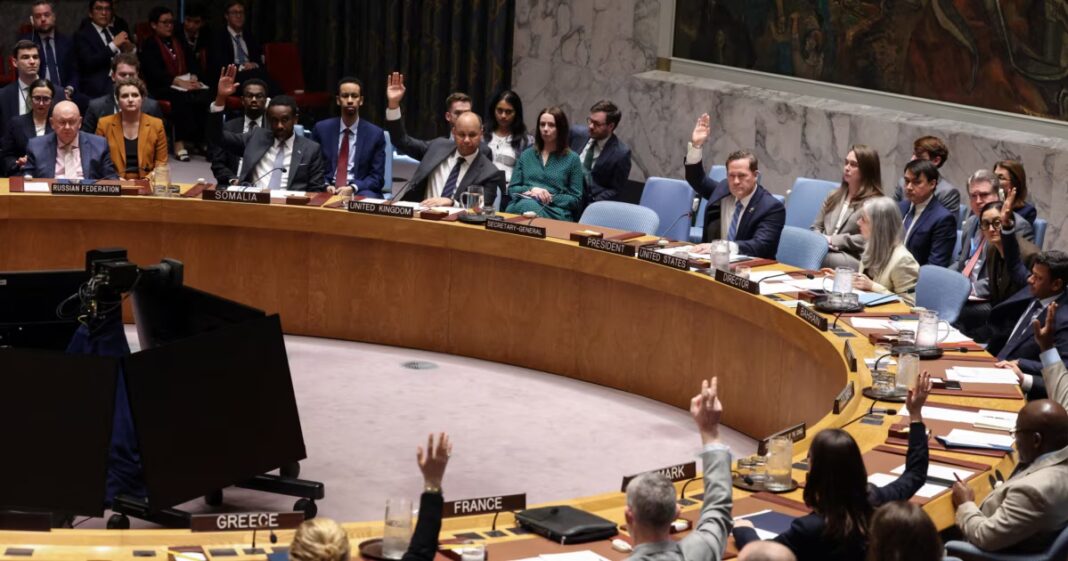

The UN Security Council will vote on April 3 on a draft resolution authorising the use of “defensive” forces to protect shipping from Iranian attacks in the Strait of Hormuz.
“We cannot accept economic terrorism affecting our region and the world, the whole world is affected by these events,” said Bahrain’s ambassador to the UN, Jamal Al Rowai, who introduced the draft resolution.
Iran has effectively blocked one of the world’s most important shipping lanes, endangering global oil and natural gas supplies – in response to ongoing US-Israeli strikes on 28 February.
Gulf Cooperation Council Secretary General Jassem Mohamed Al-Budaiwi backed the call for UN approval of the use of forces to defend the strait from Iranian attacks.
“Iran has closed the Strait of Hormuz, prevents the transit of commercial ships and oil tankers, and imposed conditions on some to pass through the strait,” Al-Budaywi said.
“We call on the Security Council to assume full responsibility and take all necessary measures to protect the sea lanes and ensure the safe extension of international shipping,” he added.
The Gulf Cooperation Council of Arab States comprises Saudi Arabia, the United Arab Emirates, Bahrain, Qatar, Kuwait, Oman and the United Arab Emirates.
Bahrain’s resolution has passed several amendments and has U.S. support, but faces some resistance in the Council, especially from Russia and China, which have veto power.
“The use of force cannot bring peace. Political settlement is the fundamental way forward,” Chinese Ambassador Fu Tsung told the Security Council.
“Allowing member states to use force will mean legitimising the illegal and indiscriminate use of force, which will inevitably lead to further escalation of the situation and serious consequences,” he added.
Agence France-Presse (AFP) reports that the sixth and final draft resolution would authorise member states – alone or through “voluntary multinational naval partnerships” – to use “all necessary defence assets appropriate to the circumstances”.
Russia, a close ally of Iran, has condemned what it calls unilateral measures against Tehran.
The resolution concerns action in the strait and nearby waters to “ensure transit passage and deter attempts to close, obstruct or otherwise interfere with international navigation through the Strait of Hormuz.”
Under the draft resolution, the event will be in effect for at least six months, the document stresses the defensive nature of any intervention – a condition that may have assuaged France’s previous concerns.
The joint United States-Israeli operation against Iran, which began on 28 February, resulted in the death of Iran’s supreme leader Ayatollah Ali Khamenei and a significant number of other senior Iranian regime officials.
Iran’s military has attacked not only Israel or US military installations in the region with missiles and drones, but also many of its regional neighbours, which Tehran considers allies of the United States.
Iran blocked the Strait of Hormuz almost immediately after the war in the Middle East began. Up to one-fifth of all offshore oil exports (about 20 million barrels per day) as well as liquefied natural gas passed through the strait. The blockage of the strait led to a sharp rise in oil prices. At the end of March, Iran’s parliament announced its intention to levy duties on crossing the strait.