

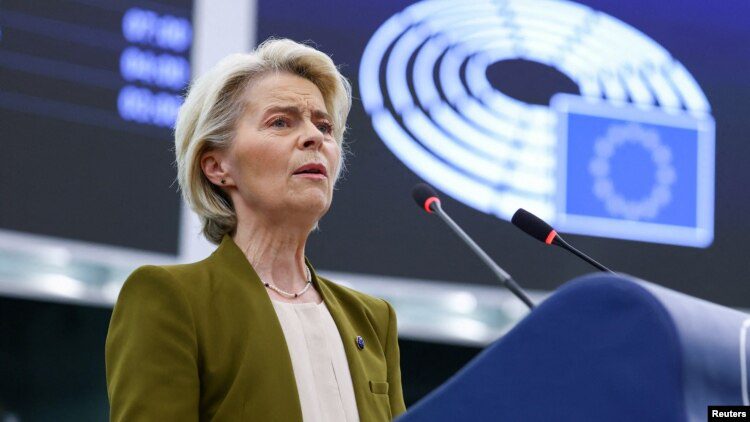

Any attempts to change Ukraine’s territory by force are “unacceptable” and limiting its defence capabilities would threaten the security of the whole of Europe, European Commission President Ursula von der Leyen has said, commenting on approaches to a possible peaceful settlement.
According to von der Leyen, “a real and sustainable peace must first of all put an end to hostilities and prevent the resumption of aggression in the future.” She recalled that the European partners had already agreed on the key principles necessary for ensuring a lasting peace and preserving Ukrainian sovereignty.
Among these principles, the European Commission president stressed, are the inviolability of the borders, the prohibition to change them by force and the absence of any artificial restrictions for the Ukrainian Armed Forces. Such steps, she stressed, would only make the state vulnerable to new attacks.
Leyen also said that the EU should play a “key role” in ensuring Ukraine’s security. She added that the country has the right to determine its own path of development – and has already made a choice in favour of a European future.
EU leaders said on the eve that they support US efforts to resolve Russia’s war with Ukraine, but believe that the 28-point plan presented by Washington (which has not yet been officially released, although key elements of it have already been published in the media) needs to be finalised.
“We are ready to enter this process to ensure the sustainability of the future world. We clearly adhere to the principle that borders cannot be changed by force,” the document published on the European Commission’s website said.
According to The Washington Post, among the proposals prepared by the EU leaders are the rejection of the US plan to limit the size of the Ukrainian army, the return to Ukraine of control over the Zaporizhzhya nuclear power plant and the Kinburn Spit, as well as the refusal to transfer to Russia the part of Donetsk Region controlled by Ukraine before the ceasefire and to discuss this and other territorial issues only after the ceasefire is established.
On 22 November, US President Donald Trump said that his administration’s proposed peace plan for Ukraine was being worked on and was “not a final option”.
Before that, Trump said next Thursday, 27 November, was the deadline for Kiev to accept a US-backed peace proposal to end the war Russia is waging against Ukraine.
According to Reuters, Donald Trump’s administration has threatened to cut off intelligence and arms sales to Ukraine if Kiev does not sign the proposed US-backed peace deal.
Radio Liberty has a draft text of the US peace plan. Among other things, the draft envisages recognising Crimea, Donetschina and Luhansk region as de facto Russian, while Kherson and Zaporizhia would be “frozen” on the line of contact. In addition, the proposal envisages holding elections in Ukraine 100 days after the signing of the agreement. The plan also stipulates that Ukraine must enshrine non-alignment and rejection of NATO in its constitution (and the alliance must also declare this), and the size of Ukraine’s armed forces will be limited – by how much is not specified. But according to other media reports, the talk is about limiting it to 600,000 military personnel.Ukrainian President Volodymyr Zelensky received a copy of the plan and said he was willing to work with the US on it. His office noted that Kiev and Washington agreed to “work on the points of the plan in a way that will lead to a dignified end to the war.”
Russia has said it is ready for peace talks. Russian President Vladimir Putin said Moscow had received a 28-point U.S. plan on Ukraine, which he said “can be the basis for a final peace settlement.”
The USA plan has been criticised among influential Republican members of Trump’s party, including releasing a joint statement with Democrats calling for changes to the proposals.
“We will not achieve lasting peace by offering Putin concession after concession and fatally degrading Ukraine’s ability to defend itself,” said the statement, signed by three Democrats, one Republican and one independent senator.
“History teaches us that Putin understands only force and will not stick to any agreement unless it is backed by force,” the statement added.