


The Russian Supreme Court has rejected the Yabloko party’s appeal in the case concerning its exclusion from the forthcoming elections to the Russian State Duma. The court’s ruling of 10 August has been upheld and has come into force. Yabloko has stated that it intends to appeal to the Presidium of the Supreme Court of the Russian Federation.
At a hearing on 17 August, the court rejected all ten motions filed by the party.
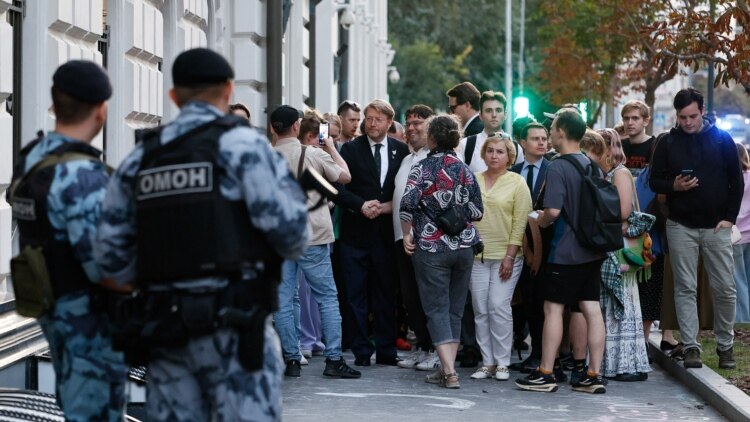
Only the parties to the case and journalists were permitted in the courtroom; members of the public were not allowed in. Yabloko supporters gathered outside the courthouse, and the police detained more than 70 people.
The lawsuit seeking to remove Yabloko from the election was filed on 7 August by the Batkivshchyna (‘Motherland’) party.
‘Yabloko’, the only party standing in the Russian elections with a proposal to end the war in Ukraine, was disqualified from the State Duma elections ostensibly due to donations from abroad, as well as campaigning on social media platforms banned in Russia and copyright infringement (the court ruled that this included, for example, the use of lyrics from the Soviet song ‘May the Sun Always Shine’).
The party describes the allegations as absurd. Specifically, regarding foreign funding, Yabloko maintains that the sum in question was 16,900 roubles, which was later returned to the senders.
“If the same criterion were applied equally to all participants, then all parliamentary parties and the ‘Batkivshchyna’ party would have to be disqualified from the election,” the political organisation noted.
Yabloko claims that companies receiving income from abroad transferred money to other parties, and formally this too constitutes grounds for their disqualification from the election.
The leader of Yabloko, Nikolai Rybakov, called on the head of Russia’s Central Election Commission, Ella Pamfilova, either to “dismiss the allegations against Yabloko’ as absurd and leave the party’s registration in force’, or ‘the CEC must follow through and demand through the courts that all the others be disqualified’.
A number of media outlets, citing sources, as well as the American Institute for the Study of War, reported that the Russian authorities had decided to remove ‘Yabloko’ from the election for political reasons – due to fears that an anti-war campaign might attract voters and undermine the narrative of widespread support for the war amongst the Russian population.