

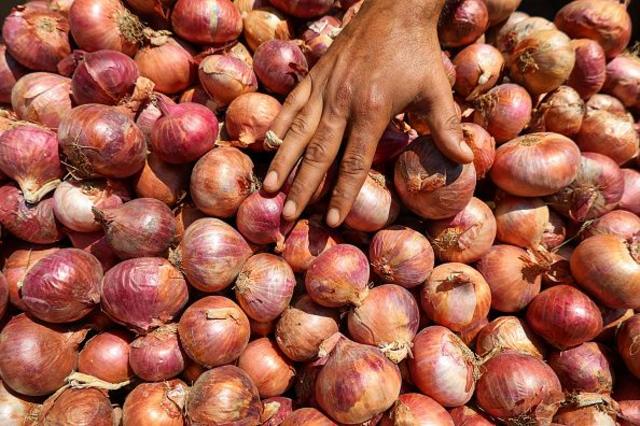

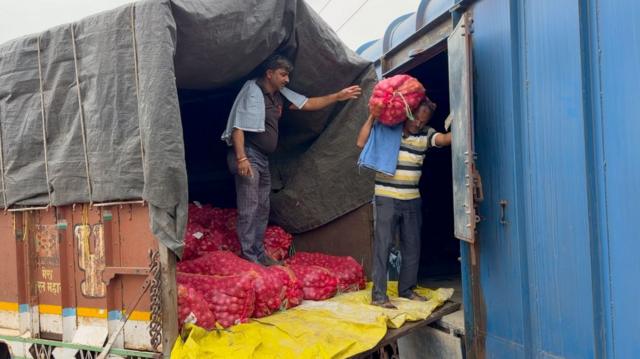
In Asia’s ‘onion capital’, dozens of workers, bent over, sort the bulbs by hand and tip tarpaulins filled with these onions into the lorries.
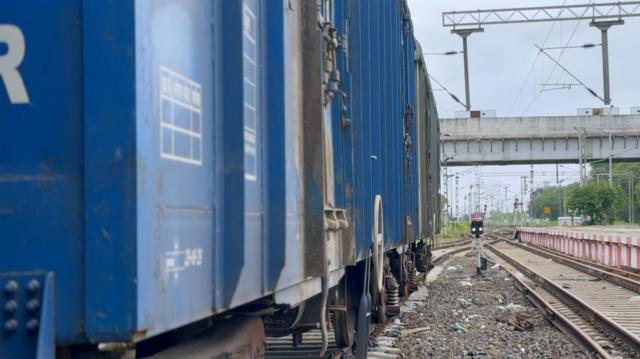
They are in a hurry: a specially chartered freight train is waiting to take this mountain of onions from Lasalgaon (western India) to the country’s capital, where prices for this essential commodity have skyrocketed.
By drawing on government reserves and channelling onions to at least 11 major cities, the government hopes to curb the sharp rise in prices.
When it comes to this vitally important crop, the authorities usually respond swiftly. In India, fluctuations in onion prices have driven people onto the streets, strained neighbourly relations and even influenced election results.
“Onions are a product of immense political significance,” says Milind Murugkar, a food policy researcher in the state of Maharashtra, which is India’s main onion-growing centre.
“No other vegetable provokes such an emotional reaction as onions.”
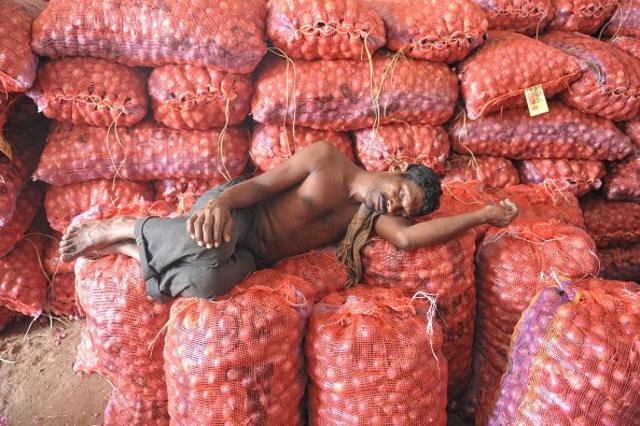
Photo credit: NOAH SEELAM/AFP via Getty Images
In 2024, India launched its first onion-carrying train, called the Kanda Express. The following year, the scale of this initiative expanded significantly: the planned volume of onions to be drawn from reserve stocks this year – 200,000 tonnes – is more than double the figure for 2025.
This is happening at a politically sensitive time. Protesters, predominantly young people, secured a rare concession from Prime Minister Narendra Modi after months of ridicule directed at him. At the same time, disruptions to maritime transport caused by the war involving Iran, coupled with an increasingly unpredictable monsoon season, have led to rising food and fuel prices, which have hit household budgets hard.
“The government is effectively backed into a corner at the moment, so it certainly doesn’t need another issue that opposition parties could use as a weapon,” noted Murugkar.
Especially when it comes to such an essential commodity as onions.
A sensitive commodity
India is one of the world’s leading producers and consumers of onions.
Whether added to a curry, fried as a snack, diced as a garnish or served raw, it forms the basis of a wide variety of dishes: from simple sustenance to haute cuisine masterpieces. Unlike many other vegetables, they can be stored for months.
However, the fact that onions do not spoil so quickly does not make their prices any more predictable. Poor harvests or bumper crops, too much or too little rain, the activities of speculators and festive periods — all these can lead to sharp fluctuations in market prices.
And yet, whatever the price, this humble bulb remains an indispensable ingredient in the kitchen.
In February this year, the average price of onions in India stood at 26 rupees ($0.27) per kilogramme. By August, according to the Consumer Affairs Department’s price monitoring system, it was already costing around 49 rupees — a staggering 88 per cent rise.
At a wholesale market in Delhi, shoppers told BBC Hindi that they were forced to buy less, but were not giving up on the vegetable altogether.
“Onions have become so expensive that we only buy the sprouting ones and go home,” said one shopper, who did not give her name.
The government maintains that there is no shortage.
According to a preliminary forecast by the Ministry of Agriculture, this year’s onion harvest is expected to total around 30.7 million tonnes, which is roughly in line with last year’s figure. This volume significantly exceeds domestic consumption.
However, total production does not always reflect the actual availability of goods on the market at any given time.
This year, excessive rainfall damaged part of the crop during the first onion harvest (between March and May), which reduced supply levels until the next harvest came in.
“Even if total annual production remains stable, the market may face a temporary shortage when stocks run low and supplies from the next harvest are delayed,” explains Garsh Vardhan, a research fellow at the Indian Council for Research on International Economic Relations.
The market situation, characterised by significant volatility, highlights numerous vulnerabilities in the world’s sixth-largest economy: from agriculture’s dependence on climatic conditions to the fact that many people are barely making ends meet.
“Onions are a special product because they link three politically sensitive issues: the interests of consumers, farmers and the problem of food inflation,” noted Vardhan. ‘When prices rise, consumers feel the pinch immediately, as onions are an integral part of the daily diet. When prices fall sharply, however, farmers suffer, as onions are grown on a large scale.’
Political circles
This ‘onion economy’ causes politicians no end of trouble.
In 1980, it made a triumphant return to power, turning the rapid rise in onion prices into a symbol of the previous government’s economic failures
The most recent example of this was the launch of the Kanda Express train
According to Lasalgaon stationmaster Pritish Dubey, on 26 August, 450–500 tonnes of this vegetable were dispatched from there on a special Kanda Express train
.
These onions will be sold in shops, with government support, at a subsidised price of 35 rupees per kilogramme. “There are difficulties,” Shiva Surase, a farmer from Lasalgaon, told BBC News Marathi.
According to him, farmers have suffered from low prices for years and fear that the new consignment of subsidised onions will flood the market, forcing them to sell their remaining crop at a loss.
The Department of Consumer Affairs stated that its “measured” intervention would “balance the availability and prices of onions, taking into account the interests of both consumers and farmers”.
Last week, some farmers even resorted to protesting on the railway tracks in an attempt to stop the Kanda Express, calling the cargo ‘rotten’.
The situation could become even more acute if the current El Niño event — a climatic phenomenon that disrupts weather patterns worldwide — leads to a fall in the onion harvest.
In key producing states, the sowing of onions has already been postponed.
“This creates the risk of a supply shortage in the coming months,” says Vardhan.
Preventing sharp price fluctuations requires fundamental changes, not just the use of trains, he added.
“The long-term solution to the problem lies in improving storage and transport conditions and establishing market links, rather than in constant short-term interventions.”