

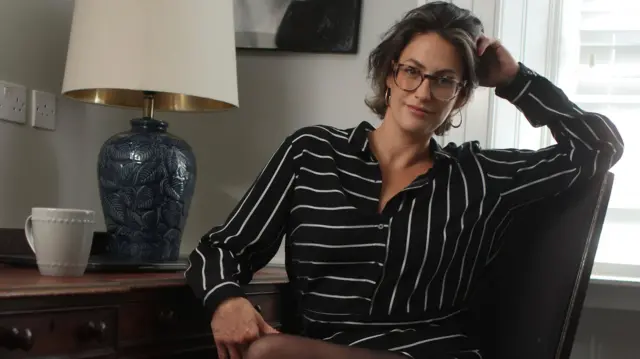

Professional dominatrix Madeleine Thomas is not your typical tech company founder.
After clients repeatedly humiliated her personal candid images, she felt “angry enough to do something about it” and turned to technology for an answer.
‘They were beautiful pictures, I’m not ashamed of those images, I’m ashamed of the way people used them against me I don’t know,’ says Madeleine.
Just over a year after launching her company Image Angel, which uses invisible forensic watermarks to track offenders, the service has won several awards and was recommended in Baroness Bertin’s independent review of pornography this year.
This career path differs significantly from her experience, namely providing BDSM-dominated sexual services to clients

Frequent misuse of intimate images. called pornography, is a criminal offence punishable by up to two years imprisonment.
And it doesn’t just apply to those working in the sex industry
The Revenge Porn Helpline report found that 1.42 per cent of the female population is abused using intimate images every year
Madeleine, 37, from Wales, says victims live with a sense of shame and stigma
. “I think a lot of people would say: you put a sexy photo on the internet, what did you expect?” – she says.
“I expect dignity, I expect respect, I expect trust, and I don’t understand why that would even be traded,” the entrepreneur adds.
“That these images could then be distributed where I live or to people I love and used to hurt them is beyond my choice, it’s not my fault, it’s the perpetrator’s fault. fault,” she says. Madeleine.

Madeleine has been working as a dominatrix, mostly online, for 10 years and has always seen the job as something that gives her strength and fulfilment.
“What she means is that I’m a dominant woman, a woman who has strength and confidence, I give my body as a reward to someone because I want to, because I want to, because it’s my body and I can do whatever I want with it,” she tells her.
“People think it’s weird, but I don’t see any difference in it compared to a nutritionist or an accountant giving advice,” Madeleine adds.
She sees herself as something of an anomaly in the world of technology.
“I know it’s weird, it’s crazy to think that someone who was dominant is now the founder of a tech company, but it’s someone who’s gone. because of this, you can recognise loopholes and make the necessary changes,” the entrepreneur believes.
She insists that she is not a technical person at all and was able to build her company after many sleepless nights, research and “breaking people” versed in technology.
“I never feel judged for being a dominatrix, on the contrary, it makes me feel empowered because I can provide a level of expertise and knowledge about the world that they will never provide. have,” says Madeleine.
How the technology works
Image Angel can be used on any online platform where people share images, such as dating apps, social media and websites.
When a viewer opens an image, an invisible forensic watermark unique to that person is automatically inserted.
This means that if you discover that your image has been shared without your consent, and provided the platform you posted it on has the technology embedded, information about who shared the file will be hidden within the image itself and can be retrieved by a data recovery specialist so that action can be taken.
How do we know this technology is effective?
“This technology already exists in Hollywood, it’s already being used in sports broadcasts, so it’s not something completely new – it’s just a new application and a new system,” says Madeleine.
“We’ve tested it, we’re working with a company that we have 30 years of experience developing technology, so we know it’s reliable and now we need to test it at scale,” she adds.
Madeleine hopes the technology will also act as a deterrent to potential attackers.
Kate Worthington from the South West Grassroots Learning Network (SWGFL) of the Revenge Porn Helpline says she has seen first-hand the panic, stress and self-blame that the abuse of intimate images causes in victims.
“If that self-blame is reinforced by the words of a misinformed friend or service: “Why did you even take those pictures?”, that guilt can be compounded, so it’s extremely important that the person gets the answer that they didn’t do anything wrong,” she says
. “It’s very important to take a multi-layered approach. We’re called to tackle technology-based gender-based violence because no single tool can tackle it alone, no single hotline. That’s the kind of multi-layered response that’s needed,” Worthington says of Madeleine’s technology.
SWGFL has a global tool, StopNCII.org, that works by creating a hash of a person’s intimate images and videos and sharing it with participating companies so they can help identify and remove that material from online distribution.

TV presenter Jess Davies was just 15 years old when pictures of her in her underwear began circulating around her town.
It was the first of several incidents Jess experienced in her teens and 20s that later influenced her advocacy for women’s rights.
“It took so long, too long, for someone to tell me it wasn’t your fault and it shouldn’t have happened,” Jess says.
She is also a passionate advocate for shifting the stigma from victims of intimate images to perpetrators.
“Sending someone a consensual image is not a crime,” she says. – says 32-year-old Jess.
“But distributing them without consent is an offence and I think that’s what should always be held accountable for,” she adds.