

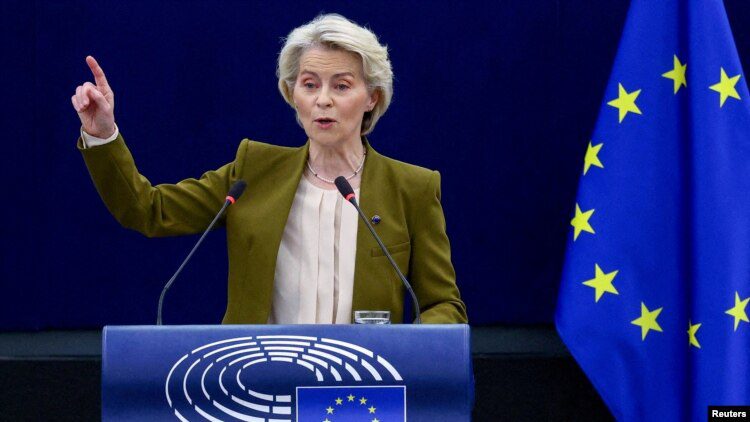

The European Commission will propose financing options for Ukraine for 2026-2027 primarily based on the use of immobilised Russian assets, its President Ursula von der Leyen said after a summit of EU leaders in Brussels, Radio Liberty reports.
“We have agreed on the essence – this is a reparation loan. And now we need to work on exactly how to make it possible, what is the best option to move forward,” von der Leyen emphasised.
At the EU summit, the leaders discussed a reparation loan for Ukraine involving frozen Russian assets. It could be provided due to the need to cover Ukraine’s financial needs for the next two years.
However, in the summit conclusions, the leaders called on the European Commission “to present options for financial support based on an assessment of Ukraine’s needs as soon as possible” – the assets are no longer mentioned in this proposal. Although the declaration was proposed to be approved in a different version. The Commission was to be called upon to develop proposals for “possible gradual utilisation of cash balances related to frozen Russian assets”.
Commenting on the final version of the summit declaration in the part about Ukraine regarding possible “options for its financial support”, the head of the European Commission noted that immobilised Russian assets remain a key option.
“During the discussion (of the leaders – ed.) it was very clear that if you look at options, these are options on how to use immobilised assets. Potentially there are always other options… so a clear commitment from the European Council to cover the financial needs over the next two years… is the first statement that should always be present. Then the focus is on immobilised assets, and here options are considered,” von der Leyen explained the updated conclusions of the summit.
Commenting on the availability of other options, European Council President António Costa, for his part, recognised that “there is always an alternative – that is the essence of politics”.
“The political decision is to make the best decision. And for that we need to compare the pros and cons… a responsible body like the European Council (EU leaders – ed.) should ask for alternatives in order to compare them. That is why we are asking the commission to present them and the Council to analyse them. Then the European Council will meet again in December to approve the final decision,” said Costa.
The European Council president also added that all technical issues “can be solved” and assured that the EU is ready to work further to ensure support for Ukraine.
“Ukraine will have the means to continue fighting for a just and lasting peace, for self-defence, against Russian aggression, and Ukraine can continue to count on the support of the European Union. Europe is not tired,” Costa summarised.