


The European Commission has said that it will stop the liberalisation of visa regime for Georgian diplomatic passport holders when the new European Union rules come into force at the end of the month.
At the same time, the EU authorities do not rule out that it will target the entire population of the South Caucasus country if Tbilisi does not resort to measures to strengthen democratic rights and freedoms.
This came to light after the commission presented its annual report on 19 December on non-EU countries whose citizens enjoy visa-free travel for up to 90 days in each 180-day period. The rules apply to most members of the bloc, as well as EU-affiliated countries such as Iceland, Liechtenstein, Norway and Switzerland.
Georgian citizens have enjoyed the benefit since 2017.
The Commission said Tbilisi had “violated numerous commitments made during the visa liberalisation dialogue” and was accused of failing to implement the recommendations of last year’s report, such as protecting fundamental rights, including freedom of association, assembly and expression.
In that report, Brussels also criticised the Georgian government’s controversial law on “foreign influence” and “family values and protection of minors”.
“Given the systemic and deliberate nature of this rollback, the commission will consider appropriate measures in the framework of the revised visa suspension mechanism, which will enter into force on 30 December 2025,” the text said.
Last month, EU foreign policy chief Kaja Kallas said that Georgia “has no viable path to the EU at this stage unless conditions change dramatically.”
In particular, the report blamed the situation on Georgian government policies, namely repression of political opponents and policy changes that seem to tend to lean in favour of Moscow, which has undermined relations with the bloc.
The new rules, which were approved earlier this autumn, allow the European Commission to partially or completely halt visa liberalisation for a country not only for breaches of internal affairs rules (such as overstaying, non-refoulement or unsubstantiated asylum claims) but also for human rights violations.
It also allows the EU executive to make this decision on its own, even though it is likely to consult EU member states before doing so.
In response, Georgian parliament speaker Shalva Papuashvili accused the bloc of “blackmail”.
Diplomatic sources told Radio Liberty that most EU member states would like to at least suspend visa liberalisation for Georgian officials without affecting ordinary citizens.
However, the commission admits that the second phase of the suspension “could be extended to the entire population if the Georgian authorities fail to address these problems.”
The Georgian Dream won the 2024 parliamentary elections, which were marred by irregularities, including cases of vote-buying, physical violence and intimidation, according to the Organisation for Security and Cooperation in Europe. The Parliamentary Assembly of the Council of Europe, among others, called on Tbilisi to hold new elections.
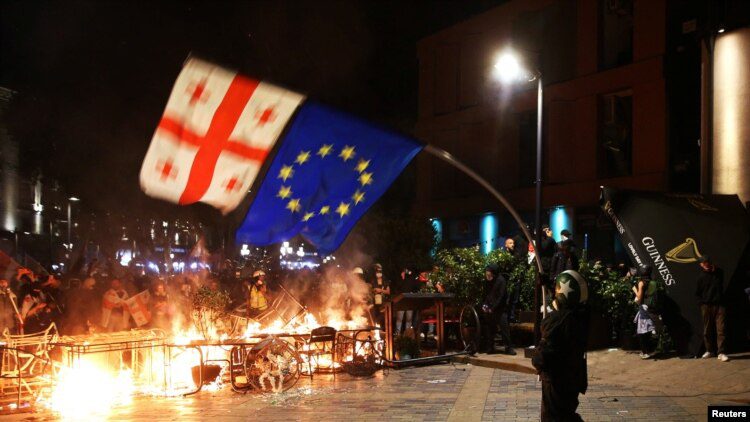
Protests have been ongoing in Georgia since November 2024. They began after Prime Minister Irakli Kobakhidze announced the suspension of EU accession talks.
In December 2024, rallies outside the legislature escalated several times into violent clashes between protesters and special forces of the Interior Ministry. Hundreds of people were injured in various degrees of severity.