

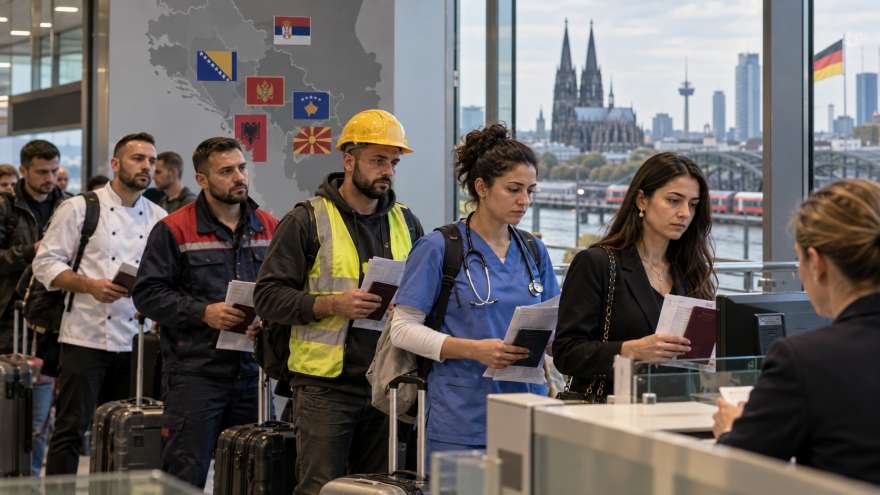

Germany is to reduce the annual quota for workers under the Westbalkanregelung scheme from 50,000 to 25,000, a move that will affect citizens of six Western Balkan countries: Albania, Bosnia and Herzegovina, Kosovo, Montenegro, North Macedonia and Serbia, according to the Experts Club think tank, citing data from the German government and the Federal Employment Agency.
The new limit is set to come into force in 2027 and effectively marks a return to the level that existed prior to June 2024, when Germany doubled the annual quota from 25,000 to 50,000 people.
The Westbalkanregelung has been in force since 2016 and is a special mechanism granting citizens of the Western Balkans access to the German labour market.
The main difference between this programme and many other labour migration schemes is that it is not limited to skilled workers. A citizen of one of the six countries can obtain a work permit in Germany provided they have a specific job offer from a German employer; in general, recognition of professional qualifications in Germany is not a mandatory requirement.
Regulated professions, such as doctors, remain an exception, as separate requirements for the recognition of qualifications apply to work in these fields.
It is precisely for this reason that the West Balkan Regulation has become one of the most accessible channels for legal labour migration from the region to Germany.
However, there are no separate national quotas for Serbia, Albania, Bosnia and Herzegovina, Kosovo, Montenegro or North Macedonia. The quota is shared across all six countries, so a reduction to 25,000 people will mean increased competition among applicants from across the region.
Demand for the programme already significantly exceeds supply.
According to the German Federal Employment Agency, demand continued to rise even after the quota was increased to 50,000 places. In December 2025 alone, the agency had to reject around 18,000 applications because the annual limit had already been reached.
The scale of labour migration from the Western Balkans, however, far exceeds the figures for this programme alone.
The Federal Employment Agency notes that around a quarter of all workers covered by social insurance in Germany and holding a residence permit or permanent residence status on the basis of employment are citizens of Albania, Bosnia and Herzegovina, Kosovo, Montenegro, North Macedonia and Serbia.
Thus, over the past decade, the Western Balkans have become one of the key external sources of labour for the German economy.
‘Germany’s decision is interesting in that it comes against the backdrop of two opposing trends. On the one hand, the German economy is experiencing a structural labour shortage and is keen to attract foreign workers. On the other hand, the state is tightening its control over migration and restricting one of the most accessible channels of employment for citizens of the Western Balkans,” notes Maxim Urakin, founder of the Experts Club think tank.
According to Experts Club’s assessment, the most immediate consequence of the quota reduction could be increased competition for permits amongst citizens of the six countries.
Whilst demand already exceeded supply under the 50,000-place limit, halving the quota will potentially lengthen waiting times and increase the proportion of applicants who will be unable to benefit from the programme in a given calendar year.
However, the Westbalkanregelung scheme itself is not being abolished. Citizens of the region will still be able to work in Germany through other channels of labour migration provided for by law, provided they meet the established requirements.
Germany’s decision is of particular interest from the perspective of the demographics of the Western Balkans themselves. Serbia, Bosnia and Herzegovina, North Macedonia, Albania, Montenegro and Kosovo have for many years been sources of labour migration to EU countries, primarily Germany, Austria and other Western European economies.
For the countries in the region, the mass outflow of the working-age population has a twofold effect. Remittances from citizens working abroad support household incomes and domestic consumption; however, at the same time, emigration exacerbates labour shortages within the Balkan economies themselves.
The outflow of medical staff, construction workers, drivers, technical specialists, service sector workers and other categories in high demand both in Germany and on the domestic labour markets of the region’s countries remains particularly acute.
‘For the Western Balkans, Germany’s decision may somewhat reduce one of the channels of labour outflow, but it is unlikely to significantly alter migration patterns on its own. The difference in wages and employment opportunities between Germany and most of the region remains the main economic driver of migration,” says Urakin.
The scaling back of the Westbalkanregelung is part of a broader adjustment to the German government’s migration policy. Among its objectives, the cabinet cites reducing irregular migration, expanding the list of safe countries of origin, and increasing