


Microsoft has developed a new storage medium that can keep data intact for centuries and millennia. This can be done using a femtosecond laser and a regular piece of glass, according to a study published in the journal Nature.
The amount of information generated by humanity is increasing exponentially-research shows that it doubles about every three years. Often this information is of commercial, personal or governmental value and requires long-term storage. Despite advances in the development of modern digital recording media, they are still largely limited to the use of magnetic tapes and hard magnetic discs.
These drives can store information for several years, at best decades, so the data recorded on them must be continuously rewritten to other media, a process that requires equipment, time and energy. For this reason, scientists are faced with the challenge of developing a storage medium that can store digitally recorded data for much longer, e.g. centuries, without degrading due to natural processes.
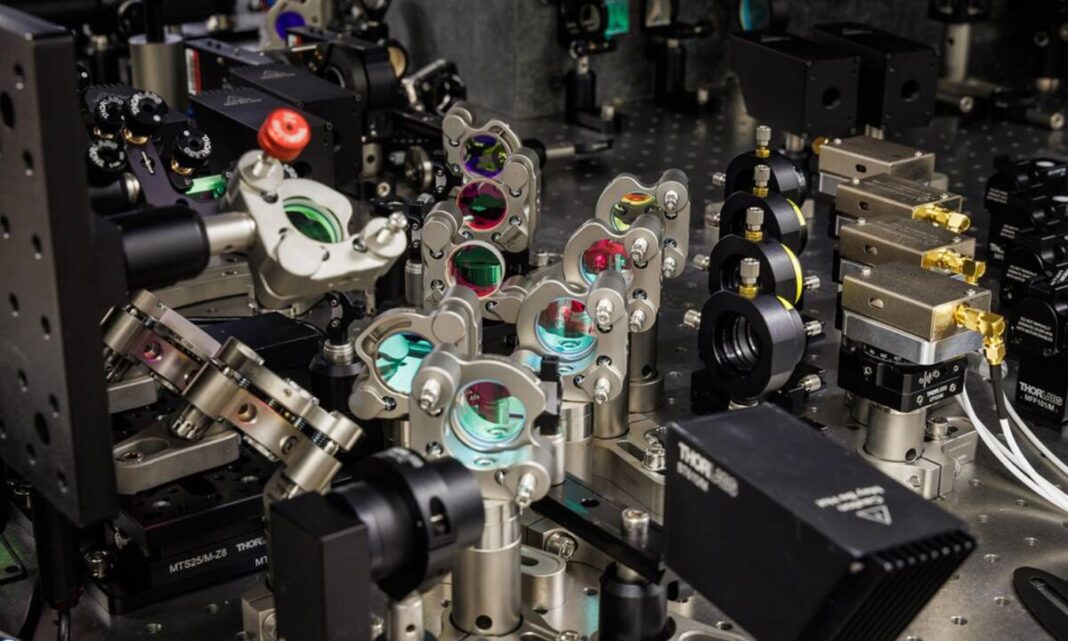
Scientists from Microsoft Research, the research arm of Microsoft, have developed a new way of long-term data storage-the Silica system. Using femtosecond laser installation, scientists were able to record data on an ordinary piece of glass, forming in its thickness so-called voxels – three-dimensional areas of space with modified optical properties (analogue of a two-dimensional pixel).
In this case, unlike existing media, such as hard discs or solid-state drives, one voxel, a memory element, can store more than one bit of information (1 bit of information is a symbol or signal that can take only two values). “The energy or polarisation of the laser is modulated as the beam moves relative to the glass. Voxels are written in two-dimensional planes, which then form a three-dimensional volume,” the study said.
The experiments showed quite high recording speeds – it can be done at 65.9 Mbit per second and dense storage of information, 1.59 Gbit per cubic millimetre of media, or 4.84 terabytes per square piece of glass with an area of 12 square centimetres and a thickness of 2 mm. “This is equivalent to 2 million printed books or 5,000 films shot in 4K (Ultra High-Definition (UHD) resolution,” explained Feng Chen, co-author of the study.
To assess the longevity of the chosen storage medium, the scientists conducted experiments simulating long-term storage-extrapolation showed that the recorded information remains readable on a scale of 10,000 years at a temperature of 290 degrees Celsius. This means that at room temperature storage, the data will remain intact for even longer. Specialists have also developed a system for reading the recorded information based on the use of a transmission microscope, which allows voxels to be read automatically layer by layer.
The scientists recognise that data storage can be threatened by mechanical and chemical influences, the effects of which have not yet been studied. “If implemented on a large scale, the Silica system could become a milestone in the history of knowledge storage media, similar to the bones of oracles, medieval parchment or modern hard drives. One day, a piece of simple glass could absorb human culture and knowledge accumulated over millennia,” the authors believe.