

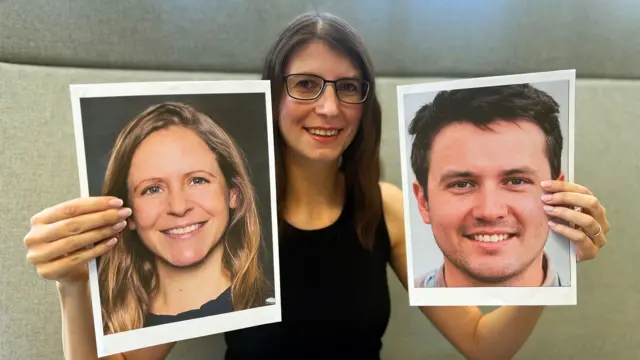

Psychologist Dr Claire Sutherland is holding two large photographs. One shows the face of an Australian scientist leading an international study; the other is a deepfake generated by artificial intelligence.
Artificial intelligence has become so adept at creating realistic images that it is becoming increasingly difficult to tell what is real and what is not.
But is it possible to teach people to recognise an image of a person that was actually created by a machine?
This question was investigated by Sutherland from the University of Aberdeen and her Australian colleague. But before we reveal the answer, try this test and make a note of your result.
The AI (artificial intelligence) has marked the images created by artificial intelligence.
The images labelled as real are, in fact, real.
If you found it difficult, you’re not alone.
In the past, computer-generated visual effects – often used by fraudsters – were much easier to spot because the AI made mistakes, such as adding an extra finger or something else that was clearly odd.
But artificial intelligence learns from its mistakes.
‘Artificial intelligence is becoming too sophisticated, and fraudsters can avoid using images with obvious flaws,’ explained Professor Amy Davell.
She is the woman with long hair falling to her shoulders in the Sutherland image. The image of the man is a fake. Davell is director of the Emotion and Face Laboratory at the Australian National University.
She is leading a team of researchers in Australia, Canada and the UK to find out whether people can be trained to recognise AI-generated fakes. The answer, at least for now, is yes, but training people to recognise AI-generated fakes requires a more nuanced approach.
A fake face
Sutherland is leading research being carried out at the University of Aberdeen (UK).
She says they have already noticed that they can intuitively distinguish between real faces and those generated by AI simply by looking at them.
“So we thought it would be really interesting to find out whether we could teach other people to do this,” she said.
For the experiments using StyleGAN3, one of the most realistic AI-based image generators, a dataset comprising thousands of facial images was created.
Participants were tested before and after the training.
What should we look for?
The researchers taught participants to pay attention to six perceptual characteristics:
Symmetry — AI often fails to reproduce the features that make us human, such as a slightly drooping eyelid or an asymmetrical smile. “If something seems too perfect to be true, it probably isn’t.”
Proportionality — a similar criterion. Very large noses or lumps are not typical of images created using deepfake technology.
Attractiveness — “Faces generated by AI tend to look more attractive,” explains Sutherland. “This is a more subjective, aesthetic aspect, but AI often creates faces that are pleasing to the eye.”
Distinctiveness (in the sense of uniqueness) — ‘This is what makes a face stand out in a crowd. AI faces tend to cluster around the mean, so they look somewhat typical, lacking a striking personality.’
Emotionality — “AI-generated faces tend to look less emotionally expressive,” says Sutherland. “They show fewer emotions.”
Memorability — AI-generated faces “are often less memorable — they’re hard to remember.”
Artificial intelligence also tends to render faces of people of colour, as well as those of older people or children, less accurately, because most of the data it receives relates to young white people.
Some of these tips may seem similar and somewhat vague, but that is the point.
It is rare to find an infallible tell-tale sign that will immediately expose a fake created by artificial intelligence. Instead, it is about learning to recognise the characteristic features of such images and developing the relevant intuition.
Researchers have found that if you show people images (both AI-generated and real ones) and then tell them which is which, their ability to distinguish between them improves significantly — even within as little as an hour.
It turned out that participants typically increased their recognition accuracy from around 40 per cent to 80 per cent.
Some managed to achieve almost 100 per cent accuracy.
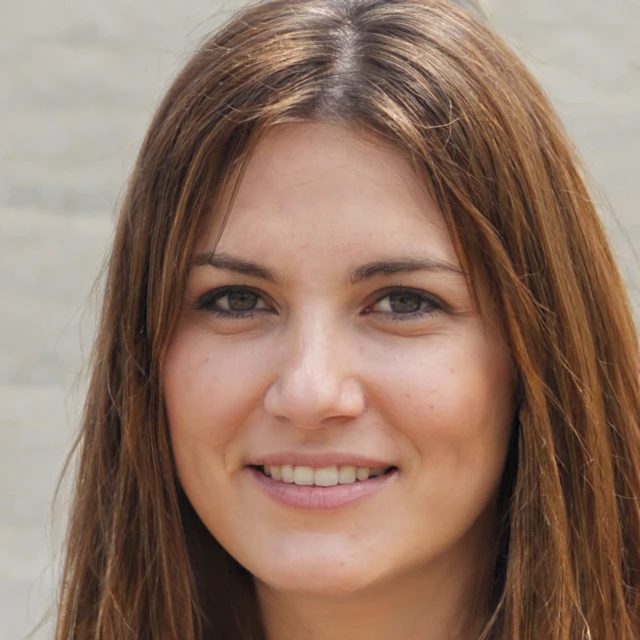
Photo by Nightingale
Ironically, the way the human brain recognises images is similar to how generative AI models work. Give them enough data to train on, and over time their accuracy will improve, even if we cannot fully understand how they do it.
The study also examined how confident participants were in recognising AI-generated images. Previous research had shown that people were overconfident in their ability to recognise AI-generated faces, with the most confident participants making the most mistakes.
After the training, the researchers found that participants had become more confident in recognising deepfakes.
‘That’s useful,’ says Sutherland. ‘Because if you don’t know when you’re right or wrong, you can’t really do anything with that information.’
So, are you ready to take another test?
How did you get on?
Do you feel more confident?
If not, don’t beat yourself up. In both the human world and the world of generative AI, practice makes perfect – or at least brings you closer to perfection.
There are plenty of websites where you can improve your skills if you’d like.
Why is it important to learn how to spot fakes created by artificial intelligence?
The obvious danger is fraud.
Global consultancy firm Deloitte predicts that losses from AI-related fraud in the US alone could rise to more than $50 billion next year, compared with $16 billion in 2023.
The report cites an example of fraud in which an employee of a Hong Kong firm transferred 25 million pounds to fraudsters following a video call featuring a deepfake of their boss.
Another sinister use of deepfake technology is political espionage. Back in 2019, an Associated Press investigation revealed that a LinkedIn profile, including a photograph, belonging to a woman named Katie Jones, may have been fabricated. Jones posed as a specialist on Russia and Eurasia with links to prominent Washington think tanks and political circles. The AP report claimed that this was in fact a deepfake created by Russian intelligence, which had successfully made contact with high-ranking US political aides and national security officials.

Photo credit: LinkedIn
In Australia, one politician is proposing that political content generated by artificial intelligence should be required to be disclosed and labelled with a ‘watermark’.
To be fair, scientists, including Sutherland, also see some positive aspects to the use of this technology, such as the ability to quickly and cheaply show what a child might have looked like at various ages in the past.
She says that if people “do this in good faith and are aware that AI has been used, it could potentially be very useful for creative professions”.
So, the good news is that we do not yet live in a dystopian world where it is impossible to distinguish between what is real and what has been created by a computer.
The bad news is that AI models may already have ‘read’ published scientific research. And they are continuing to learn.