

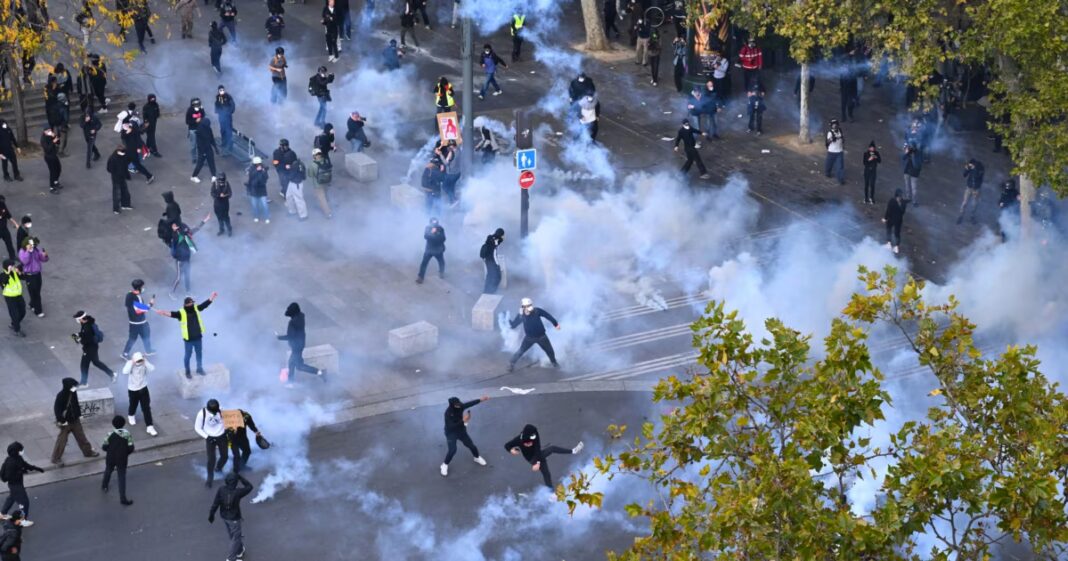

In France, around 1,500 retail outlets were damaged during the riots that took place the day before. According to preliminary estimates, the total damage could run into several hundred million euros, Alexandre Bompard, head of the French Federation of Trade and Distribution, said on LCI television.
He said it was still too early to assess the full extent of the damage, but the impact on the retail sector was already ‘significant’.
“Across the French retail sector, 1,500 business owners have been directly affected,” said Bompard. He added that the amount of damage would be “very substantial” and put a preliminary estimate at several hundred million euros.
The report does not provide details on the circumstances and causes of the unrest, nor on the specific extent of the damage.
The government has pledged to support affected businesses
Shortly before midnight the previous night, the French Prime Minister warned of the ‘serious consequences’ of the riots for the country and announced that he had instructed ministers to help business owners whose premises had been damaged.
He emphasised that “those who had no part in the violence should not be held responsible for the destruction”. The Prime Minister also called for the fast-tracked consideration of a bill that would require those responsible to pay for the damage caused.
More than 600 police officers, gendarmes and firefighters have been injured
According to updated figures from the French Ministry of the Interior, 1,800 people were arrested following Saturday’s protests.
The Minister, Laurent Nunes, reported that more than 600 police officers, gendarmes and firefighters were injured during the unrest. He clarified that the figures are preliminary and that the material damage is significant.
“Demonstrating is a fundamental right. Causing unrest through violent and coordinated action is not,” Núñez wrote on social media platform X.
The minister also accused far-left groups of organising the violence. According to him, law enforcement agencies are continuing their investigation to identify those involved in the attacks and looting.
The first wave of protests in France began in late September. They were mainly attended by secondary school pupils demanding improvements to the quality of school education and increased funding for state schools. They were supported by university students, parents and teachers. Later, the circle of protesters widened: trade unions, social activists, representatives of far-left political movements, the ‘yellow vests’ and other groups of citizens joined the protests.