


Iran has executed two more men amid an accelerated campaign of political executions following the outbreak of war with the United States and Israel.
Ehsan Afrashteh, a cybersecurity and network specialist, was hanged on charges of spying for Israel early in the day on 13 May, according to Iran’s Radio Liberty service. Late that night, Mohammad Abbasi, who took part in mass protests in January, was executed at Gezel Hesar Prison on charges of murdering a security official in Malard, a town near Tehran.
According to HRANA, a US-based human rights group, Abbasi’s family was summoned to the prison to see him but were wrapped up at the gate. They later learnt of Abbasi’s execution by telephone.
In a May 14 statement, the Mojahedin-e Khalq (MEK), an exiled Iranian opposition group that for years has been considered a terrorist organisation by the United States and Britain, said Abbasi was a member.
Iran’s Mizan news agency, which is close to the country’s judiciary, did not link Abbasi to the MEK and called his hanging a “qisas,” an Islamic concept meaning an execution carried out at the request of the victim’s family.
The Islamic Republic released a video of the trial in which Abbasi was accused of killing a member of the security forces during the peak of mass protests on 8-9 January.
In Afrashteh’s case, two sources who spoke to Radio Liberty said he was approached by foreign intelligence officials while travelling in Turkey. He informed Iran’s Intelligence Ministry before returning home, but was arrested at Imam Khomeini International Airport immediately after landing and transferred to prison, the sources said.
HRANA previously reported that Afrashteh’s confessions while in detention were “fabricated,” he denied the charges, and his family’s property was seized and relatives were placed under surveillance.
Human rights groups and sources close to the family say Afrashteh’s case illustrates Iran’s use of forced confessions and wartime courts to address perceived security threats.
The executions were carried out as part of an intensified campaign since 18 March – weeks after the United States and Israel launched strikes against Iran.
At least 29 political executions have since been confirmed in Iran, with those convicted falling into three categories: protesters who took part in mass demonstrations in January and were accused of mohareb, or “waging war against God”; members or alleged members of the MEK convicted on charges of armed rebellion; and those convicted of spying for the CIA or Mossad, Israel’s intelligence service.
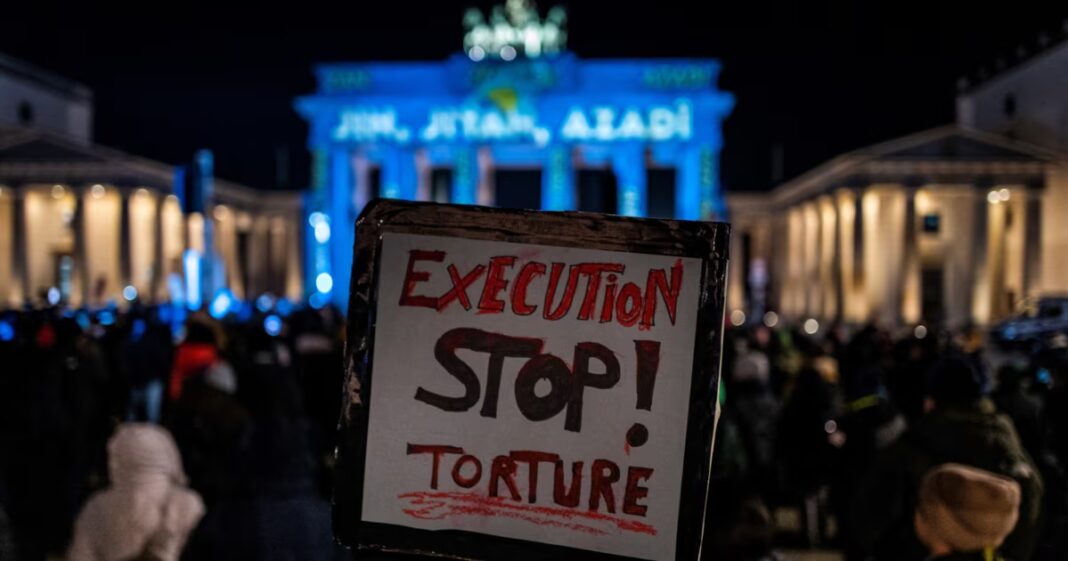
Human rights organisations have condemned the trials of those executed. The Oslo-based Centre for Human Rights in Iran said in April that many trials were marked by “torture, forced confessions and a complete lack of due process.” Iran Human Rights Monitor, a foreign group documenting human rights abuses, described the pace of executions as “political cleansing” under wartime conditions.
Last month, UN High Commissioner for Human Rights Volker Türk called on Iran to “impose a moratorium on the use of the death penalty.”
Iran is one of the world’s biggest executioners, hanging hundreds of people there each year, many of them for drug offences and murder.