

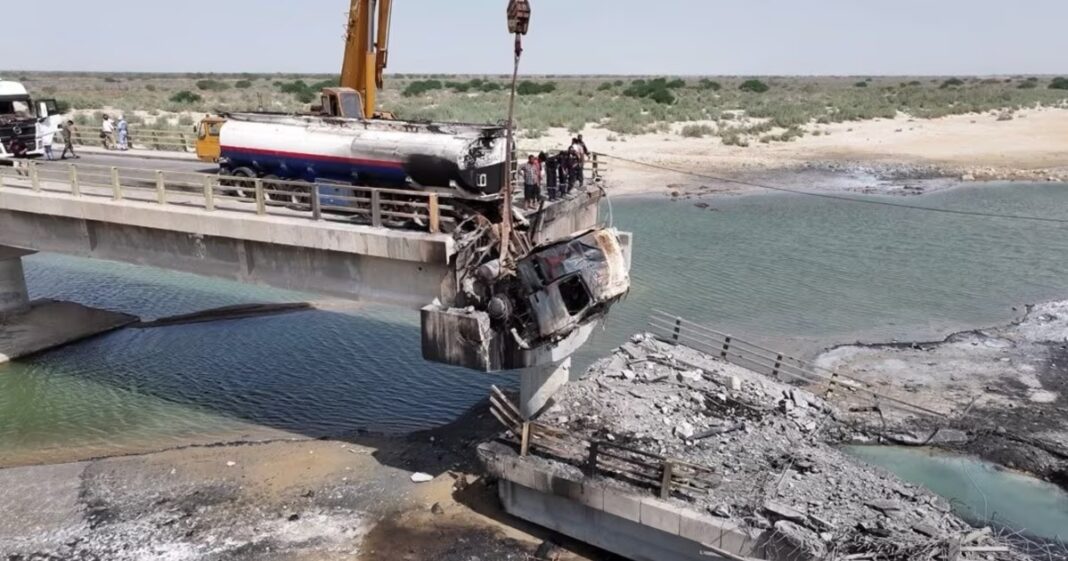

In a stark warning issued following the seventh night of US strikes on Iran, the Islamic Revolutionary Guard Corps (IRGC) stated that neighbouring countries in the Persian Gulf should be prepared for an ‘appropriate and proportionate’ response.
In its statement, the IRGC warned “countries hosting US military bases” to mobilise their civil defence units and evacuate the civilian population away from potential military targets, as reported on 18 July by the semi-official Iranian news agency Tasnim.
The QIR’s warning came immediately after an apparent shift in US military strategy: on 18 July, strikes expanded from targets near the Strait of Hormuz to numerous sites in central and southern Iran.
Citing Qir, the Iranian news agency ISNA reported that the new warning was Iran’s direct response ‘to the change in US military strategy’ that had taken place over the past 24 hours.
Referring to the US strikes in its statement, the Quds Force justified its warning by stating that Iran was carrying out “defensive retaliation” in response to the “inability of international organisations to halt these actions”.
On 17 July, US Central Command (CENTCOM) stated that the new strikes were aimed at further weakening Iran’s military capabilities, on the orders of the Commander-in-Chief (US President Donald Trump).
CENTCOM reported that it had “carried out strikes against surveillance sites, military logistics infrastructure, underground weapons depots and naval forces”, using fighter jets, drones and warships, in addition to other assets.
Earlier, senior Iranian officials had threatened “full-scale offensive operations” if the US continued its strikes against Iran for another two or three days. Quoting Major General Mohsen Rezaei, senior military adviser to Iran’s Supreme Leader Mojtaba Khamenei, the Iranian news agency IRIB reported that “Iran will no longer limit itself to ‘an eye for an eye’ strikes”… And no political border will be safe’.
Meanwhile, on 17 July, Tehran continued to fire drones and missiles at neighbouring Bahrain, Iraq, Kuwait, Oman and Qatar, causing damage to infrastructure.
Al-Jazeera reports that the security threat level in Qatar has been raised following loud explosions in the capital in the early hours of 17 July. Citing Qatar’s Ministry of the Interior, the channel reported that a child had been injured by shrapnel during the attacks. Qatar is home to a major US military base, and since the conflict began in late February, the country has been regularly targeted by Iranian drones and missiles.
In Kuwait, the Ministry of Electricity, Water Supply and Renewable Energy Ministry stated on 17 July that a power station and a desalination plant had been damaged during the Iranian strikes, causing a fire and damaging a significant number of power units.
Against the backdrop of ongoing hostilities and the growing risk of the war escalating further, there are renewed calls for an immediate ceasefire and a resumption of dialogue.
On 17 July, the foreign ministers of China and Pakistan issued a joint statement calling for a return to the ceasefire agreed last month between Iran and the US.
In June, the US and Iran signed a memorandum of understanding. The document provided for a 60-day ceasefire and the resumption of shipping through the Strait of Hormuz. However, active hostilities resumed as early as the beginning of July.